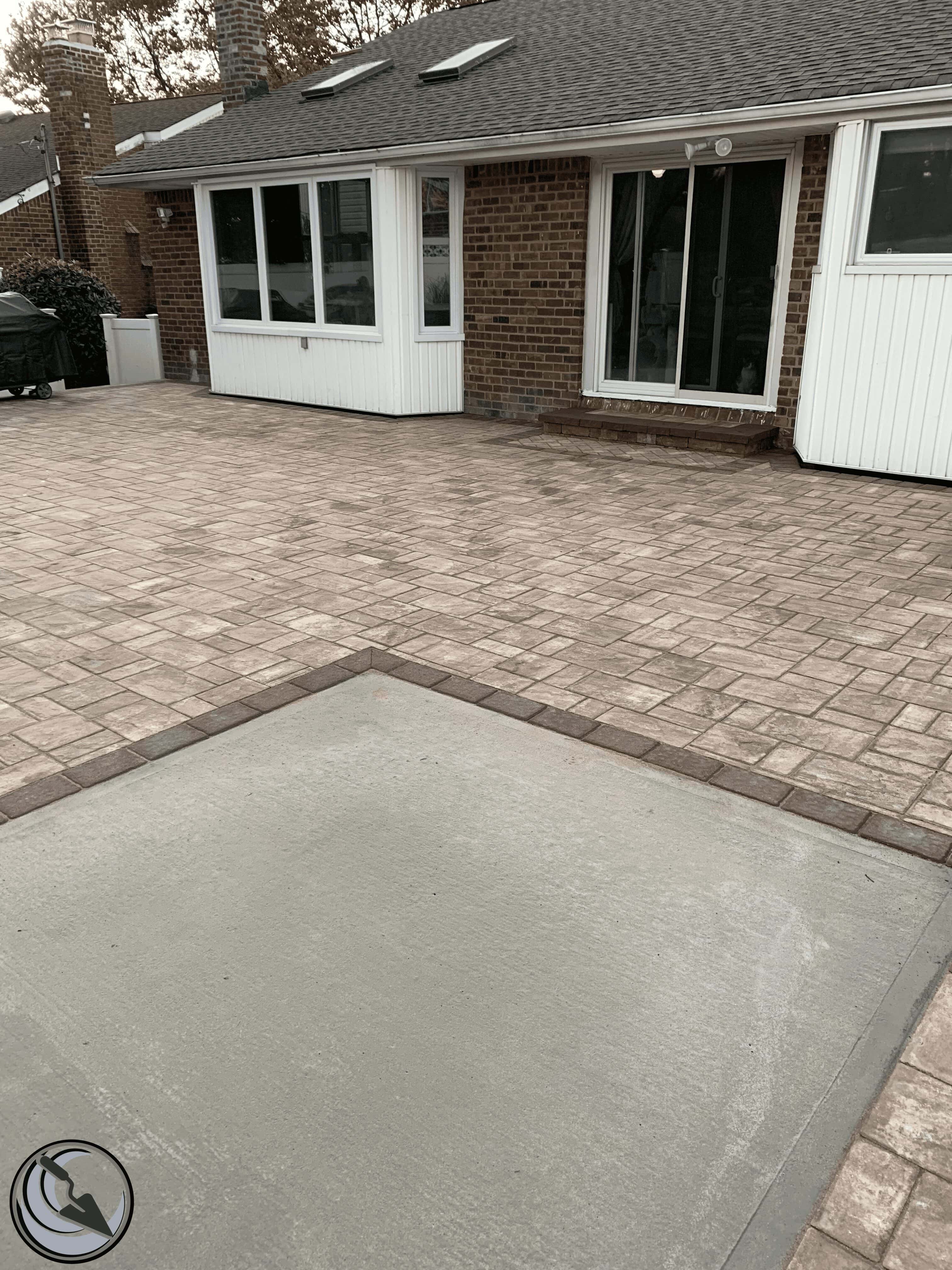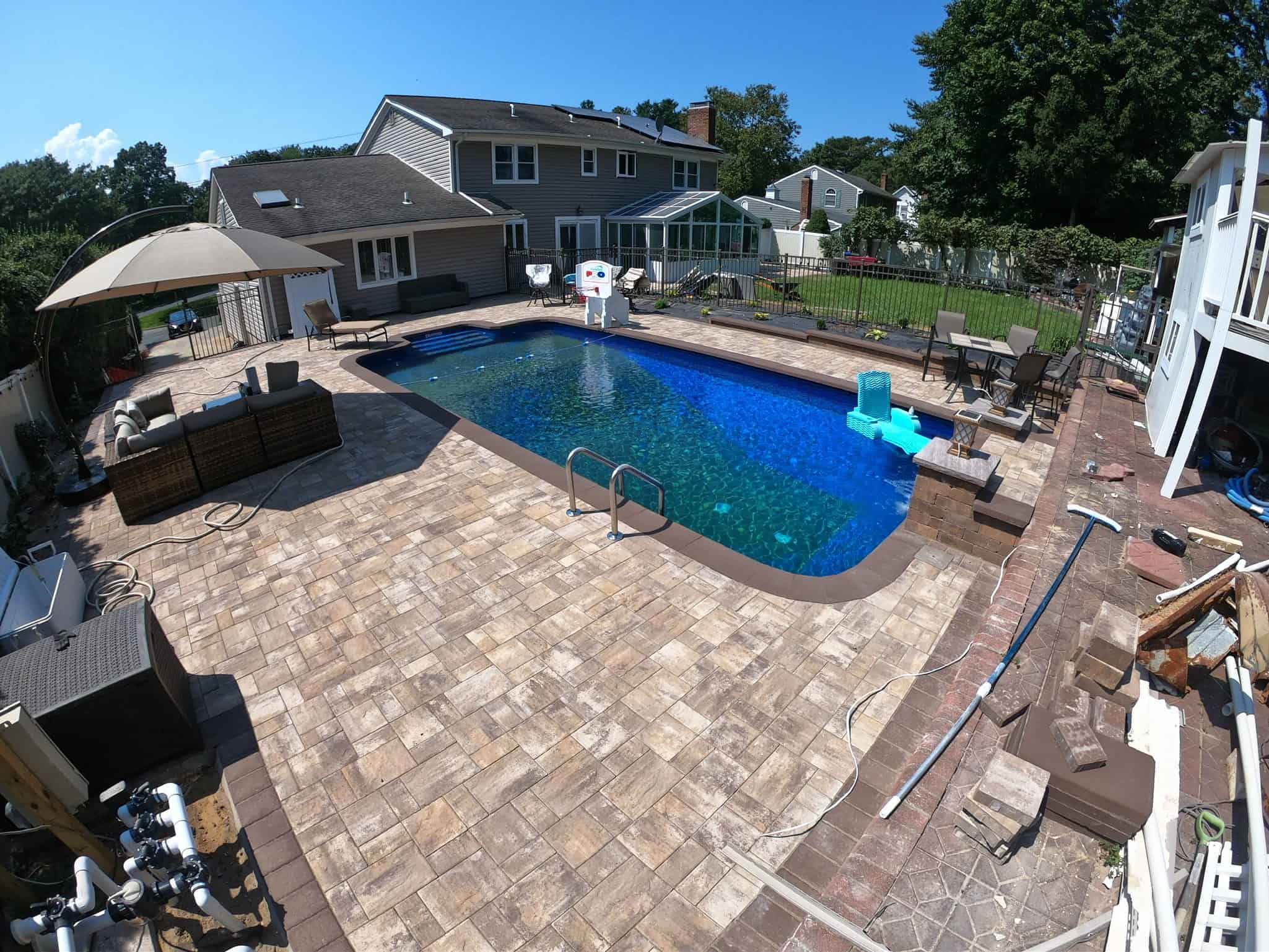
The surface material gets all the attention — but what's underneath determines whether your patio lasts five years or fifty.
Share:
Summary:
You’ve probably spent a fair amount of time looking at photos — paver patterns, stamped concrete finishes, color options, cost comparisons. That’s where most of the online content lives. But here’s what almost nobody talks about: the surface you’re choosing only performs as well as the foundation underneath it. And in Suffolk County, where the soil shifts, the ground freezes hard every winter, and drainage problems can appear out of nowhere, that foundation is everything. This guide is about what actually separates a patio that holds up from one that doesn’t — starting eight inches underground.
When most people hear “base prep,” they picture someone digging a hole and filling it with gravel. The reality is more involved — and the details matter a lot more than the summary suggests.
A properly built paver base starts with excavation. On Long Island, that means going down 8 to 10 inches — not the 4 to 6 inches that might be acceptable in other parts of the country where the soil is stable and dense. Long Island sits on glacial outwash, which is sandy, loose, and highly responsive to moisture and temperature changes. That kind of soil needs a deeper, more engineered base to stay put through the seasons.
From there, a geotextile fabric goes down to keep the native soil from migrating up into the base layers over time. Then comes compacted crushed stone — spread and compacted in lifts, not dumped in all at once. A one-inch bedding layer of coarse sand follows, graded to a precise pitch so water drains away from the house. Edge restraints lock the perimeter. Polymeric joint sand gets swept in and compacted to finish. Each step builds on the last. Skip or rush any one of them, and you’ve introduced a failure point that won’t show itself until the second or third winter.
This is the part that trips up contractors who learned their trade somewhere else — or who follow a generic installation guide without accounting for where they’re actually working.
Long Island’s soil is the product of glacial activity. It’s sandy, it shifts with moisture, and it doesn’t compact the same way clay-heavy or stable-soil markets do. When a base is built too shallow on this kind of ground, the freeze-thaw cycle does the rest. Water infiltrates the base, freezes, expands, and pushes upward. The surface above it moves. Pavers rock. Stamped concrete cracks. And by spring, you’re looking at a patio that’s already showing its age.
The frost depth on Long Island runs to approximately 36 inches. That doesn’t mean you need to excavate 36 inches — but it does mean the base has to be engineered with frost heave in mind. Proper depth, proper compaction, and proper drainage work together to manage what the ground does when temperatures swing. Cutting any one of those corners creates a path for failure.
There’s also the drainage piece, which is especially relevant on the South Shore. Communities like Mastic Beach, Bay Shore, and East Islip sit in areas with naturally high water tables. If water has nowhere to go under a patio, it finds its own way — usually by lifting or undermining the base. That’s why site-specific drainage planning isn’t optional in Suffolk County. It’s structural. Some properties need French drains or dry wells built into the project scope before the base prep even begins. A contractor who doesn’t assess this during the estimate isn’t giving you a complete picture.
On the North Shore — Northport, Port Jefferson, Sound Beach — the drainage challenge is different but the stakes are similar. Coastal moisture and salt air put additional stress on materials and base systems that weren’t designed with that environment in mind. The base prep needs to account for it, and so does the material selection.
The short version: what works in a stable-soil market will fail here. And most of the time, that failure happens quietly underground before it ever shows up on the surface.
Stamped concrete and paver patios are not just different surfaces. They’re fundamentally different structural systems, and their bases are built differently for that reason.
Stamped concrete is a monolithic slab. It gets poured over a compacted gravel base — typically around 4 inches deep in standard conditions, though some contractors go deeper — with wire mesh or fiber reinforcement embedded in the concrete itself. Control joints get cut into the slab to give it designated places to crack if the base shifts. That’s not a flaw in the design; it’s an acknowledgment that concrete will crack eventually, and the goal is to control where.
The problem is what happens when the base isn’t right. Because the slab is one continuous piece, a base failure anywhere affects the whole surface. A section that settles unevenly creates a crack. That crack can’t be invisibly repaired. Patching stamped concrete requires matching the original color and texture — which, after a few years of weathering, is nearly impossible to do cleanly. You end up with a visible repair in the middle of your patio, or a full section demo and re-pour.
Pavers handle base failures differently. Because they’re a modular system — individual units set in a bedding layer — they can shift without cracking. If a section settles unevenly over time, those pavers can be lifted, the base re-leveled, and the pavers reset. It’s not a trivial repair, but it’s a recoverable one. The patio doesn’t have to come out.
That said, the same modularity that makes pavers more forgiving after a failure also makes base prep just as critical upfront. Industry data consistently points to poor base preparation as the cause of 90% of paver installation failures. The modular system gives you a path to recovery — but it doesn’t give you a pass on doing the base correctly the first time.
Stamped concrete also requires ongoing maintenance that pavers don’t. The surface needs to be resealed every two to seven years, depending on exposure and sealer quality. Without it, the color fades, the texture wears smooth in high-traffic areas, and moisture gets into the slab — accelerating exactly the kind of freeze-thaw damage that Suffolk County winters are good at delivering. Pavers don’t require regular sealing to maintain their structural integrity.
None of this means stamped concrete is a bad choice. It means the base preparation for either material has to be done right — and on Long Island’s sandy, shifting, freeze-thaw-stressed ground, “right” means something more demanding than the national average.
Most homeowners comparing contractors focus on the quote. That makes sense — it’s the most visible number. But the quote doesn’t tell you how deep they plan to excavate, what base materials they’re using, or whether they’ve actually assessed your property’s drainage before pricing the job.
A few specific questions will tell you more about a contractor’s quality than any number of testimonials. Ask how deep they excavate. Ask what base materials they use and how they compact them. Ask whether they install edge restraints and polymeric joint sand. Ask how they handle drainage on your specific property. A contractor who can answer these questions specifically — without hesitation — is a contractor who actually does the work correctly. One who gets vague or dismissive is telling you something important.
Manufacturer certifications aren’t just a marketing credential. They’re a process guarantee.
When a contractor becomes a certified installer for a manufacturer like Cambridge, Techo-Bloc, Unilock, or Nicolock, they’re agreeing to follow that manufacturer’s specified installation protocols — which include base preparation requirements. The manufacturer has engineered their product to perform within a specific installation system. If the base isn’t built to spec, the product warranty doesn’t apply. So a certified installer has a direct incentive to do the base prep correctly, every time.
It also means the contractor has been trained on those protocols, not just told about them. Certification requires demonstrated competency. It’s a different standard than a contractor who simply buys the same materials from a distributor.
We hold certified installer status from Cambridge, Techo-Bloc, Unilock, Nicolock, Eldorado, and Boral. That’s six manufacturers — an unusually broad set of certifications that reflects both the range of materials we work with and the installation standards we’re held to across all of them. Nicolock, notably, manufactures their pavers right here on Long Island — a product engineered for this exact climate, installed by a contractor certified to install it correctly.
When you’re investing in a patio on a property worth well over half a million dollars — which describes most homes in Suffolk County right now — the difference between a certified installation and an uncertified one isn’t just about aesthetics. It’s about whether the manufacturer stands behind the product on your property.
**How deep should a paver base be on Long Island?**
On Long Island’s sandy glacial outwash soil, we excavate to 8 to 10 inches as a standard — deeper than the 6-inch baseline common in more stable-soil markets. The combination of loose, shifting soil and hard freeze-thaw winters in Suffolk County demands it. A shallower base will move, and what’s on top of it will move with it.
**Does stamped concrete crack in Long Island winters?**
It can — and the base is usually why. Stamped concrete is a rigid, monolithic slab. When the base beneath it shifts from freeze-thaw activity or soil movement, the slab has nowhere to flex. Control joints help manage where cracks form, but they don’t prevent cracking if the base prep wasn’t done right. On Long Island specifically, where the ground freezes and thaws repeatedly through the winter, a poorly prepared base under a stamped concrete slab is a slow-motion problem waiting to surface.
**Are pavers better than stamped concrete for Suffolk County?**
It depends on your priorities, but pavers do handle Long Island’s conditions more naturally. They flex with ground movement instead of cracking, they can be repaired without demolishing the whole surface, and they don’t require regular resealing to stay structurally sound. Stamped concrete can look excellent and perform well when the base is built correctly and the surface is maintained — but the maintenance requirement is real, and the repair options when something goes wrong are more limited. For most Suffolk County homeowners, the long-term math tends to favor pavers.
**What’s the difference between regular joint sand and polymeric sand?**
Regular sand washes out over time, which opens up gaps between pavers — gaps that weeds fill quickly and that allow pavers to shift laterally. Polymeric sand contains a binding agent that hardens when activated with water, locking the joints and keeping everything stable. It also resists insect infiltration. It costs more than regular sand, and some contractors skip it to lower their bid. We don’t skip this step.
**Do I need a permit for a patio in Suffolk County?**
Permit requirements vary by municipality across Suffolk County and depend on project scope. Some towns require permits for patios above a certain size or for work within a certain distance of property lines or structures. We’re licensed in Suffolk County (#HI-62761), Nassau County (#167041), Southampton (#L005914), and East Hampton (#9808) — including the townships with the strictest contractor requirements on the island — and we handle the permitting questions as part of the estimate process, not as an afterthought.
The surface you choose — stamped concrete or pavers — matters. But it’s a secondary decision. The primary one is whether the contractor you hire understands what has to happen underneath it, specifically on Long Island, with its sandy soil and coastal conditions and winters that test every installation that wasn’t built to last.
Most of what separates a patio that holds up for decades from one that starts failing after a few seasons is invisible at installation. That’s what makes it so easy to cut corners — and so important to ask the right questions before anyone breaks ground.
If you’re planning a patio in Suffolk County and want a straight conversation about what the project actually involves, Stone Escapes Masonry & Outdoor Design Inc offers free onsite estimates scheduled directly with the owner. No automated systems, no handoffs — just an honest look at your property and a clear picture of what it takes to do the job right.
Article details:
Share:
Continue learning: