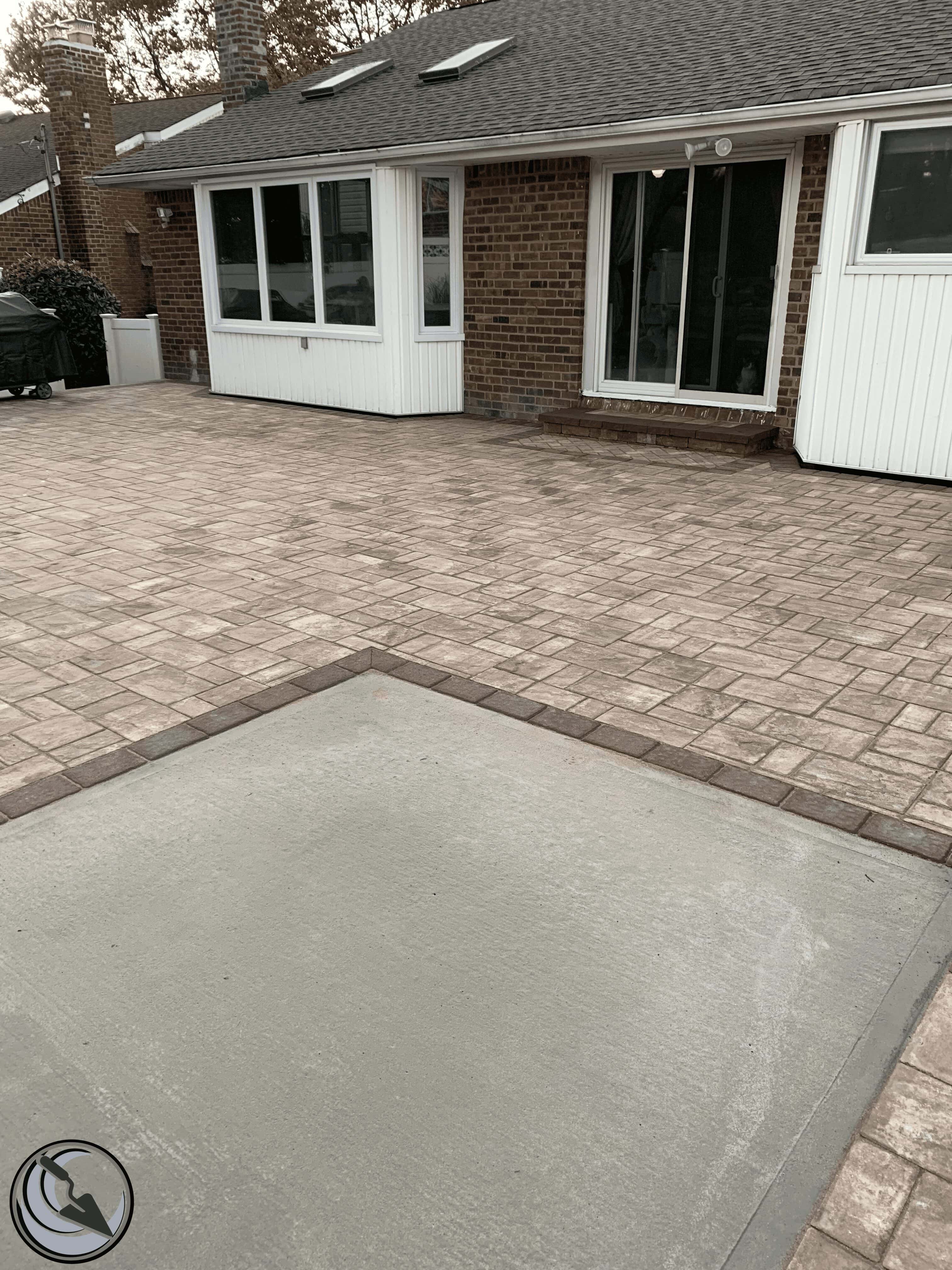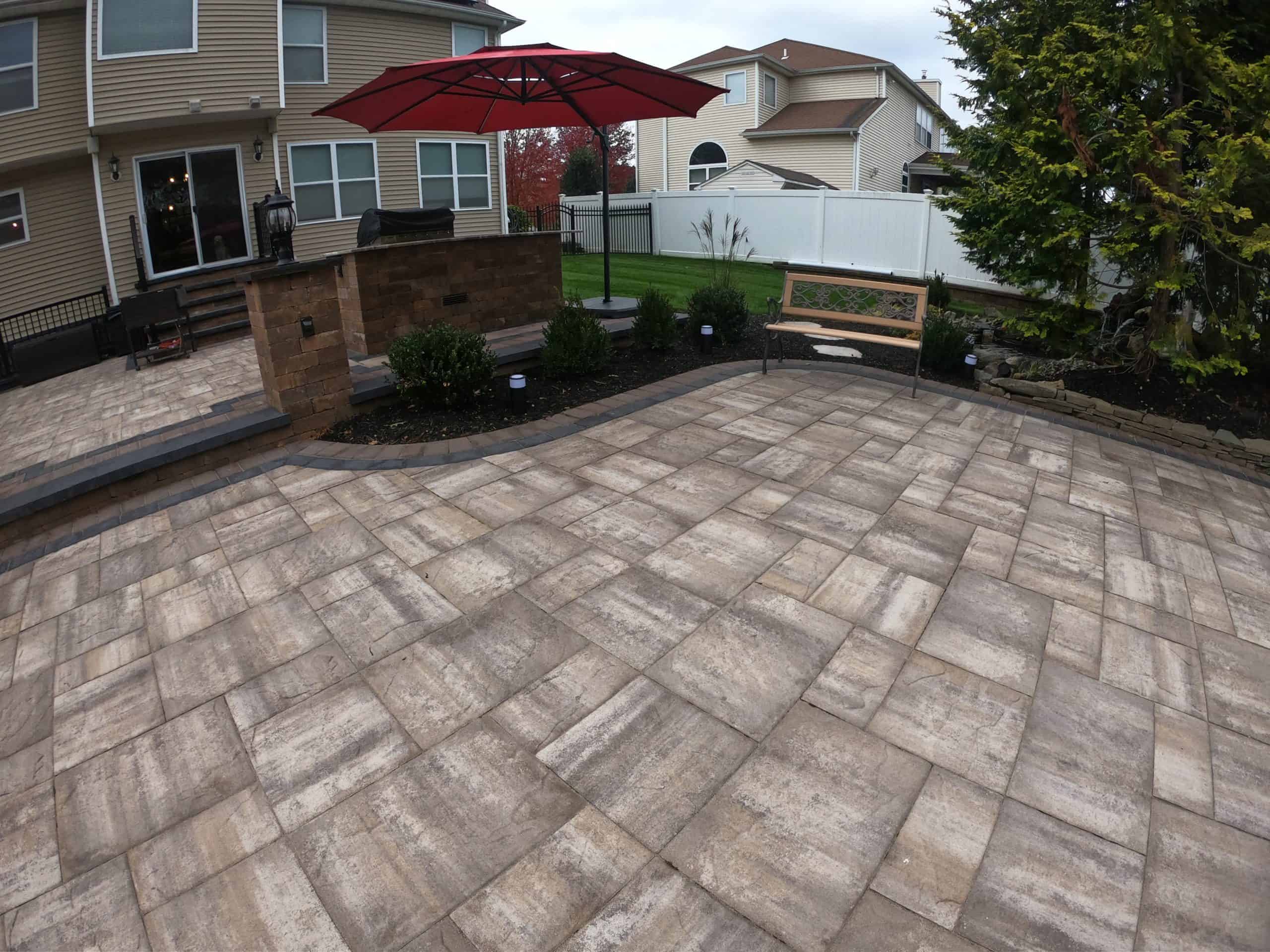
Skipping proper hardscape drainage doesn't just cause puddles — it quietly destroys your patio, driveway, and retaining walls from the ground up.
Share:
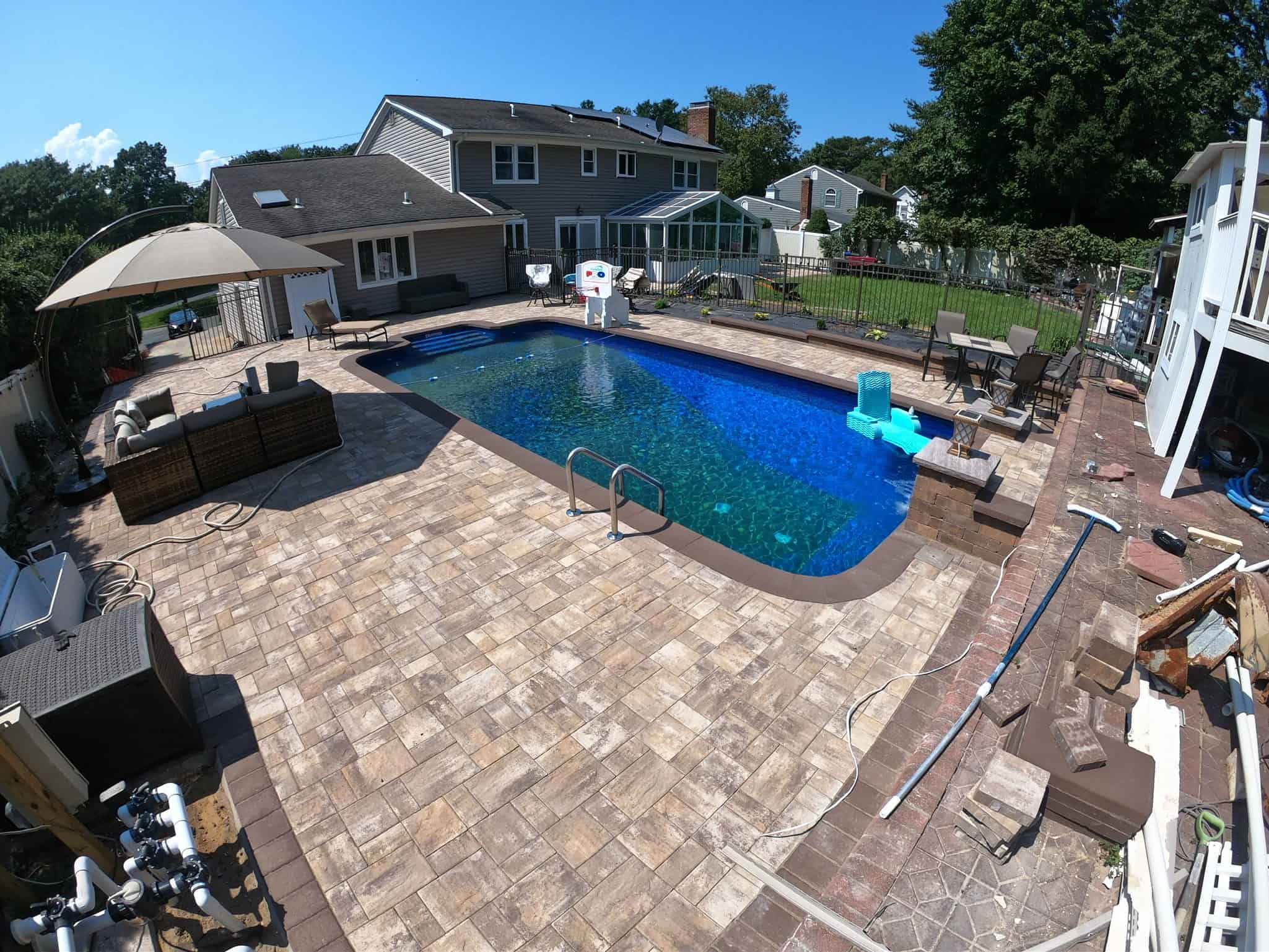
Summary:
You spend real money on a patio or driveway, and it looks great — for a year or two. Then the pavers start shifting. Water pools after every rain. A corner sinks. A retaining wall starts to lean. And suddenly you’re getting quotes to fix something that should have been right the first time.
This isn’t bad luck. It’s almost always a drainage problem — one that was built in from day one. In Suffolk County, where sandy glacial soil, harsh winters, and coastal moisture create conditions most contractors don’t fully account for, getting drainage right isn’t optional. It’s the difference between a hardscape that lasts 20 years and one that needs major repairs in five.
Drainage in a hardscape installation isn’t just about sloping the surface so water runs off. That’s one piece of a system that has to work at multiple levels — literally.
The surface needs to pitch away from your home or structure at roughly 1 to 2 percent, which works out to about an eighth of an inch per foot. Subtle, but critical.
Beneath the pavers, you need a properly compacted aggregate base — typically 8 to 10 inches deep in Suffolk County conditions — that allows water to move through and away from the installation. Without that depth, water saturates the base layer, the ground shifts, and the pavers above follow. Add a few freeze-thaw cycles to that saturated base and the damage accelerates fast.
Most of Suffolk County sits on sandy glacial outwash soil — the material left behind by retreating glaciers thousands of years ago. It’s the reason the South Shore beaches look the way they do, and it’s also why hardscape drainage here behaves differently than it does in most of the country.
Sandy soil drains quickly, which sounds like a good thing. And in some ways it is. But it also means water moves laterally and wicks upward into masonry bases. It shifts under load when saturated. And it compacts unevenly if the base prep isn’t done correctly. A contractor who’s used to working in clay-heavy soil or stable inland ground may not recognize these behaviors until the problem shows up on the surface — usually a season or two after installation.
On the South Shore, from Babylon and Bay Shore down through Islip and Patchogue, high water tables add another layer of complexity. In those areas, standard grading and base depth alone often aren’t enough. French drains, dry wells, or additional drainage aggregate may be necessary to keep water from migrating back up through the base.
Then there’s the freeze-thaw cycle. Suffolk County winters aren’t extreme by upstate standards, but the temperature oscillates above and below freezing repeatedly — sometimes multiple times in a single week during January and February. Water expands about 9 percent when it freezes. If that water is sitting in a saturated base or in the joints of an improperly installed paver field, it’s pushing outward with real force every time the temperature drops. Over a few winters, that force is enough to heave pavers, crack joints, and compromise the structural integrity of a retaining wall.
The East End communities — Southampton, East Hampton, Sag Harbor — add coastal salt air to that equation. Salt accelerates the breakdown of masonry materials that aren’t rated for coastal exposure. Choosing the right materials and sealing them properly matters as much as the drainage system beneath them.
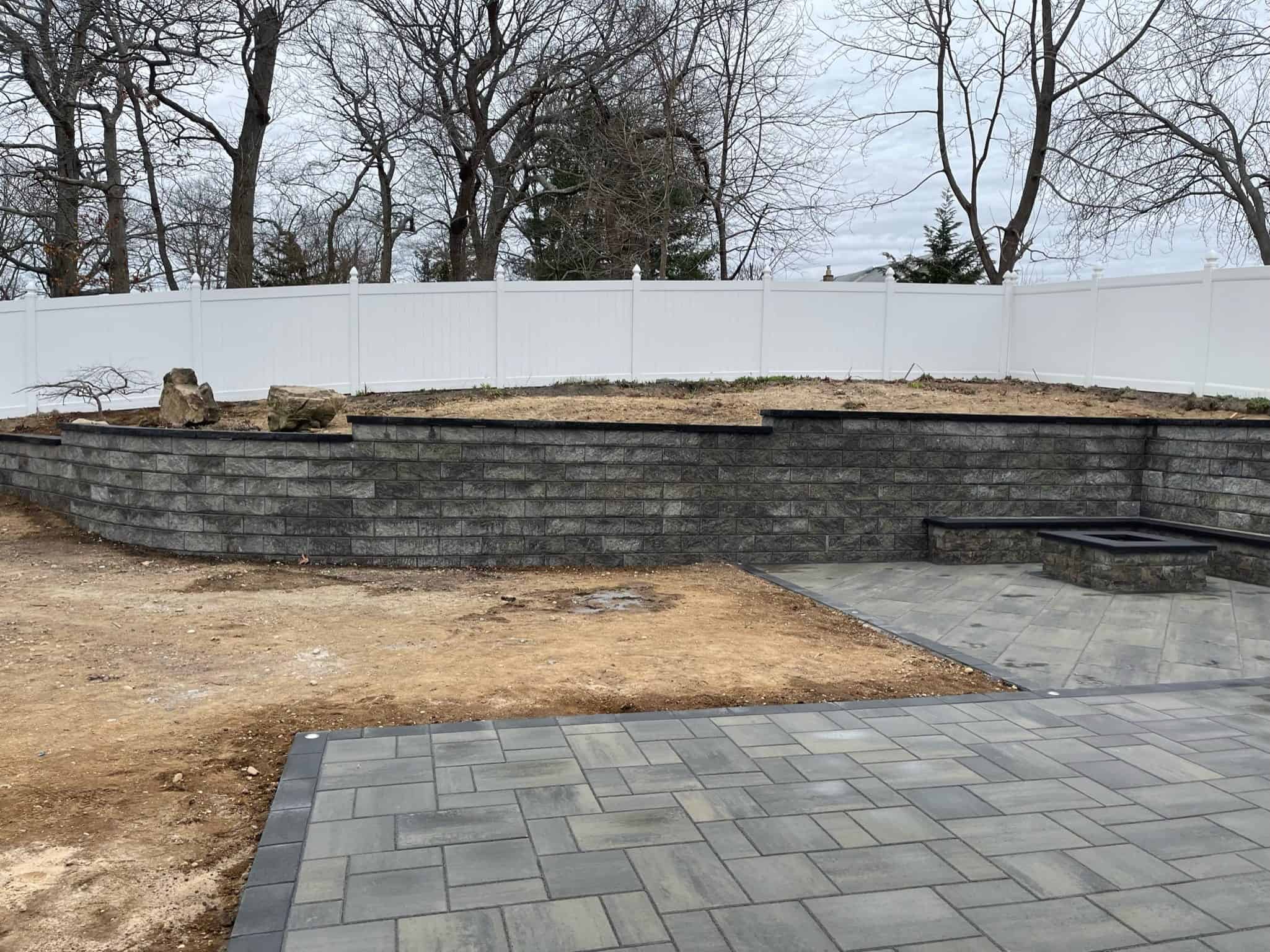
Of all the drainage problems we see in hardscape work, retaining wall failures are the most alarming — and the most preventable. When a retaining wall starts to lean, crack along its joints, or bow outward, most homeowners assume it’s a structural problem with the wall itself. Usually, it’s a drainage problem behind it.
Here’s what happens. Soil holds water. When rain saturates the ground behind a retaining wall and that water has nowhere to go, it builds pressure — hydrostatic pressure — against the back face of the wall. That pressure doesn’t announce itself. It just pushes, steadily, until something gives. Walls begin to lean. Mortar joints crack. And in serious cases, the wall fails outright.
The fix is drainage aggregate — crushed stone backfill placed directly behind the wall — combined with a perforated drainage pipe at the base and weep holes that allow water to escape through the wall face rather than build up behind it. This isn’t an upgrade or an optional add-on. It’s the standard that any properly trained installer follows.
In Suffolk County, the sandy soil actually increases the risk here because moisture infiltrates quickly and moves through the soil rapidly. A heavy rain event can saturate the ground behind a wall in a matter of hours. If the drainage system behind that wall isn’t designed to handle that volume, the pressure builds faster than it would in a slower-draining soil environment.
We include proper drainage behind every retaining wall we build — not because it’s required on the estimate, but because the wall won’t last without it. Gravel backfill, drainage pipe, weep holes: these are standard components of the job, not line items we negotiate away.
A patio and a driveway face the same basic drainage principles, but driveways have demands that patios don’t. Vehicle weight — sometimes significant — bears down on the surface repeatedly over years. That load accelerates base failure when drainage isn’t handled correctly.
Water that pools at the garage transition point has nowhere to go except under the pavers or through the joint between the driveway and the garage apron, which is one of the first places you’ll see cracking and heaving.
Driveways also collect concentrated runoff from a larger surface area. If the grading doesn’t direct that water away from the structure and toward a proper outlet — a catch basin, a French drain, or a graded lawn edge — it finds its own path. Usually that path leads somewhere you don’t want it.

The symptoms are usually visible before the structural damage becomes serious, if you know what to look for. Pooling water that sits on the surface for hours after rain is the most obvious sign. If you’re walking around puddles on your driveway the morning after a storm, the surface pitch is wrong or the base is already compromised.
Pavers that rock when you walk or drive over them are a sign the base beneath them has shifted or eroded. This happens when water infiltrates the base, softens it, and allows individual pavers to move independently of the field. Left alone, this spreads. The pavers around the compromised section take on uneven load, the joints open up, more water gets in, and the damage cascades outward.
Cracks along the edges of the driveway — particularly near the garage apron or at the transition to the street — often indicate that water is collecting at those joints and freezing. The 9 percent expansion of freezing water in a tight joint is enough to push pavers apart over a few winters. Once the joint opens, water gets in more easily, and the cycle accelerates.
What most homeowners don’t realize is that fixing these symptoms after the fact is substantially more expensive than preventing them. Replacing a failed driveway base means pulling up the pavers, excavating, recompacting, and reinstalling — essentially doing the job twice. Getting the drainage right the first time, with proper excavation depth, compacted aggregate, correct surface pitch, and edge restraints that hold the field together, is the only version of this job that makes financial sense.
On Long Island specifically, the combination of sandy soil and freeze-thaw cycles means driveway drainage failures tend to show up faster than they might in other markets. We’ve seen driveways installed by contractors who cut corners on base depth start showing movement within two winters. The math on that is not complicated.
Drainage is invisible once the pavers are laid. That’s the fundamental problem with evaluating hardscape contractors on price alone. A contractor who skips proper base depth, uses a thin aggregate layer, omits geotextile fabric, or doesn’t plan for drainage is betting that you won’t know the difference — and for the first year or two, you probably won’t.
The questions that reveal whether a contractor actually understands drainage are specific. Ask them how deep they excavate. The industry range is 4 to 12 inches; in Long Island’s sandy soil, the upper end of that range is appropriate. We excavate to 8 to 10 inches as a standard practice. If a contractor tells you 3 or 4 inches is sufficient for a driveway, that’s worth noting.
Ask what the base layer consists of and how it’s compacted. Angular crushed aggregate — not rounded gravel, not sand — is the correct material because it locks together under compaction and allows water to move through it. Ask whether they use geotextile fabric between the subgrade and the aggregate layer to prevent fine particles from migrating upward and clogging the drainage system over time.
Ask specifically about drainage planning for your site. What’s the slope? Where does the water go? Is there a low point that needs a catch basin or a French drain? A contractor who gives you a vague answer or pivots immediately to talking about paver styles hasn’t thought this through.
We start our estimate process by reading the slope and identifying low spots before we think about which pavers look best. That’s the sequence that produces installations that hold up. Stone Escapes Masonry & Outdoor Design Inc is certified by Cambridge, Techo-Bloc, Unilock, and Nicolock — all of which require demonstrated knowledge of base preparation and drainage as part of their certification standards. We’re also licensed in Suffolk County (#HI-62761), Southampton (#L005914), and East Hampton (#9808), which means we’re accountable to the municipalities where we work.
The short version: drainage is what determines whether a hardscape installation lasts or fails. Surface slope, base depth, aggregate selection, retaining wall backfill, driveway edge management — these aren’t details. They’re the job. Everything visible on top of them is only as good as what’s underneath.
In Suffolk County, the stakes are higher than in most markets. Sandy soil, freeze-thaw cycles, coastal moisture, and high water tables on the South Shore create conditions that punish shortcuts quickly. The contractors who understand those conditions build differently — deeper bases, better drainage planning, materials rated for coastal exposure.
If you’re planning a patio, driveway, retaining wall, or any hardscape project on Long Island and you want to talk through what proper drainage actually looks like for your specific property, Stone Escapes Masonry & Outdoor Design Inc offers free onsite estimates with the owner. No portals, no callbacks from a scheduler — just a direct conversation with someone who’s been doing this work in Suffolk County for over 15 years.
Article details:
Share:
Continue learning: