What works in other markets often fails on Long Island. Here is what Suffolk County homeowners need to know before installing patio pavers.
Share:
Summary:
Most paver patios don’t fail because someone picked the wrong color stone. They fail because of what is underneath. What is underneath is where shortcuts are easiest to hide. On Long Island, that matters more than almost anywhere else. The sandy glacial soil, the coastal moisture, and the five-month freeze-thaw window are not minor variables. They are the reason a patio that looks identical to one in another state can crack and shift within two winters here. This guide is for Suffolk County homeowners who want to understand what they are buying before they sign anything.
Long Island’s geology is glacial outwash, which is loose, sandy, and highly permeable. That kind of soil doesn’t hold a base the way clay or loam does. Add to that the freeze-thaw cycling that runs from November through March, and you have a combination that tests every installation hard every single year.
What this means practically is that the base preparation underneath your pavers matters more here than in most other markets. The depth of excavation, the type of base material, the compaction method, and the drainage planning are not details to gloss over. They are the whole game. A patio built on a shallow base in Suffolk County isn’t just a risk. It is a timeline.
This is one of the most important questions you can ask a contractor, and the answer tells you a lot about how seriously they take the work. For most of Suffolk County, a properly prepared base requires excavation to at least 8 to 10 inches. In areas with particularly sandy or unstable soil, that depth goes deeper still.
When water gets into the base layer and freezes, it expands. That expansion pushes pavers upward. If the base is shallow, poorly compacted, or made of the wrong material, the movement is uneven and the surface cracks, shifts, and settles. Do that five winters in a row and you have a patio that looks ten years older than it is.
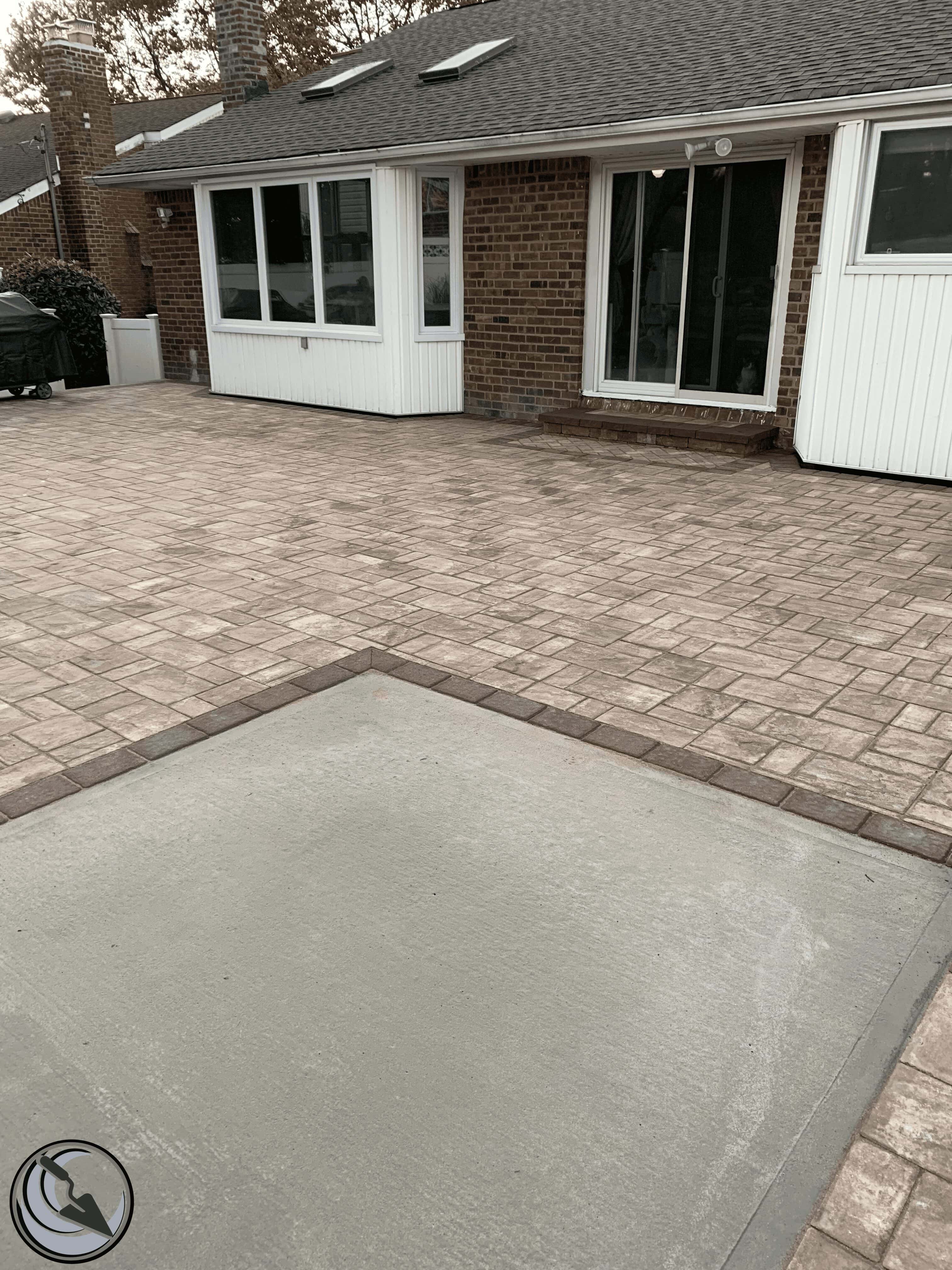
A proper base uses crushed stone instead of unprocessed fill or sand alone, and it is compacted in layers. Each lift gets compacted before the next goes down. It is not glamorous work, but it is the work that determines if your patio looks the same in year fifteen as it did in year one.
Edge restraints matter too. On sandy soil, pavers want to drift laterally over time. Solid perimeter restraints along every edge keep that from happening. Skipping them, or using cheap ones, is another place where a low bid saves money on installation day and costs you on year three.
The contractors who are vague about base depth during an estimate, and who give you a price without specifying what is included, are often the ones cutting corners underground where you will never see it until it is too late. Ask directly. A specific answer is a good sign. A shrug or a subject change is not.
We excavate to 8 to 10 inches as standard practice, with deeper preparation in areas where the soil conditions call for it. That is not a premium upgrade. That is the baseline for work that holds up in this environment.
Yes, and this is one of the things that gets skipped most often on lower-budget installations. Long Island’s terrain is relatively flat, which sounds like a good thing until you realize that water has nowhere obvious to go. Without deliberate drainage planning built into the project from the start, water pools under the base layer, erodes the material beneath, and accelerates the settling and shifting that eventually ruins the surface above.
This is especially relevant near the Great South Bay, along the South Shore, or on properties with any history of standing water after heavy rain. Coastal properties in Southampton and East Hampton also deal with salt air and moisture infiltration that can affect material longevity if the installation doesn’t account for it.
Drainage planning doesn’t mean digging a trench and hoping for the best. It means understanding where water currently flows on your property, designing the slope and grading of the patio surface to direct water away from the foundation and off the paved area, and selecting base materials that allow controlled permeability. When it is done right, you don’t think about it again. When it is skipped, you notice it every time it rains.
A connected issue is joint filling. Polymeric sand, which is the material used to fill the joints between pavers, hardens when wet and locks everything in place. It also resists weed growth and keeps insects from working their way in from below. Using the right joint material and applying it correctly is a finishing step that affects both the look and the long-term performance of the surface.
Every project we take on starts with a site-specific drainage assessment before any installation begins. The patio design follows the drainage plan, not the other way around. It adds time to the planning phase, but it is the reason our installations hold up the way they do.
The estimate process is where you learn the most about a contractor. You learn this not from what they say about themselves, but from how specifically they answer your questions. A contractor who can tell you exactly how deep they will excavate, what base material they will use, and how they will handle drainage on your specific property is a contractor who has genuinely thought about your project.
A contractor who gives you a total price and a handshake without those specifics has given you very little to evaluate. In a market where bid ranges for the same project can vary widely, understanding what is included is the only way to make a real comparison.
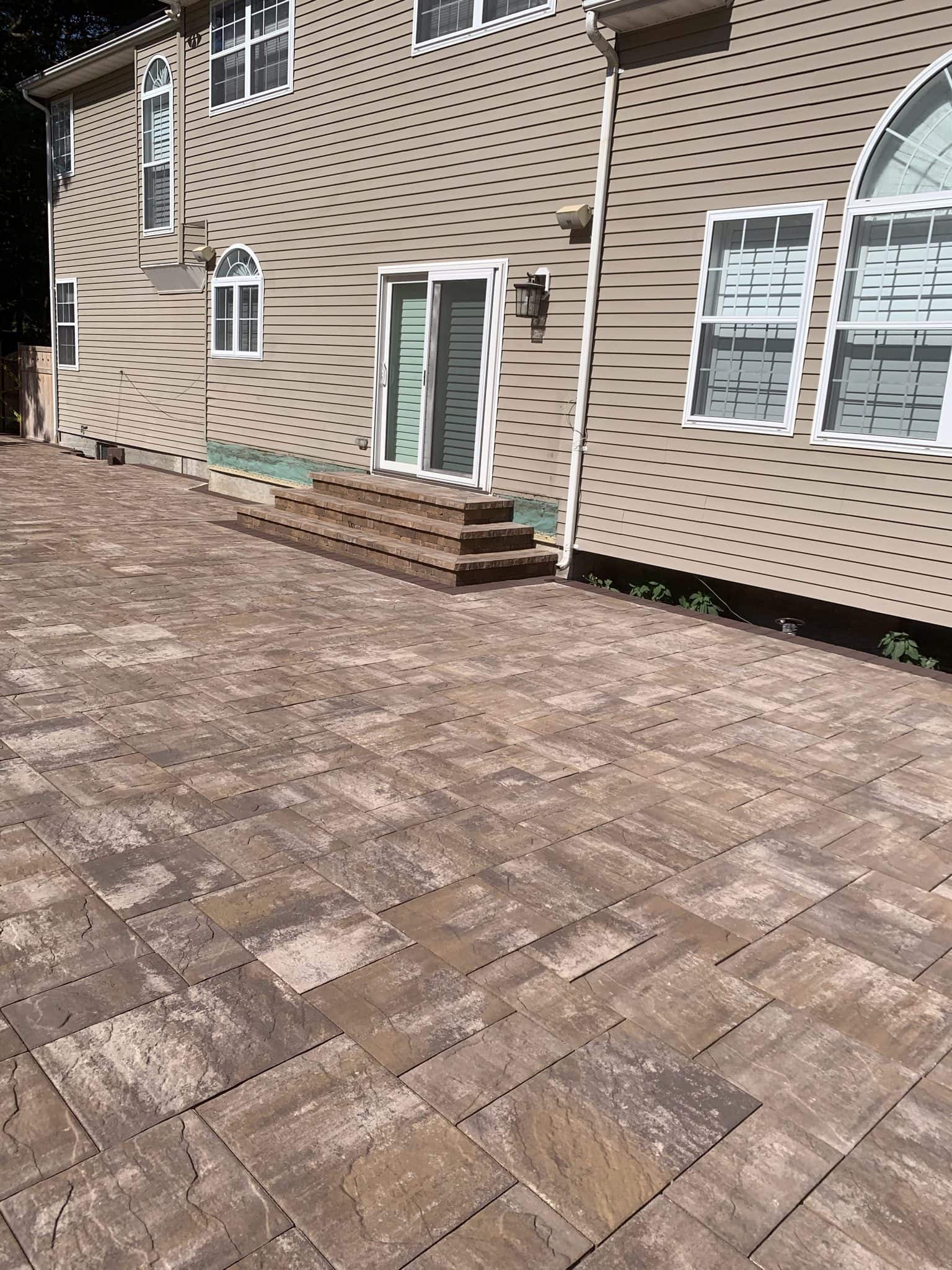
Yes, and this is more complicated than most homeowners realize. Suffolk County requires a Home Improvement Contractor license for any masonry or paving work on residential property. That license requires proof of general liability insurance, workers’ compensation coverage, a passing score on a written exam covering Suffolk County home improvement law, and a formal application process.
But here is what a lot of homeowners don’t know: the county license doesn’t automatically cover every municipality within the county. Southampton and East Hampton each require their own separate licensing on top of the county credential. A contractor who holds a Suffolk County license but hasn’t gone through the additional licensing process in those towns is not authorized to work there, and if something goes wrong, that gap in coverage becomes your problem too.
This matters most for homeowners on the East End, where many of the highest-value properties and most ambitious outdoor renovation projects are located. If you are in Southampton, NY or East Hampton, NY and you are planning a significant paver patio, poolscape, or outdoor kitchen project, verify that your contractor holds the specific municipal license for your town rather than just the county-level credential.
We are licensed in Suffolk County, Nassau County, East Hampton, and Southampton. Each of those is a separate license, separately applied for, with its own requirements. We went through that process because the work we do spans all of those jurisdictions, and our clients shouldn’t have to wonder if we are authorized to be on their property.
It is also worth confirming that any contractor you are considering carries adequate general liability insurance and workers’ compensation. If a crew member is injured on your property and the contractor doesn’t have proper coverage, the liability can fall to you. Ask for certificates of insurance directly instead of just a verbal confirmation.
Material selection comes down to how the space will be used, how much exposure it has to moisture and salt air, and what kind of maintenance you are willing to do over time. There is no single right answer, but there are informed ones.
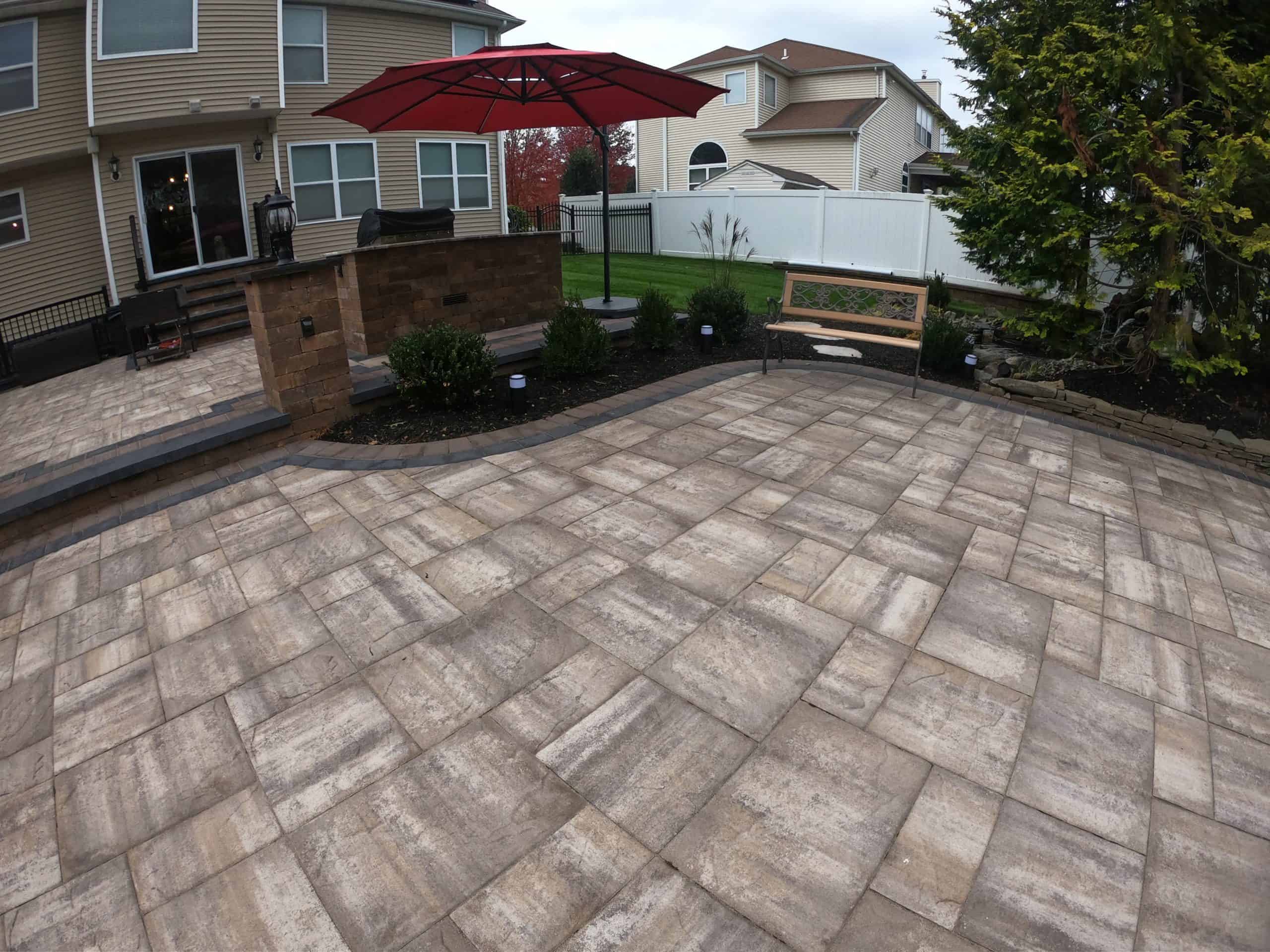
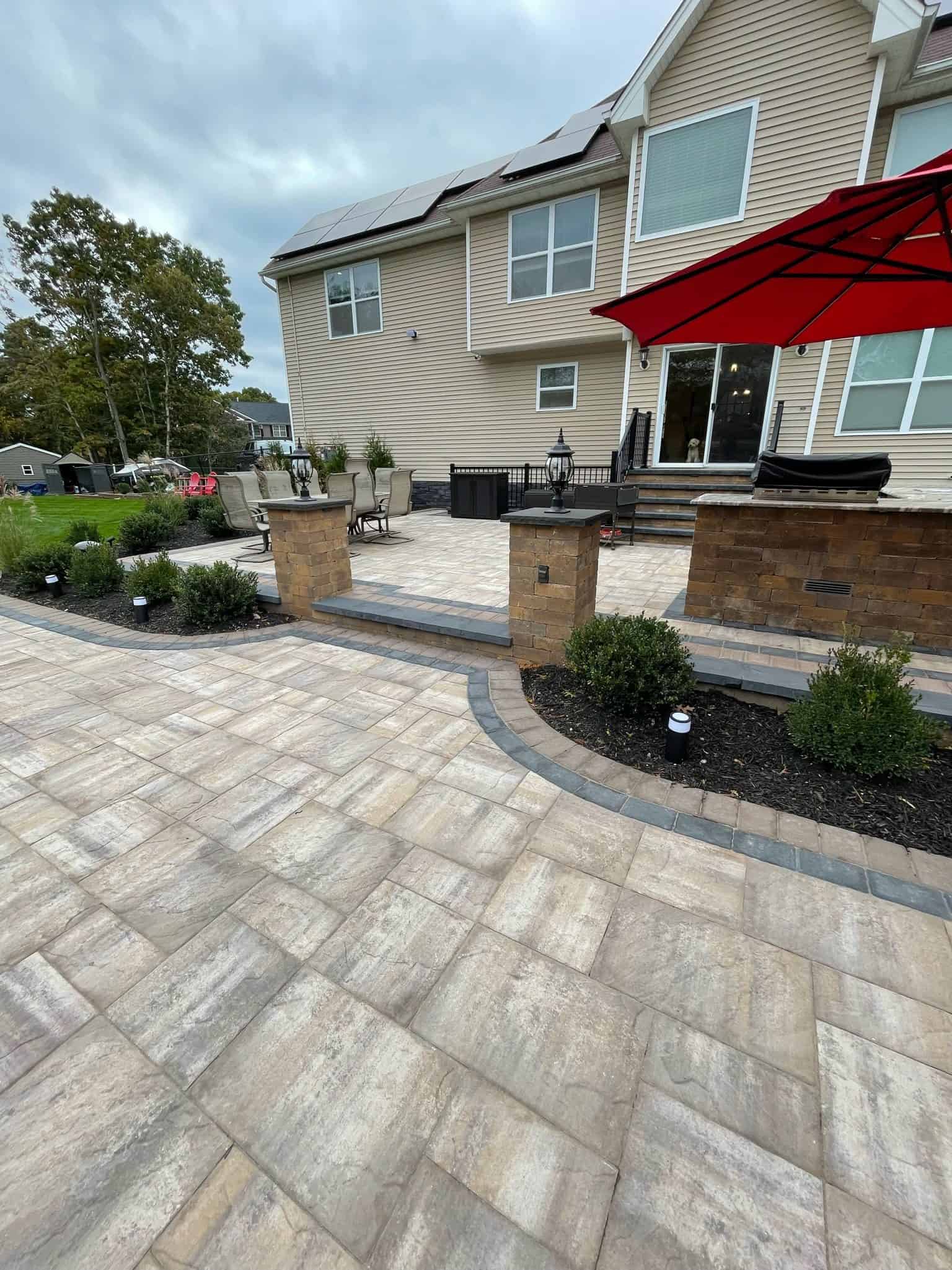
Concrete pavers, including products from manufacturers like Cambridge, Techo-Bloc, Unilock, and Nicolock, are the most commonly used for patios, driveways, and pool surrounds in Suffolk County. They are durable, available in a wide range of profiles and finishes, and engineered to handle freeze-thaw cycling. Nicolock, notably, is manufactured in Lindenhurst as a local Long Island product with a supply chain that doesn’t depend on distant shipping. Many concrete pavers now come with factory-applied surface treatments that significantly reduce maintenance requirements compared to natural stone or older concrete products.
Natural stone options like bluestone, travertine, and granite offer a look that manufactured pavers can approximate but not fully replicate. Bluestone is a classic choice for patios and walkways across Long Island, particularly in older neighborhoods and on properties where the architecture calls for something more traditional. Travertine has become popular for pool surrounds because its surface stays cooler underfoot in direct sun and has a texture that reduces slip risk when wet. Both require more attention to sealing and joint maintenance than concrete pavers, and both respond differently to Long Island’s freeze-thaw conditions, which is exactly why material-specific installation knowledge matters.
For driveways, the load-bearing requirements change the calculus. Concrete pavers designed for vehicular traffic have different thickness and base specifications than patio pavers. A contractor who treats them the same way is cutting a corner that will show up as cracking or settlement after a few winters of cars pulling in and out.
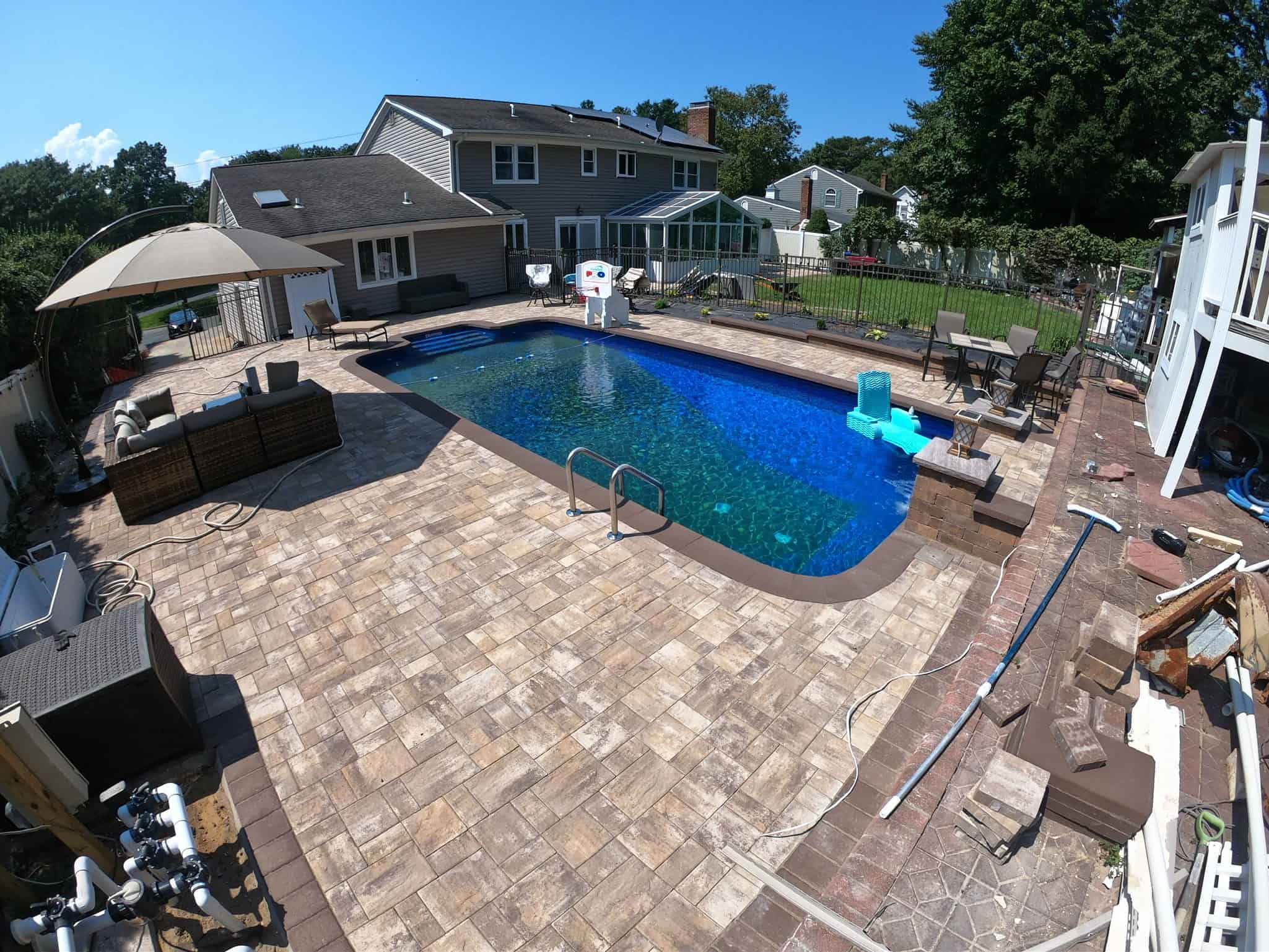
Pool surrounds present their own set of considerations. The constant moisture, the pool chemicals, and the bare feet all affect which materials hold up and which ones deteriorate faster than expected. We have installed poolscapes across Suffolk County and we have seen what happens when the wrong material or the wrong base prep gets used near water. The fix is always more expensive than doing it right the first time.
We hold certifications from Cambridge, Techo-Bloc, Unilock, Nicolock, Eldorado, and Boral, meaning we have been trained on the installation standards for each of those product lines. It also means we can give you an honest recommendation across a wide range of materials rather than steering you toward whatever one brand we happen to carry.
The right contractor for a paver patio in Suffolk County isn’t necessarily the one with the biggest truck or the lowest number on the estimate. It is the one who can tell you exactly what they are going to do before they do it, including base depth, drainage plan, materials, and edge restraints, and then show up and do it.
Long Island’s conditions are specific. Sandy soil, coastal exposure, and five months of freeze-thaw cycling are not factors you can ignore and hope for the best. They are the reason proper preparation matters so much here, and the reason a well-built patio in Suffolk County can last 25 to 50 years while a poorly built one starts failing within a few winters.
If you are planning a paver patio, a driveway, a pool surround, a fire pit area, or a full backyard renovation, Stone Escapes Masonry & Outdoor Design Inc is worth a conversation. Every estimate is done in person by the owner, every project gets the same preparation standards, and we are licensed in the jurisdictions where we work. Reach out today to schedule your in-person estimate and ensure your outdoor space is built to last.
Article details:
Share:
Continue learning: