If your driveway has been on your to-do list all summer, this is the window you've been waiting for — and it's closing faster than you think.
Share:
Summary:
You noticed the cracks back in April. Maybe a low spot that pools water after rain, or an edge that’s been crumbling since the last hard winter. You told yourself you’d deal with it when things slowed down. Now it’s September, and here’s what most contractors won’t tell you upfront: this is genuinely the last reliable window for driveway repair in Suffolk County before the ground freezes. Not a sales tactic. An actual temperature threshold that determines whether the work will hold. Here’s what you need to know before the season closes.
Asphalt requires ground temperatures above roughly 50°F to compact and cure properly. Below that threshold, the material stiffens too fast during installation, which means it won’t bond the way it should — and a driveway that doesn’t bond correctly fails early, often within a season or two. In Suffolk County, ground temperatures typically reach that cutoff in November. That sounds like plenty of time, but contractor schedules across the county fill up fast in October. Homeowners who call late often find the next available slot isn’t until April.
The other issue is what happens to an unrepaired driveway over a Long Island winter. This isn’t the sustained cold of upstate New York, where temperatures drop and stay down. Long Island’s ocean proximity creates something more damaging: constant oscillation around 32°F. Temperatures crossing the freezing point dozens of times in a single season. Every one of those cycles pushes water deeper into existing cracks, freezes it, expands it, and widens the damage. A hairline crack in September is a pothole by March.
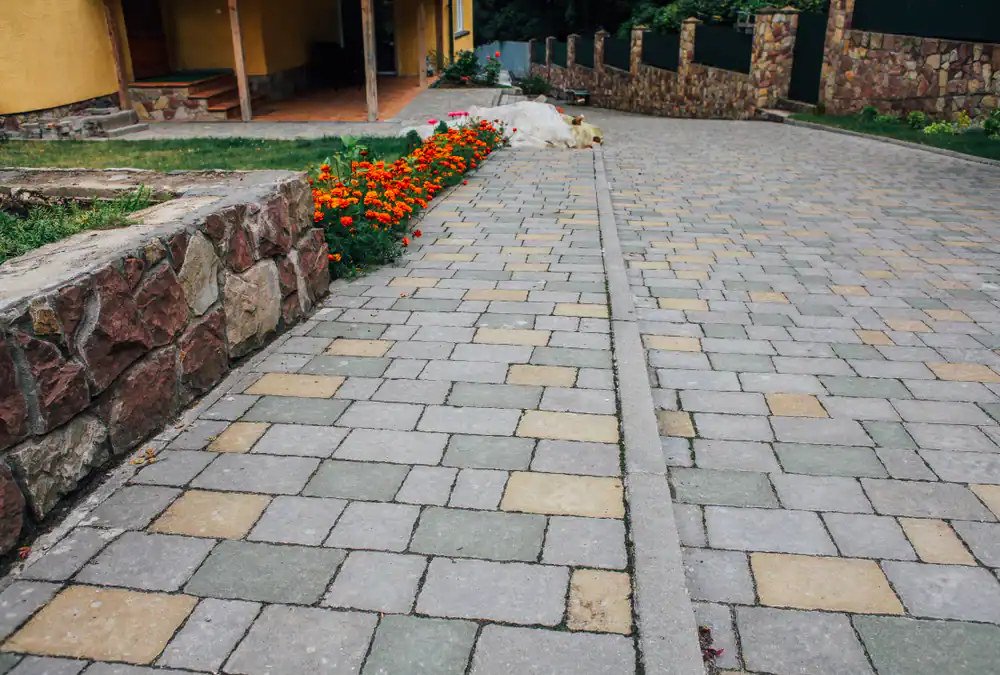
Most people think of cold climates as the enemy of driveways. But sustained cold — where temperatures drop and stay down — is actually less damaging than what Long Island experiences. When the ground freezes and stays frozen, water stops moving. When temperatures hover near 32°F and swing back and forth, water keeps cycling through the freeze-expand-thaw process repeatedly throughout the winter.
Climate data confirms that Long Island sees more freeze-thaw cycle days per season than New York City and even some colder inland areas, specifically because of the moderating effect of the surrounding ocean. What that means for your driveway in Suffolk County is straightforward: existing damage doesn’t just sit there over winter. It grows.
Water enters a crack, freezes, and expands — widening the gap. When it thaws, more water gets in. The next freeze expands it further. By the time spring arrives, what looked like a manageable surface crack may have become a structural failure in the base beneath it. That’s when repair costs jump significantly, because you’re no longer fixing a surface problem — you’re fixing a foundation problem.
The other factor specific to Suffolk County is soil composition. Much of Long Island sits on sandy glacial soil. Sandy soil drains well, but it also shifts. A driveway installed without proper excavation depth and base compaction — and plenty of contractors cut corners here — will settle unevenly over time. When freeze-thaw cycles work on top of a poorly prepared base, the surface cracks faster and the damage spreads more quickly than it would on more stable ground. This is why the prep work underneath matters as much as what you see on the surface.
Addressing driveway damage before winter isn’t about aesthetics. It’s about stopping a process that gets more expensive with every freeze-thaw cycle that passes over an unrepaired crack.
The most common reason driveways fail prematurely in Suffolk County isn’t the material — it’s the preparation underneath. Proper excavation for a driveway should reach 8 to 10 inches deep. That’s not an arbitrary number. It accounts for the sandy, shifting soil that’s common across the county, the drainage requirements of low-lying areas with high water tables, and the depth needed to create a stable base that won’t heave or settle under freeze-thaw pressure.
Many contractors excavate to 2 to 4 inches. It’s faster, it’s cheaper to execute, and it looks identical on day one. The difference shows up in year two or three, when the surface starts cracking from below because the base never had the stability to support it. By then, the contractor is long gone and the homeowner is back to square one — often spending more on the second installation than they would have on a properly done first one.
Beyond excavation depth, drainage planning matters enormously in Suffolk County. Coastal and low-lying areas throughout the county — from Bay Shore to Medford to Sayville — often sit above a high water table. Without a drainage system built into the installation, water has nowhere to go and will eventually undermine the base. A French drain system integrated into the driveway installation isn’t an upgrade in these areas; it’s a necessity.
We excavate to 8 to 10 inches on every project, install drainage systems designed for Long Island’s specific conditions, and use manufacturer-certified materials and techniques. Those certifications — from Cambridge, Techo-Bloc, Unilock, and Nicolock — aren’t just credentials. They mean the manufacturer warranties on the materials can be passed directly to you as the homeowner. Contractors who aren’t certified can’t offer that protection, even if they’re using the same brand of material.
One of the most common questions we hear from Suffolk County homeowners is some version of: “Is mine worth fixing, or do I just need to start over?” It’s a fair question, and the honest answer is that it depends on what’s happening beneath the surface — not just what you can see from the driveway.
The general rule the industry uses is this: if repair costs would run 40 to 50 percent of what a full replacement would cost, and the base is compromised, replacement is the smarter long-term investment. Patching a surface that’s sitting on a failed base is money that buys you a year or two at most before the same problems return. But if the base is structurally sound and the damage is limited to the surface, repair is a completely reasonable option — and significantly less expensive.
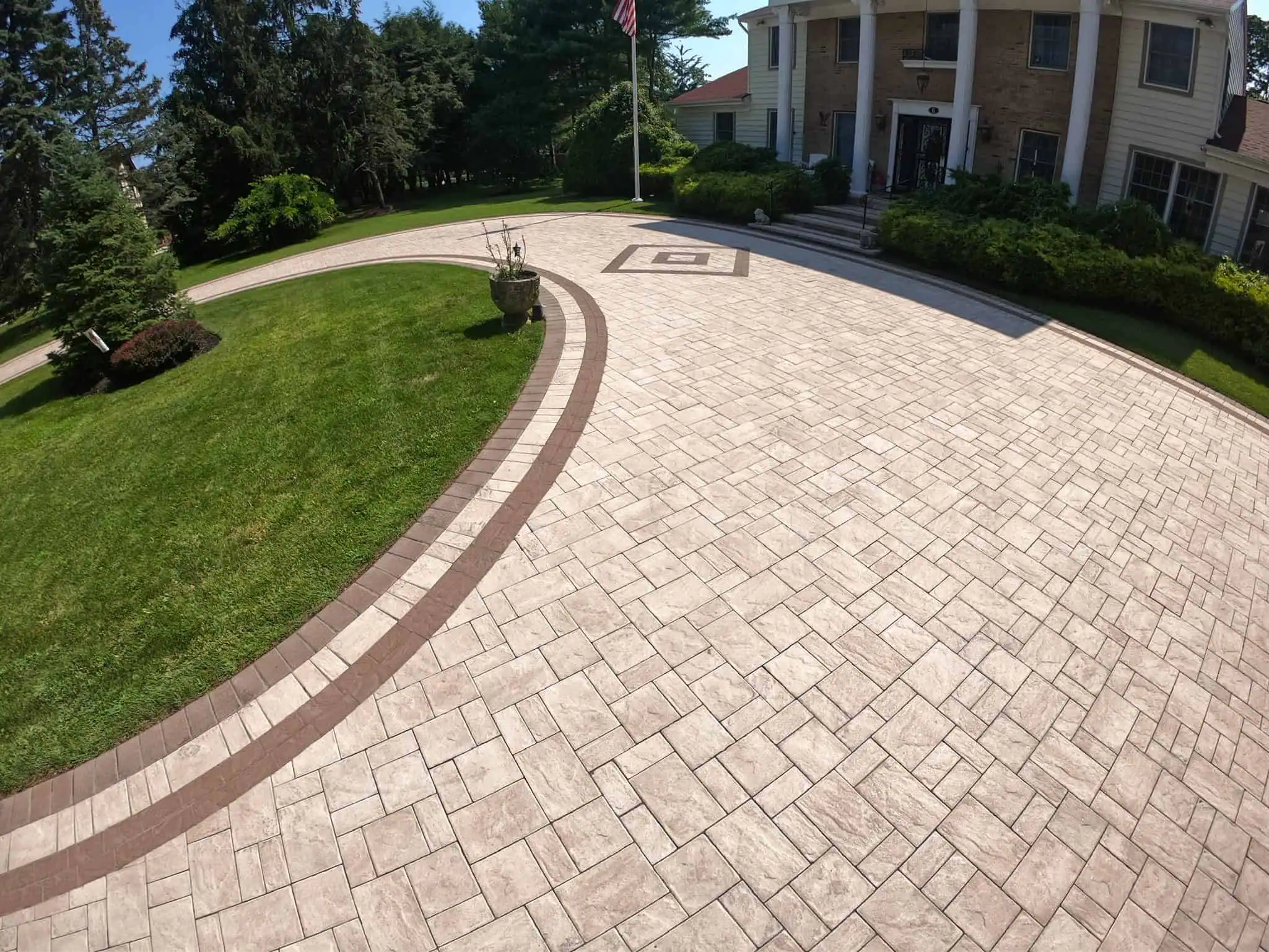
Surface cracks that are isolated and haven’t spread significantly are usually repairable. Small potholes from freeze-thaw damage — the kind that show up in one or two spots after a rough winter — are also typically candidates for repair rather than full replacement. The cost for professional asphalt driveway repair generally runs $2 to $5 per square foot, with most homeowners spending somewhere between $1,070 and $4,025 depending on the scope of the damage. A single pothole repair from freeze-thaw damage typically runs $150 to $300.
The signs that point toward replacement are different. If you’re seeing widespread cracking across the surface — not one or two cracks but a network of them — that’s often a sign the base has failed and the surface is reflecting that failure. Uneven sections, areas that have sunk or heaved significantly, or drainage problems that have gotten worse over time all suggest the issue is structural, not cosmetic.
Concrete spalling — where the surface layer flakes or chips away — is another indicator, particularly in areas where rock salt or deicing chemicals have been used repeatedly over the years. Spalling is caused by moisture working through the concrete surface during freeze-thaw cycles, and it accelerates with salt exposure. When we assess a driveway in Suffolk County, we’re looking at the full picture: the surface condition, the base stability, the drainage situation, and the soil beneath. A proper assessment takes into account what’s happening under the driveway, not just what’s visible from the top. That’s the only way to give an honest recommendation — and it’s why we do every estimate in person, on-site, with the owner involved directly.
Driveway repaving — resurfacing the existing driveway with a new layer of material — sits between repair and full replacement. It makes sense when the base is still structurally intact but the surface has deteriorated past the point where crack filling or spot repairs would hold. It’s a legitimate option that can extend the life of a driveway significantly, but only when the underlying base actually warrants it.
What repaving does not fix is a base problem. If the base has shifted, settled unevenly, or been compromised by drainage issues, laying a new surface on top of it will produce the same cracking within a few seasons. This is one of the more common situations where homeowners feel like they’ve been taken advantage of — not necessarily because the contractor was dishonest, but because the recommendation was made without a thorough assessment of what was happening beneath the surface.
On Long Island, the decision between repaving and full replacement also has to account for the soil and drainage conditions specific to your property. A driveway in Stony Brook, NY on sandy, well-draining soil behaves differently than one in a low-lying area of Ronkonkoma or West Babylon where the water table is higher and drainage is a persistent issue. The right answer depends on where you are and what your specific conditions look like — not a one-size answer that applies across the county.
Asphalt installed pricing in New York runs $4.50 to $9 or more per square foot. Paver driveways run $10 to $50 or more per square foot installed, depending on the material and complexity. Those ranges reflect real variation based on scope, materials, and site conditions — which is exactly why an in-person assessment matters before any number gets put on paper.
We’re licensed in Suffolk County (#HI-62761), Nassau County (#167041), Southampton Township (#L005914), and East Hampton Township (#9808). We work across all of Long Island, and we’ve seen enough driveways in enough conditions to give you a straight answer about what yours actually needs.
The window is real, and it closes faster than most homeowners expect. September is when Suffolk County driveway repair schedules start filling up, and once the ground temperature drops, the work can’t be done properly until spring — meaning another full winter of freeze-thaw cycles working on whatever damage is already there.
If your driveway has been on your list, now is the time to get an actual assessment rather than keep guessing whether it needs repair or replacement. An honest answer starts with someone looking at it in person — not a quote over the phone based on square footage alone.
Stone Escapes Masonry & Outdoor Design Inc offers free on-site estimates scheduled directly with the owner. No call centers, no automated systems — just a straightforward conversation about what your driveway actually needs and what it would take to fix it the right way before winter arrives.
Article details:
Share:
Continue learning: