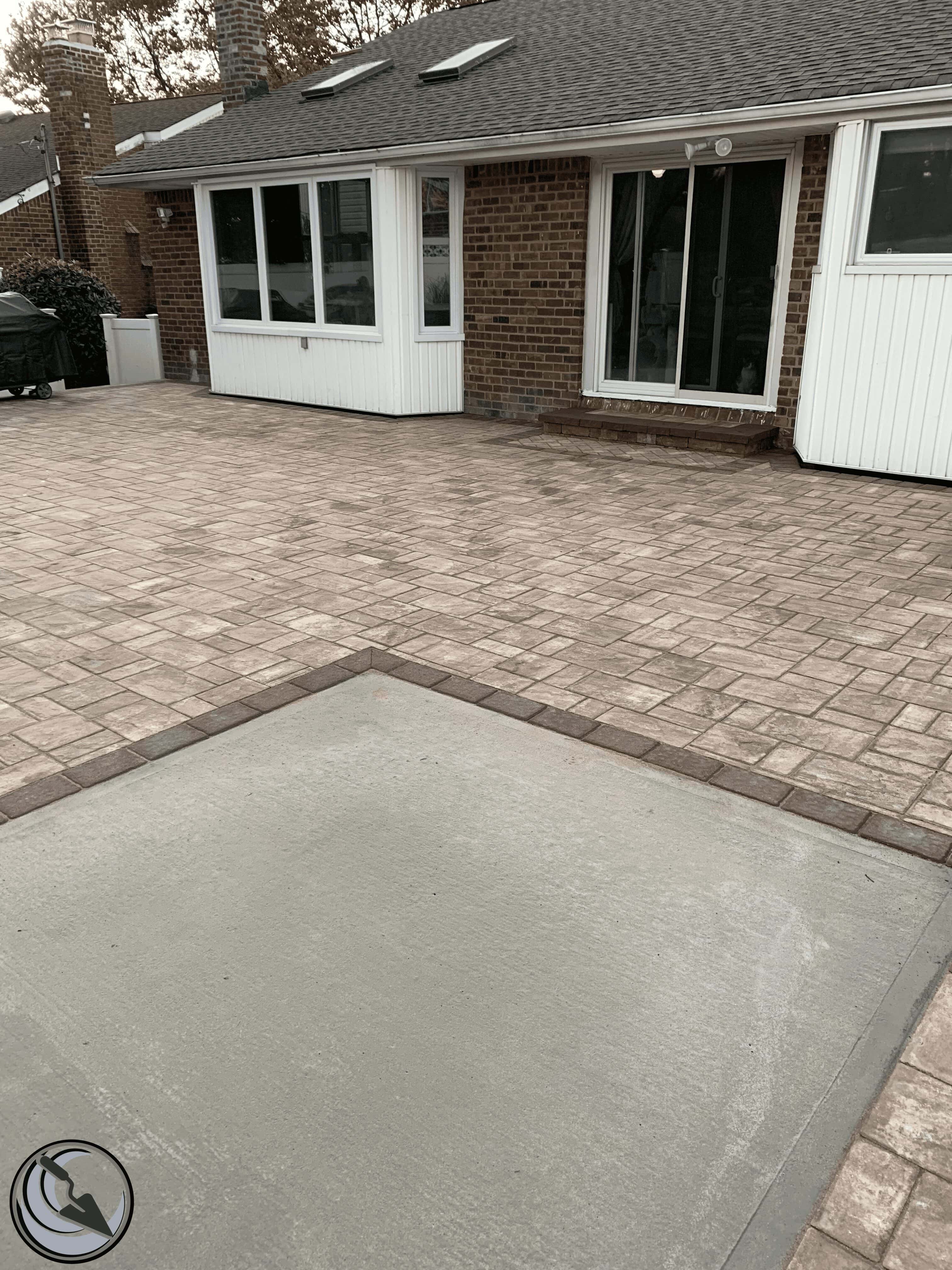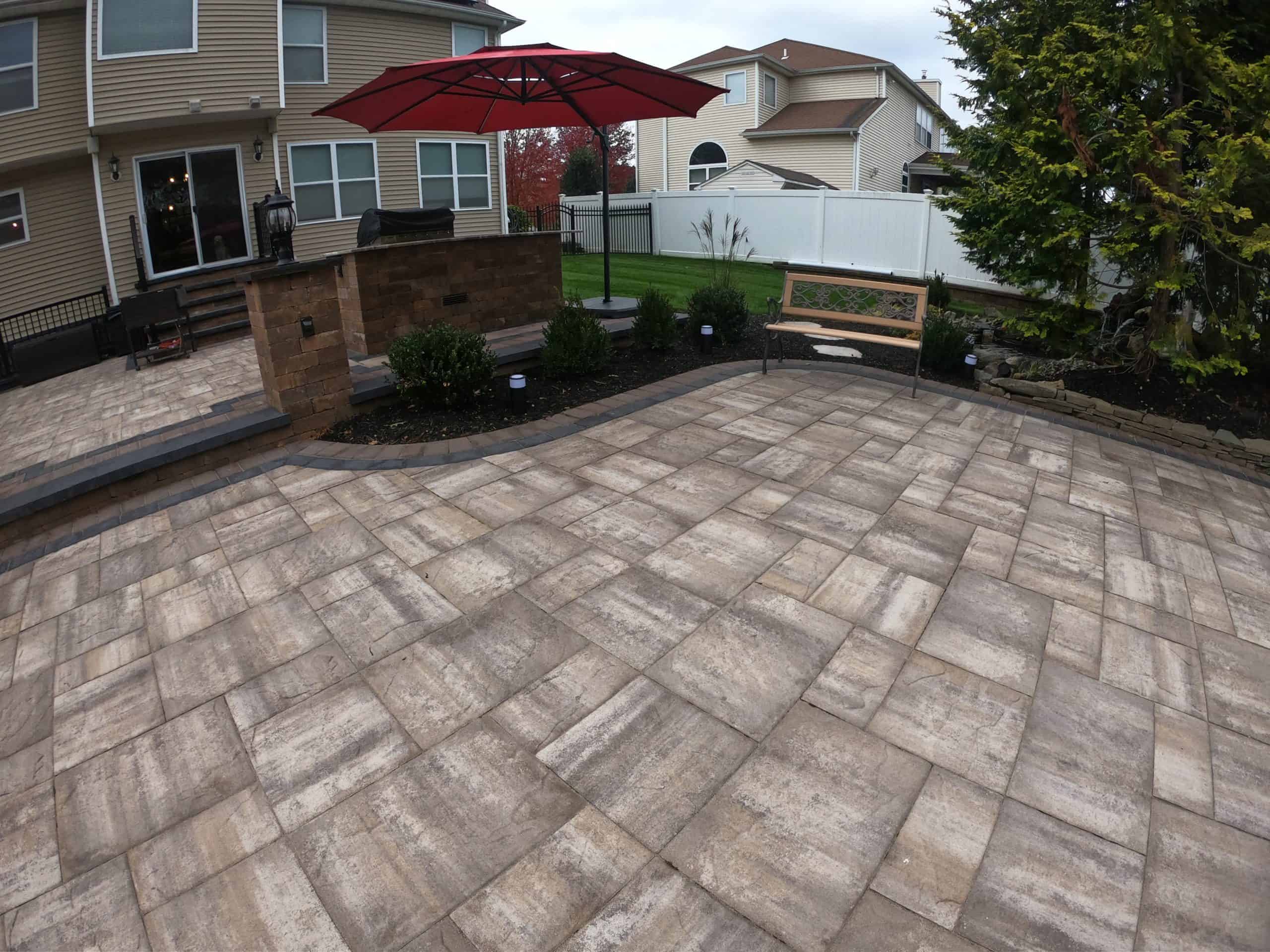
Trying to figure out what a natural stone patio actually costs on Long Island? Here's a straight answer — and the comparison most homeowners get wrong.
Share:
Summary:
You’ve probably already looked up patio costs and gotten a range so wide it was almost useless. Somewhere between $13 and $65 per square foot — which tells you almost nothing when you’re trying to budget a real project. The truth is, natural stone patio pricing on Long Island depends on a handful of specific factors, and most of the confusion comes from comparing quotes that aren’t actually quoting the same thing.
This guide is written for Suffolk County homeowners who want a straight answer: what does bluestone cost, what does travertine cost, how do those numbers change for Long Island specifically, and what should you actually be evaluating when you get competing bids.
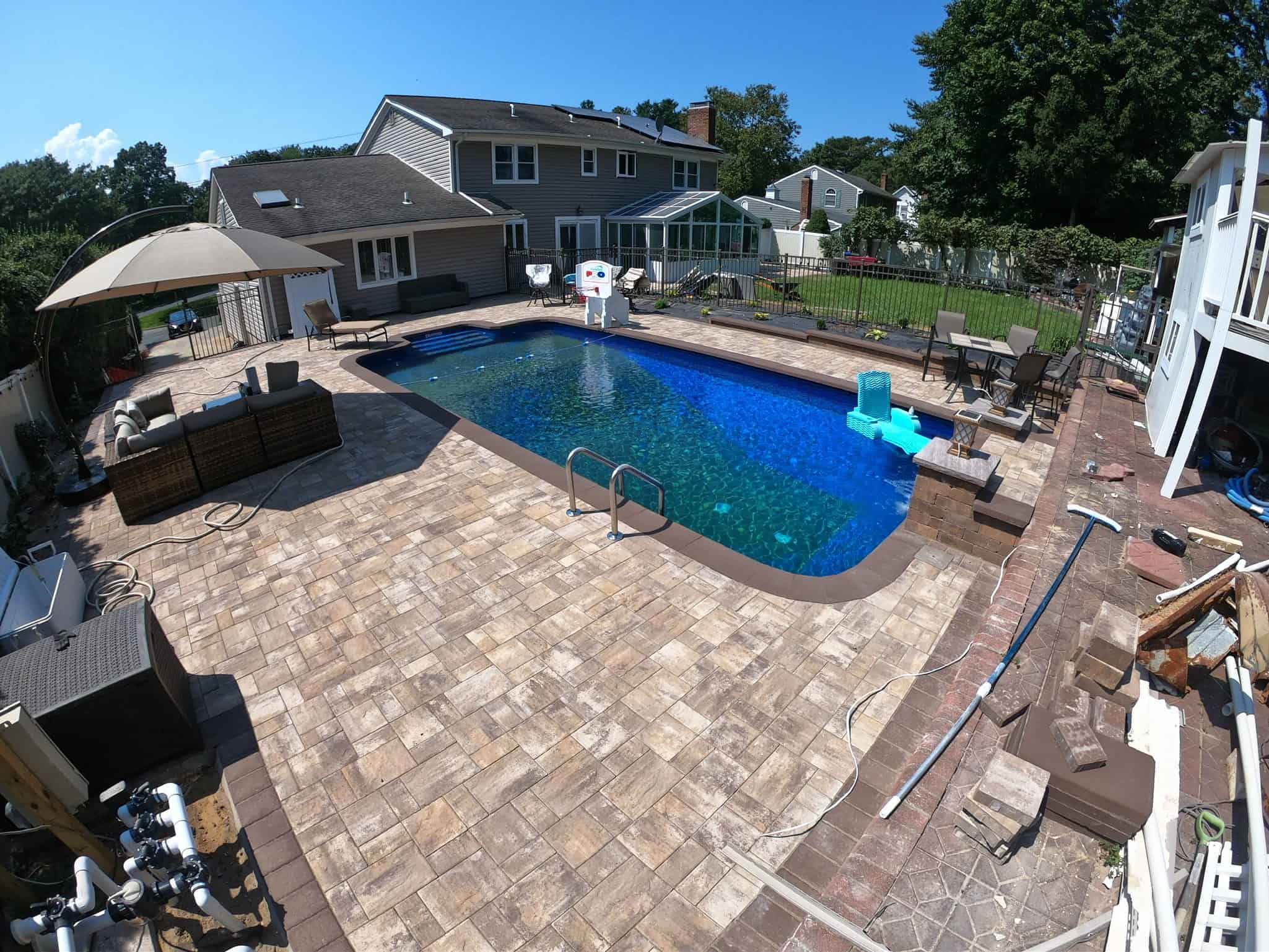
Bluestone has been the go-to natural stone for Long Island patios for decades. Its blue-gray color, irregular texture, and full-range patterning are part of the visual identity of older Nassau and Suffolk neighborhoods — you’ve seen it on countless front stoops and backyard patios across the Island. It comes from Pennsylvania quarries, it handles freeze-thaw cycles well, and it holds up in the coastal conditions that define this region.
Nationally, bluestone patio installation runs $15 to $31 per square foot. On Long Island, that number is higher. A properly installed bluestone patio in Suffolk County typically runs $35 to $65 per square foot for a pool patio application, with standard backyard patios generally falling in the $20 to $40 per square foot range depending on size, layout complexity, and site conditions. That price is fully loaded — excavation, base material, compaction, the stone itself, edge restraints, polymeric sand, and cleanup.
If you’ve already gotten a couple of quotes and they’re nowhere near each other, the stone probably isn’t the reason. The real variable is almost always what’s underneath it.
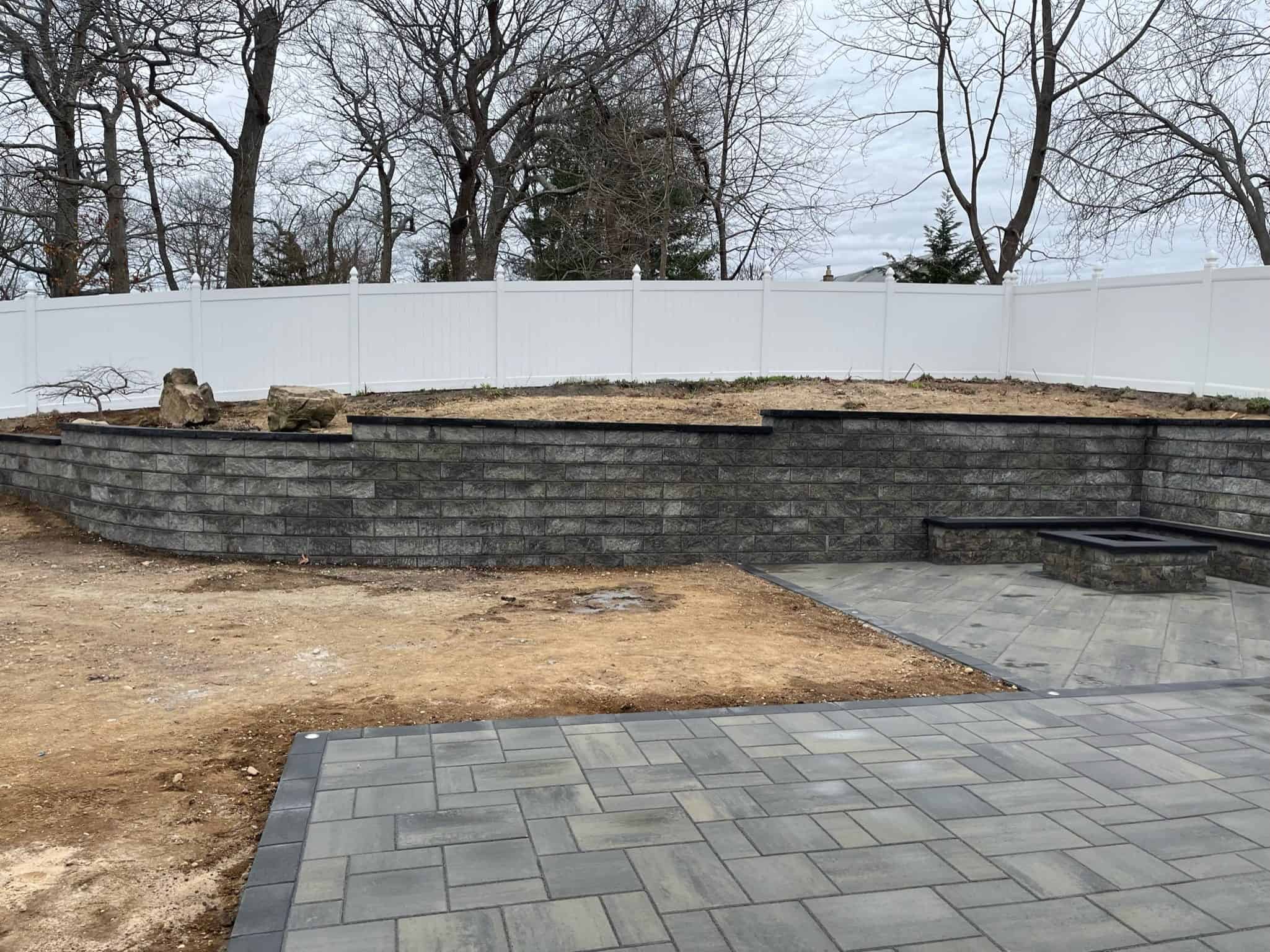
Long Island’s soil is sandy and glacial. That’s not a problem you can ignore — it’s a problem you have to engineer around. A properly built base on Long Island requires excavation to 8 to 10 inches, a compacted gravel subbase, a bedding layer, edge restraints to prevent lateral shifting, and polymeric sand in the joints to resist weeds and insects. A gravel base alone costs $2 to $5 per square foot installed. When you add drainage planning for sites with water management concerns, that number climbs further.
The lowball quotes you’ll see in Suffolk County almost always save money by cutting what you can’t see. A 2-inch sand base instead of a 6-inch compacted stone base. No polymeric sand. No edge restraint. Those patios look fine for one season. By the second or third winter, they’re heaving, cracking, and sprouting weeds through every joint. The freeze-thaw cycles here are relentless — water gets into every gap, freezes, expands, and does it again all winter long. A patio built on a shallow base doesn’t survive that process intact for long.
So when you’re comparing quotes, the first question to ask every contractor is: how deep are you excavating, and what does the base consist of? A contractor who can’t answer that clearly, or who gives you a vague answer, is usually the one cutting corners on it. The base is the entire reason a patio is still flat and level ten years from now — it’s not a place to save money.
Licensed contractors in Suffolk County charge $75 to $150 per hour for skilled masonry labor, and that rate reflects what proper installation actually requires. If a quote seems dramatically lower than others, it’s worth asking specifically what’s being left out.
Yes — and it’s worth understanding before you finalize a material choice. Bluestone comes in two primary surface finishes, and they behave differently underfoot and in price.
Natural cleft bluestone has a rough, textured surface created by splitting the stone along its natural grain. It’s slip-resistant, which makes it a practical choice for pool surrounds and areas that get wet. The texture also gives it a more organic, traditional look that fits well with older Suffolk County homes and landscape styles. Material costs for natural cleft bluestone run $6 to $11 per square foot before installation.
Thermal bluestone is flame-treated to create a smoother, more uniform surface. It’s cleaner-looking and easier to maintain, but it can get slippery when wet, which is a real consideration if you’re using it near a pool or in a shaded area that stays damp. Material costs for thermal bluestone run $9 to $14 per square foot before installation.
Neither finish is inherently better — the right choice depends on where the patio is, how it will be used, and what aesthetic you’re going for. What matters more than the finish, in terms of long-term performance, is the installation methodology underneath it. A thermal bluestone patio built on a proper 8-to-10-inch base will outlast a natural cleft patio built on 2 inches of sand, every time. The stone on top is what you see; the base is what determines whether it’s still level in a decade.
One practical note: regardless of which finish you choose, plan to order 5 to 10 percent more material than your measured square footage. Bluestone can crack during cutting and shaping on-site, and having extra material on hand avoids costly delays mid-project.
Travertine has become the preferred material for pool decks across Suffolk County’s coastal communities — and for good reason. On a hot July afternoon, travertine stays noticeably cooler underfoot than concrete, dark stone, or brick. That’s not a minor detail when you’re walking barefoot from the pool on a 90-degree day in East Hampton or Huntington.
Nationally, travertine patio installation runs $13 to $45 per square foot. On Long Island, a travertine pool patio typically runs $30 to $55 per square foot installed. For non-pool applications, costs generally fall in the lower end of that range. A standard gravel base adds $2 to $5 per square foot, and sealing after installation — which is strongly recommended, especially around pools — runs $1 to $3 per square foot.

This is the question we hear most often from Suffolk County homeowners considering travertine. The short answer is yes — but only if it’s installed correctly and sealed properly.
Travertine is naturally porous. It has small voids and channels throughout the stone that, if left open, can trap water. When that water freezes in winter, it expands and can crack or chip the stone from the inside out. That’s the real risk with travertine in a freeze-thaw climate, and it’s why some homeowners have seen travertine patios fail prematurely on Long Island.
The key variables are material grade and installation quality. Premium-grade travertine rated for freeze-thaw conditions is denser and less porous than standard commercial-grade material. The voids should be filled before installation. The base needs to be built to the same depth and standard as any other natural stone installation — 8 to 10 inches of compacted gravel, proper drainage, edge restraints. And the surface needs to be sealed after installation, then resealed periodically, to prevent water infiltration.
When those conditions are met, travertine performs well in Long Island winters. When they’re not — when someone installs an unsealed, lower-grade travertine on a shallow base — you get the failure stories that give the material a bad reputation. The stone isn’t the problem. The installation is.
Coastal salt air is the other Long Island-specific factor worth mentioning. Salt settles on outdoor surfaces and slowly degrades materials that aren’t properly sealed. Travertine near the water — in Southampton, East Hampton, or anywhere along the South Shore — needs consistent sealing maintenance to hold up over time. That’s not a dealbreaker, it’s just a maintenance commitment to factor into your decision.
It’s a fair question, and the honest answer is: it depends on what you’re optimizing for.
Concrete pavers cost less upfront. A manufactured paver patio on Long Island typically runs $20 to $35 per square foot installed — less than bluestone or travertine in most applications. If budget is the primary constraint, concrete pavers are a legitimate option and can look very good when installed properly.
But natural stone holds advantages that compound over time. It’s denser and more weather-resistant than concrete, which matters in a climate that puts outdoor surfaces through real stress every winter. It doesn’t fade the way concrete does — the color in natural stone is the stone itself, not a surface pigment. And in Suffolk County’s real estate market, where the median home value sits at $578,400 and homes are regularly selling above asking price, the aesthetic and resale distinction between natural stone and manufactured pavers is real. Homeowners can expect roughly 80% return on investment from a patio addition, and natural stone tends to perform better than concrete at the high end of that range.
There’s also a design flexibility argument. Bluestone and travertine offer patterns, textures, and visual depth that concrete pavers simply can’t replicate. If you’re investing in a pool surround, an outdoor kitchen area, or a backyard that will be photographed for a listing in a few years, natural stone reads differently — and buyers notice.
The practical takeaway: if you’re building a functional patio on a tight budget, concrete pavers are a reasonable choice. If you’re building something you want to still be proud of in 15 years — and that adds genuine value to a Suffolk County home — natural stone is worth the difference in cost.
The most important thing you can do before signing anything is ask every contractor the same question: what exactly is included in this number? Excavation depth, base composition, edge restraints, joint sand type, sealing — these are the variables that separate a patio that lasts 20 years from one that needs to be redone in five. If a contractor can’t walk you through each of those items clearly, that’s your answer.
For Suffolk County homeowners, the local conditions aren’t optional considerations — they’re the whole ballgame. Sandy soil, freeze-thaw cycles, coastal salt air, and the prevalence of pools in this region all affect which material makes sense for your specific property and how it needs to be installed. A contractor who understands those conditions will give you a different conversation than one reading from a national spec sheet.
If you’re ready to get a clear, honest estimate for a bluestone or travertine patio on Long Island, we at Stone Escapes Masonry & Outdoor Design Inc offer free onsite estimates scheduled directly with the owner — no call centers, no sales reps, no surprises.
Article details:
Share:
Continue learning: