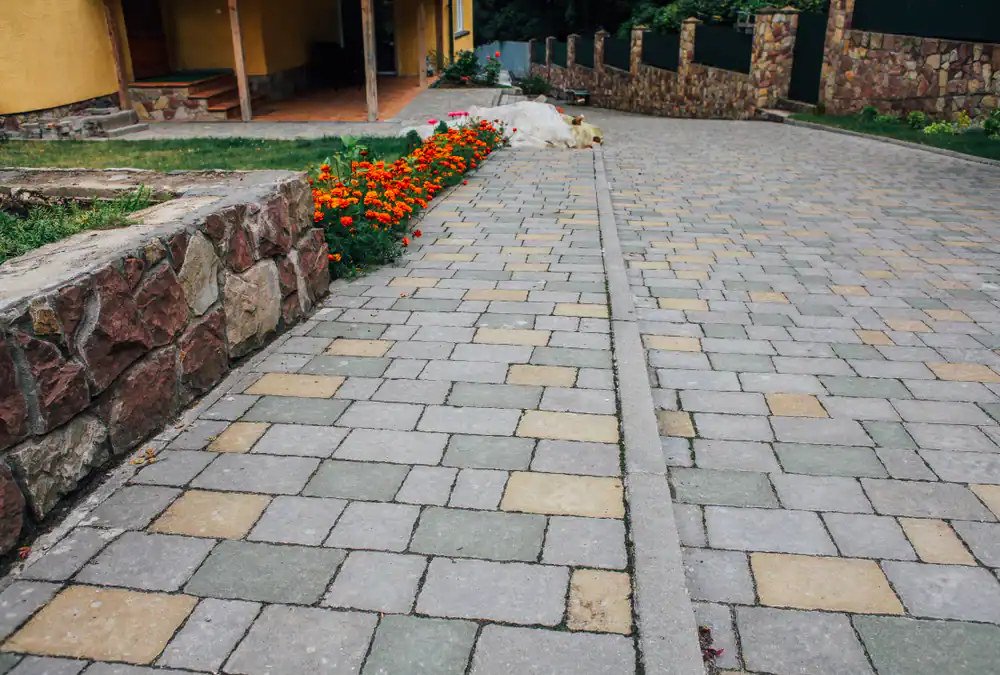
Every spring, Suffolk County homeowners walk outside and find cracked concrete, heaved pavers, and surfaces that look worse than the year before. Here's why it keeps happening — and how to stop it.
Share:
Summary:
Every spring, the same story plays out across Suffolk County. Homeowners in Bay Shore, Smithtown, Patchogue, and Ronkonkoma walk out to their driveway or patio and find pavers that have shifted, concrete that’s cracked, or surfaces that are chipping and pitting in ways they weren’t last fall.
Some of it looks minor. Some of it is alarming. All of it is frustrating — especially if you’ve already paid to have the work done once before.
The good news is that freeze-thaw damage to concrete and pavers is not a mystery, and it’s not something you just have to accept as part of living on Long Island. Understanding what’s actually happening — and why — is the first step toward fixing it the right way.
Water expands approximately 9% when it freezes. That might not sound like much, but when that water is trapped inside a hairline crack, a paver joint, or a pore in the concrete surface, that expansion generates enormous internal pressure — up to 25,000 PSI in some cases. For reference, a car tire runs at around 32 PSI. The forces at work inside your driveway are on a completely different scale.
Each freeze-thaw cycle forces water to expand inside those voids, then contract again when temperatures rise. The crack widens slightly. The joint erodes a little more. The surface chips. And then it happens again — and again.
Over a Long Island winter, that cycle repeats roughly 20 to 30 times. By spring, what started as a hairline crack has become something you can’t ignore.
Most people assume that colder winters cause more freeze-thaw damage. The reality is more nuanced — and it explains a lot about why Long Island hardscape takes such a beating compared to regions that stay deeply frozen all winter.
The most destructive pattern isn’t sustained cold. It’s repeated oscillation above and below freezing. A winter that holds steady at 10°F actually does less freeze-thaw damage than one that swings between 15°F and 45°F every few days — because the surface stays frozen rather than cycling through expansion and contraction over and over.
Long Island’s maritime climate, sitting between Long Island Sound to the north and the Atlantic Ocean to the south, produces exactly the yo-yo pattern that maximizes damage. Temperatures in Ronkonkoma, Bay Shore, Smithtown, and Patchogue routinely cross the freezing threshold multiple times per week through January and February.
Add to that the coastal humidity and salt air that keep masonry surfaces consistently moist, and you have conditions that are genuinely more demanding than most inland climates. Salt naturally attracts moisture. When salty water infiltrates cracks and pores before temperatures drop below 25°F, it extends the window for liquid water penetration — and intensifies the damage when it finally refreezes.
Homeowners who use de-icing salt to keep their driveways and walkways safe are often unknowingly accelerating the same deterioration they’re trying to manage. This isn’t a reason to panic. It’s a reason to understand that Suffolk County’s freeze-thaw environment is specific, and that the solutions need to be specific too. General-purpose installation methods designed for milder climates simply don’t hold up here.
When pavers heave, shift, or start looking uneven after a winter or two, the instinct is to blame the materials. Bad pavers. Cheap stone. Just what happens over time. In reality, the materials are almost never the problem. The problem is almost always what’s underneath them — and specifically, whether water has anywhere to go.
Freeze-thaw damage to paver installations is fundamentally a drainage problem. When water can’t drain away from the base of a paver installation, it saturates the bedding layer and the aggregate base beneath it. That saturated base is what freezes, expands, and pushes the pavers upward. This is how frost heave works — not just at the surface, but from the ground up.
Suffolk County’s soil adds another layer of complexity. Long Island sits on a glacial outwash plain, which means the dominant soil type is sandy rather than clay-based. Sandy soil drains well in its natural state, but that only helps if the base preparation is designed to work with it.
When excavation is too shallow and drainage isn’t planned into the project from the start, water doesn’t drain — it pools beneath the surface and becomes the engine of freeze-thaw destruction. Proper drainage in a Long Island paver installation means excavating to a depth of 8 to 10 inches, laying a compacted crushed stone aggregate base that moves water away from the surface, grading the installation so water flows away from structures, and using polymeric sand in the joints to minimize infiltration while still allowing slight paver movement.
Every one of those steps matters. Skip any of them, and you’re building a surface that the first hard winter will start to work against.
Frost heave is what happens when the ground itself moves. Ice lenses form in saturated soil below the surface, growing by drawing moisture from the surrounding soil and expanding upward. The force that generates is extraordinary — ice lenses can exert enough upward pressure to lift a 200-ton structure.
When that force acts on a paver installation, the result is the uneven, raised, displaced surface pattern that homeowners across Suffolk County see every spring. The frost line in Suffolk County sits at approximately 36 inches. Any structural footing — retaining walls, steps, piers — needs to extend below that depth to avoid frost heave acting directly on the footing itself.
For paver surfaces, the solution isn’t necessarily excavating to 36 inches, but it does mean building a base that sits below the active freeze-thaw zone and drains well enough that saturation never builds up in the first place.

Poured concrete and interlocking pavers respond to freeze-thaw stress in fundamentally different ways. Concrete is one continuous rigid slab. When the ground beneath it moves — even slightly — the slab has no way to flex or accommodate that movement. It cracks. Once a crack forms, water gets in, the freeze-thaw cycle widens it, and the damage compounds quickly.
Interlocking pavers work differently. Because they’re individual units with joints between them, they can move slightly with the ground without cracking. The joints also allow water to filter through rather than pooling on the surface, which reduces the moisture load that drives freeze damage in the first place.
And when a paver does get damaged — whether from a hard impact or localized heaving — you can replace individual pieces rather than tearing out a full slab. A single concrete paver replacement runs $15 to $40 per piece, compared to full slab removal and repour for a concrete driveway.
That said, pavers are not immune to freeze-thaw damage. The difference in performance between a paver installation that lasts 30 years and one that starts failing after three winters almost always comes down to base preparation — not the pavers themselves. Premium pavers from manufacturers like Cambridge, Techo-Bloc, Unilock, and Nicolock are engineered specifically for Northeast climates. They’re dense, low-permeability products designed to resist moisture infiltration and withstand repeated freeze-thaw cycling.
When they fail, it’s because the base beneath them was insufficient, not because the product couldn’t handle the climate. This is the distinction that matters most for Suffolk County homeowners deciding whether to repair or replace. If your pavers are heaving or shifting, the question isn’t whether to get better pavers. The question is whether the base is going to be built correctly this time.
Not every case of paver heaving requires a full reinstallation. The right answer depends on what’s actually causing the problem — and that requires looking at the base, not just the surface.
Localized heaving affecting a small area — a few pavers near a downspout, a section along an edge — can sometimes be corrected by lifting the affected pavers, regrading the base material, and resetting them with fresh polymeric sand. If the base depth was adequate and the drainage issue is isolated, this kind of targeted repair can hold up well.
The key is addressing the cause, not just the symptom. Releveling pavers without touching the base is a temporary fix that buys you one, maybe two winters before the same thing happens again.
Widespread heaving — where large sections of a driveway or patio are uneven, where pavers are spreading outward from the center, or where the surface has deteriorated progressively over several winters — almost always points to a base preparation failure that can’t be patched around. Insufficient excavation depth, absent edge restraints, and poor drainage planning don’t get better with surface repairs.
At that point, the honest answer is that the installation needs to come up, the base needs to be rebuilt correctly, and the pavers need to be reset with proper depth, drainage, and edge restraint systems in place. Many homeowners in Bay Shore, Patchogue, and Smithtown are dealing with masonry that was installed in the 1970s and 1980s — before modern base preparation standards were common practice. That work is now 40 to 50 years old and has been absorbing freeze-thaw stress since it went in.
Accelerating deterioration after years of relative stability isn’t random — it’s the cumulative result of decades of cycling on a base that was never built to handle it. In those cases, a proper reinstallation isn’t just the better option. It’s the only one that actually solves the problem.
Freeze-thaw damage to concrete and pavers on Long Island is real, it’s predictable, and — when the work is done correctly — it’s largely preventable. The mechanism isn’t complicated: water gets in, it freezes, it expands, and it breaks things.
What determines whether your driveway or patio holds up through 20 to 30 cycles per winter is almost entirely about what’s underneath the surface. Proper excavation depth, a well-drained aggregate base, edge restraints, and polymeric sand in the joints aren’t upgrades. They’re the baseline for any installation that’s expected to last in this climate.
If a previous contractor skipped any of those steps, the damage you’re seeing now isn’t bad luck — it’s the predictable result. If you’re trying to figure out whether your situation calls for a repair or a full reinstallation, the best starting point is an honest assessment of what’s actually going on beneath the surface.
We offer free onsite estimates — scheduled directly with our ownership — for homeowners across Suffolk County who want a straight answer about what they’re dealing with and what it’s actually going to take to fix it.
Article details:
Share:
Continue learning: