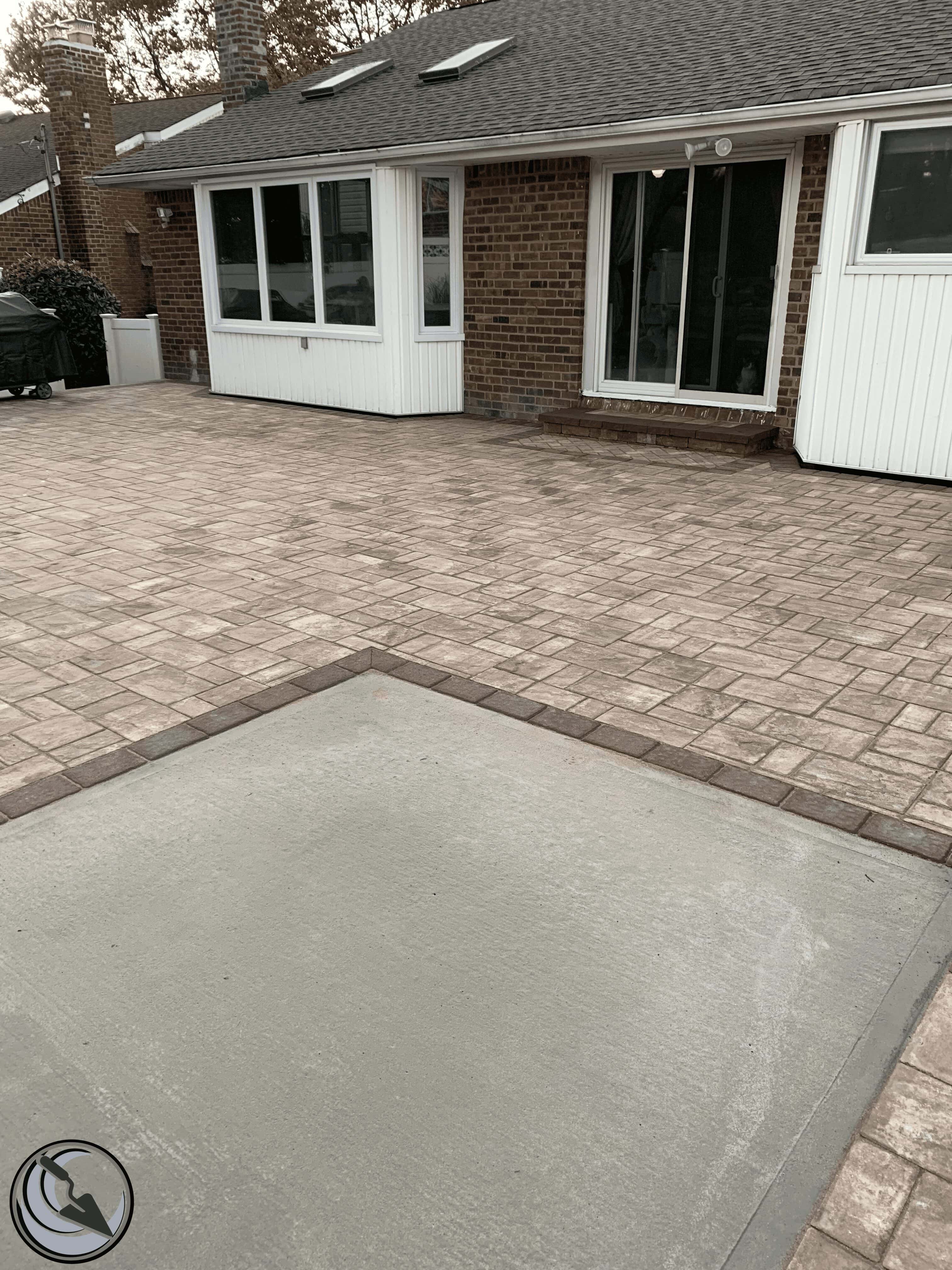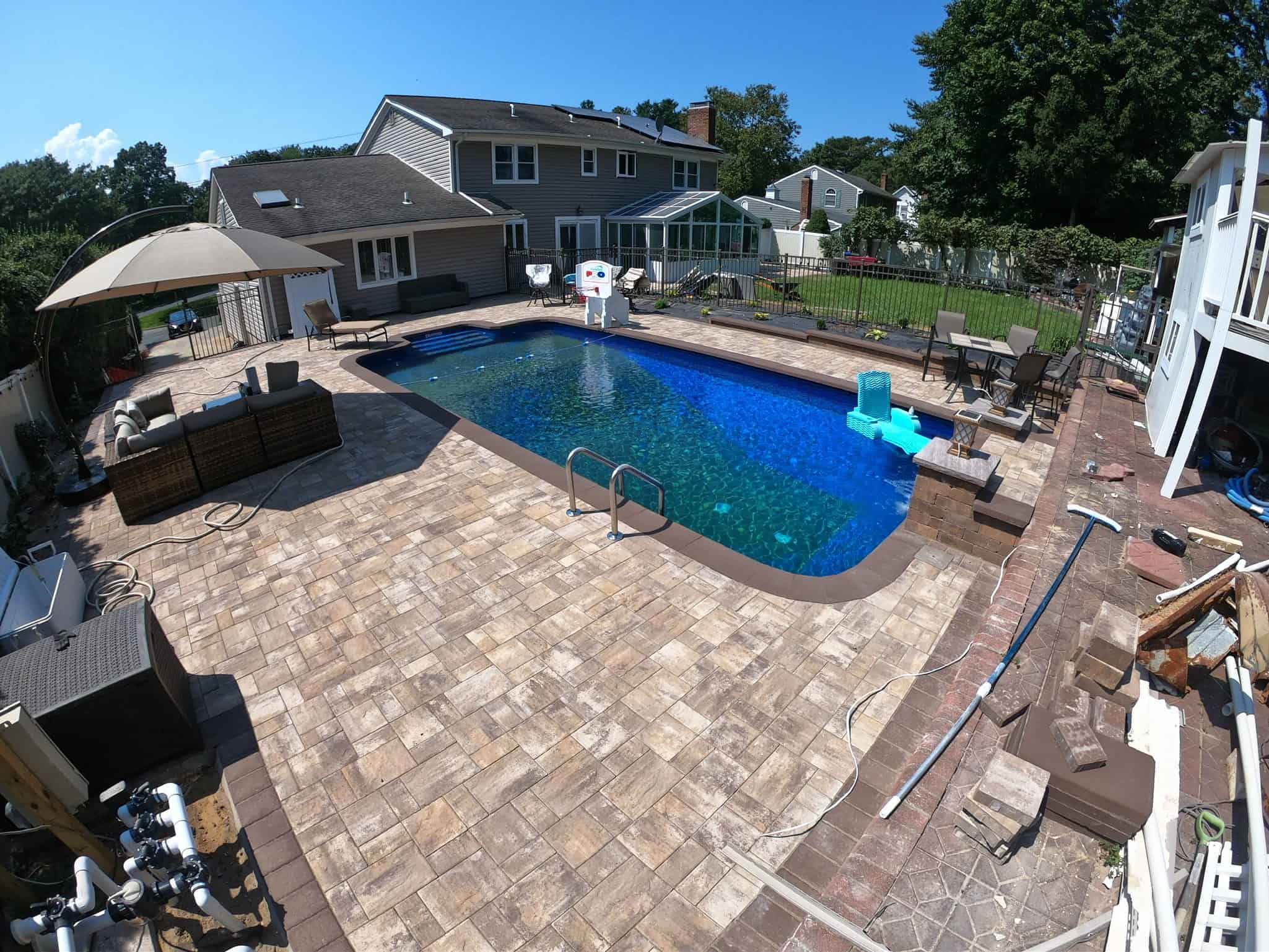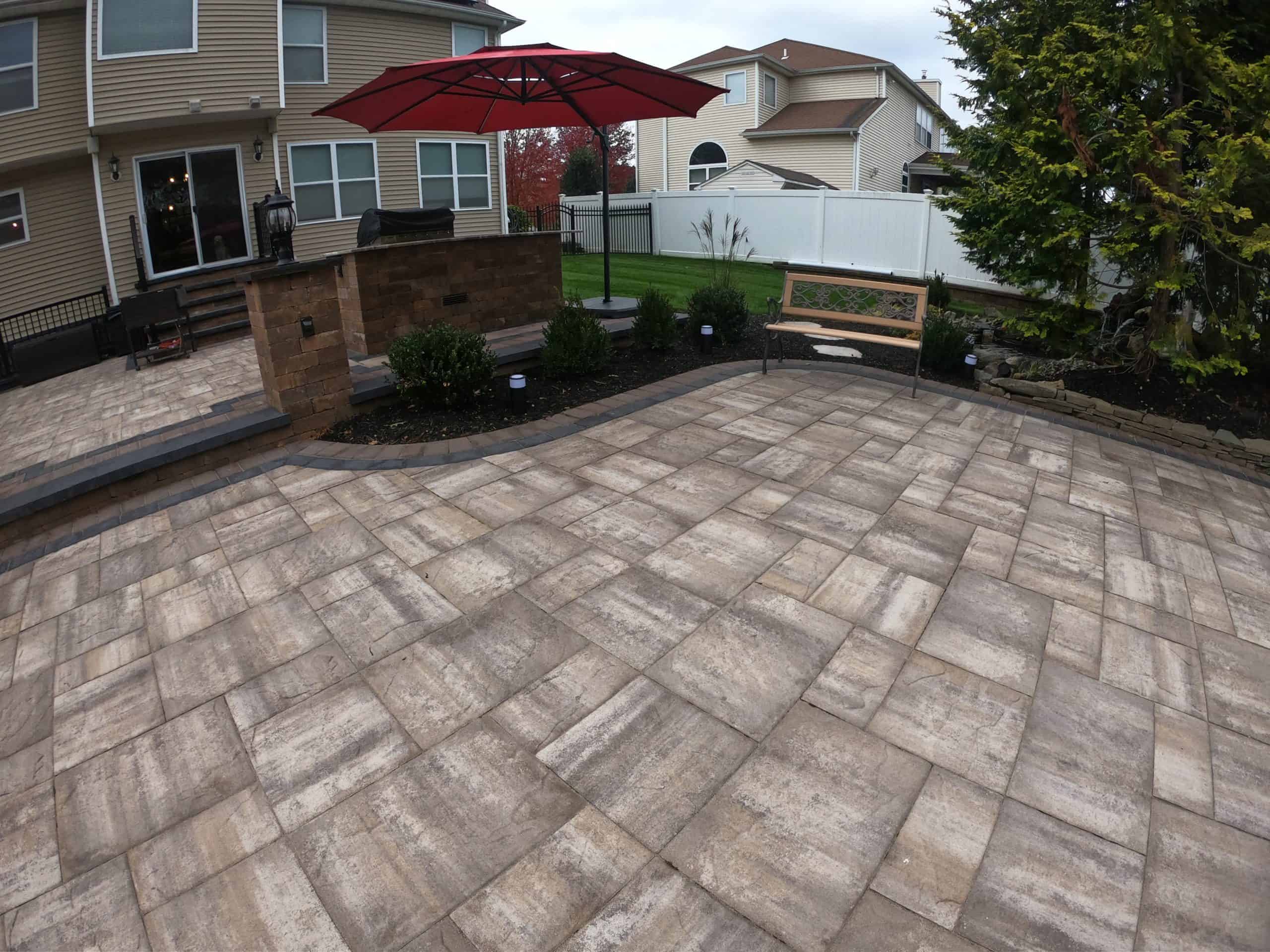
What separates a patio that lasts 25 years from one that needs replacing in five? It starts long before the first paver goes down.
Share:
Summary:
Most homeowners don’t think about masonry until something goes wrong — a driveway that’s cracking after three winters, a patio that shifted and now holds puddles, a retaining wall that’s starting to lean. By that point, the damage is done and the original contractor is long gone.
If you’re in the early stages of planning a project — or trying to figure out why a previous one failed — this is for you. We’ll walk through what residential masonry services actually involve, how a proper installation is built, and what to look for when you’re vetting contractors in Suffolk County. No fluff, just the stuff that actually matters.
Masonry covers more than most people realize. Yes, it includes patios, driveways, and walkways — but it also extends to retaining walls, outdoor kitchens, fire features, water features, poolscapes, and stonework of all kinds. A full-service masonry contractor handles the structural and functional elements of your outdoor space, not just the cosmetic ones.
The distinction matters because a retaining wall isn’t decorative. It’s holding back soil, managing water flow, and protecting your property from erosion. If it fails, you’re not just replacing a wall — you’re dealing with a landscaping and drainage problem that costs significantly more to fix. Masonry done right is infrastructure. Masonry done wrong is an expensive lesson.
Here’s where most homeowners get surprised: the work you see — the pavers, the stone, the finished surface — is only the last step. What happens underneath is what determines whether the project holds up.
A properly built paver patio or driveway starts with excavation. In Suffolk County, that means going down 8 to 10 inches, not the 4 to 6 inches that cheaper contractors often use to save time and labor. The reason depth matters so much here comes down to soil. Long Island’s ground is predominantly sandy and glacially deposited, which means it shifts and settles more than denser soils found elsewhere. Shallow excavation on sandy soil is a recipe for a surface that moves, tilts, and cracks within a few seasons.
After excavation comes base preparation — layers of compacted gravel that create a stable, load-bearing foundation. Then drainage planning. This step is especially important in low-lying areas of Suffolk County, particularly along the South Shore in towns like Bay Shore, Patchogue, and Lindenhurst, where the water table sits close to the surface. Without proper drainage built into the design, water has nowhere to go. It pools, it infiltrates, and in winter it freezes.
That last part is worth understanding. Water expands by roughly 9% when it freezes. Any gap, crack, or poorly sealed joint in a masonry surface becomes a wedge during a freeze-thaw cycle. Every winter, that wedge gets driven a little deeper. By spring, what started as a hairline crack is a structural problem. This is why material selection matters as much as installation technique — and why the same paver that performs well in a milder climate may not be the right choice for a Suffolk County winter.
Edge restraints are the final piece most homeowners never think to ask about. They’re the borders that keep individual pavers from migrating outward over time. Without them, even a well-built surface gradually spreads at the edges, creating gaps and unevenness. It’s a small detail with a big long-term impact.
This is the question that matters most, and it’s one most homeowners don’t know how to answer. Suffolk County has a serious unlicensed contractor problem. The county maintains what’s been called a “Wall of Shame” registry — and it lists over 700 unlicensed home improvement contractors operating in the area. Some are repeat offenders. That’s a documented, public record.
Licensing in New York is handled at the local level, not the state level. A contractor licensed in Suffolk County is not automatically licensed in Nassau County, Southampton, or East Hampton. Each jurisdiction issues its own license, and each one is verifiable. When you’re talking to a contractor, ask for their license number and look it up. If they can’t give you one — or give you a number that doesn’t check out — that’s your answer.
Manufacturer certifications are a separate but equally important signal. Buying and installing Cambridge pavers or Techo-Bloc products doesn’t make someone a certified installer. Certification requires completing the manufacturer’s training program and meeting their installation standards. It also typically unlocks extended product warranties for the homeowner — something an uncertified installer can’t offer you, regardless of how good their photos look.
Beyond credentials, pay attention to how we communicate with you. Do you get the owner on the phone, or a salesperson? Who shows up to the estimate? Who will actually be on your job site? The most common complaint in home improvement isn’t bad craftsmanship — it’s that the person who sold the job is never seen again once work begins. A contractor who can tell you exactly who will be there every day, from start to finish, is telling you something important about how they operate.
References matter too, but be specific about what you ask for. You want references from projects similar to yours, completed recently, in your area of Suffolk County. A contractor whose best references are from five years ago and two counties away isn’t giving you the picture you need.
Homeowners often use “concrete” and “masonry” interchangeably, but they’re not the same thing — and the distinction affects which option is right for your project and your property.
Poured concrete is a single continuous surface. Pavers are individual units set in a prepared base. Both can be used for driveways, patios, and walkways, but they behave very differently over time, especially in Suffolk County. When concrete cracks — and eventually it will — you’re typically looking at a section replacement or a full resurface. When a paver shifts or settles, it can often be lifted, the base corrected, and the paver reset. That repairability is a meaningful advantage in a climate with real winters.
The short answer is that pavers tend to perform better in Suffolk County’s specific conditions — but the longer answer depends on what you’re building, where it’s located, and what your priorities are.
Concrete is a solid choice for certain applications, particularly where a seamless surface is preferred or where the project scope calls for it. A concrete masonry company that handles both materials well can assess your site and give you an honest recommendation rather than defaulting to whatever they sell most. That flexibility matters.
For patios, driveways, and walkways in most of Suffolk County, pavers have a clear advantage when it comes to freeze-thaw resilience. Because each paver is an independent unit, thermal expansion and contraction doesn’t create the same stress fractures that crack a continuous concrete slab. The key is that the installation has to be done correctly — the right excavation depth, the right base, the right drainage. A paver surface installed over a shallow, poorly compacted base will still fail. The material isn’t magic; the method is what makes it work.
Along the North Shore — in communities like Stony Brook, Port Jefferson, and Sound Beach — and on the South Shore from Amityville through Mastic Beach, salt air is an additional factor. Materials need to be rated for coastal exposure, and drainage systems need to account for the moisture levels that come with proximity to the water. These aren’t considerations that come up in generic masonry guides written for inland markets. They’re specific to where you live in Suffolk County.
Paver installations that are properly built and maintained can go 10 to 15 years before they need any significant attention. That kind of longevity doesn’t happen by accident — it’s the result of getting the foundation right before the first paver ever goes down.
Most homeowners go into contractor conversations without a clear framework for evaluating what they’re being told. A few direct questions can change that quickly.
Start with licensing. Ask for the contractor’s Suffolk County home improvement license number and verify it. If your project is in Southampton or East Hampton, ask specifically whether they’re licensed in those townships — because those jurisdictions require their own separate licenses. This is not a technicality. It’s the difference between a contractor who knows the local code requirements and one who doesn’t.
Ask about excavation depth. A contractor who plans to excavate 8 to 10 inches and can explain why will give you a very different answer than one who’s never been asked the question before. You’re not trying to catch anyone — you’re trying to understand whether the person you’re hiring has thought through the same details you now have.
Ask whether they’re a certified installer for the materials they’re recommending. If they’re proposing Cambridge pavers, Techo-Bloc, Unilock, or Nicolock products, ask to see their certification. Manufacturer certifications aren’t just a credential for the contractor — they can directly affect the warranty coverage you receive as the homeowner.
Ask who will be on your job site. Not just on day one, but throughout the project. Contractors who rotate crews or rely heavily on subcontractors introduce quality inconsistency that’s hard to catch until the job is done. Consistent crews mean consistent accountability.
Finally, ask for local references — specifically from projects in Suffolk County, completed in the past year or two, at a similar scope to yours. Neighbors talk. A contractor whose work holds up in your area, through the same winters and on the same soil, is the most relevant proof of quality you can get.
Getting multiple estimates is smart. But understanding what separates a $10,000 quote from a $25,000 quote for the same project — excavation depth, base preparation, drainage design, material certification — is what turns price comparison into an informed decision.
The difference between a masonry project that lasts and one that doesn’t usually comes down to what happened before the first stone was set. Excavation depth, base preparation, drainage planning, material selection — these aren’t extras. They’re the job. A contractor who skips or shortcuts any of them is handing you a problem with a delayed fuse.
Suffolk County’s soil, climate, and coastal conditions are specific enough that generic masonry advice doesn’t always apply here. We know that, plan for it, and can explain what we’re doing and why at every step.
If you’re ready to talk through a project — a patio, a driveway, a retaining wall, an outdoor kitchen, or something more involved — Stone Escapes Masonry & Outdoor Design Inc offers free onsite estimates scheduled directly with the owner. No automated systems, no handoffs. Just a straightforward conversation about what you’re trying to build and how to do it right.
Article details:
Share:
Continue learning: