Every winter, freeze-thaw cycles chip away at Long Island masonry. Here's what's actually happening — and what to do before it gets worse.
Share:
Summary:
If you noticed new cracks in your driveway, patio, or retaining wall after this past winter, you’re not imagining things — and you’re not alone. Freeze-thaw cycles are the single most common cause of masonry deterioration across Suffolk County, and most homeowners don’t realize the damage is happening until it’s already progressed. The good news is that understanding what’s driving it makes it a lot easier to deal with. Whether you’re looking at surface cracks, heaved pavers, or something that looks more serious, this page will help you figure out what you’re dealing with and what actually needs to happen next.
Water expands about 9% when it freezes. That might not sound like much, but when that water is trapped inside a pore, a mortar joint, or a hairline crack in your masonry, that expansion creates enough internal pressure to fracture stone, chip brick, and push pavers out of alignment. Thaw, refreeze, repeat — and each cycle widens the gap a little more.
What makes Long Island’s climate particularly hard on masonry isn’t extreme cold — it’s the oscillation. Unlike upstate New York, where temperatures often stay well below freezing for weeks at a time, Suffolk County’s maritime climate produces frequent swings above and below 32°F throughout the season. We see 25 to 35 of these crossing events in a single winter across the region. That’s 25 to 35 rounds of expansion and contraction stress on every porous surface on your property.
Add in the sandy glacial soil that much of Suffolk County sits on — which allows moisture to move quickly and wick upward into masonry bases — and you have conditions that are genuinely harder on hardscape than most homeowners realize. This is why proper drainage and base preparation matter so much more here than in regions with more stable winter temperatures.
Not all cracks are the same, and the pattern matters more than the size. A hairline crack in poured concrete is often just normal shrinkage — annoying, but not a structural emergency. A horizontal crack in a retaining wall or foundation wall is a different story entirely. That pattern typically indicates lateral soil pressure pushing inward, which is a structural concern that tends to worsen quickly if left alone.
Vertical crack in brick is common after freeze-thaw cycles and often appears at mortar joints where water infiltrated and expanded. These are worth monitoring and repairing, but they’re generally less urgent than horizontal cracks. Stair-step cracks — the kind that follow the mortar joints diagonally across a brick wall — usually point to differential settlement, where one section of the foundation or footing has shifted relative to another. In Suffolk County’s sandy soil, this isn’t uncommon, especially in older homes where footings weren’t set deep enough to account for frost depth.
Diagonal crack from door frame or window corner is another one that gets misread. These almost always indicate settlement or movement in the structure around the opening — not just surface deterioration. They’re worth having assessed sooner rather than later, because the underlying cause tends to continue progressing.
The honest answer is that crack assessment isn’t a DIY job when anything structural is involved. The pattern, location, width, and whether the crack is active or dormant all factor into what the right response is. Getting an in-person evaluation from someone who actually knows what they’re looking at — not a salesperson running through a checklist — makes a real difference in whether you end up with a targeted repair or an unnecessary full replacement.
A large portion of the housing stock across Suffolk County was built between the late 1950s and the early 1990s. That means brick chimneys, concrete block retaining walls, poured concrete steps, and older paver installations in towns like Ronkonkoma, Bay Shore, Smithtown, and Patchogue are now anywhere from 35 to 65 years old — and carrying decades of accumulated freeze-thaw stress.
Older masonry wasn’t always installed with the base depth or drainage planning that’s standard today. Many retaining walls from that era were built without proper footings, and many concrete steps were poured without adequate reinforcement or drainage slope. Over time, freeze-thaw cycles exploit every weakness — and what started as a minor crack 10 years ago may now be a structural issue.
This is where wall cracks can go from something you keep an eye on to something that needs attention before next winter. The signs that push a crack from “monitor it” to “address it now” include visible displacement (one side of the crack sitting higher or deeper than the other), cracks that have grown noticeably over a single season, any horizontal cracking in a wall that’s holding back soil, and any crack that’s allowing water to get through. In older homes especially, mortar joints are often the first failure point — the mortar deteriorates faster than the brick or stone around it, and once it goes, water infiltration accelerates everything else.
Brick repointing contractors can stop that cycle. We specialize in what’s also called tuckpointing — replacing failed mortar joints with fresh material. It’s not cosmetic work. Proper repointing cuts off the water infiltration pathway and can add years of structural life to a masonry wall that’s otherwise in solid condition.
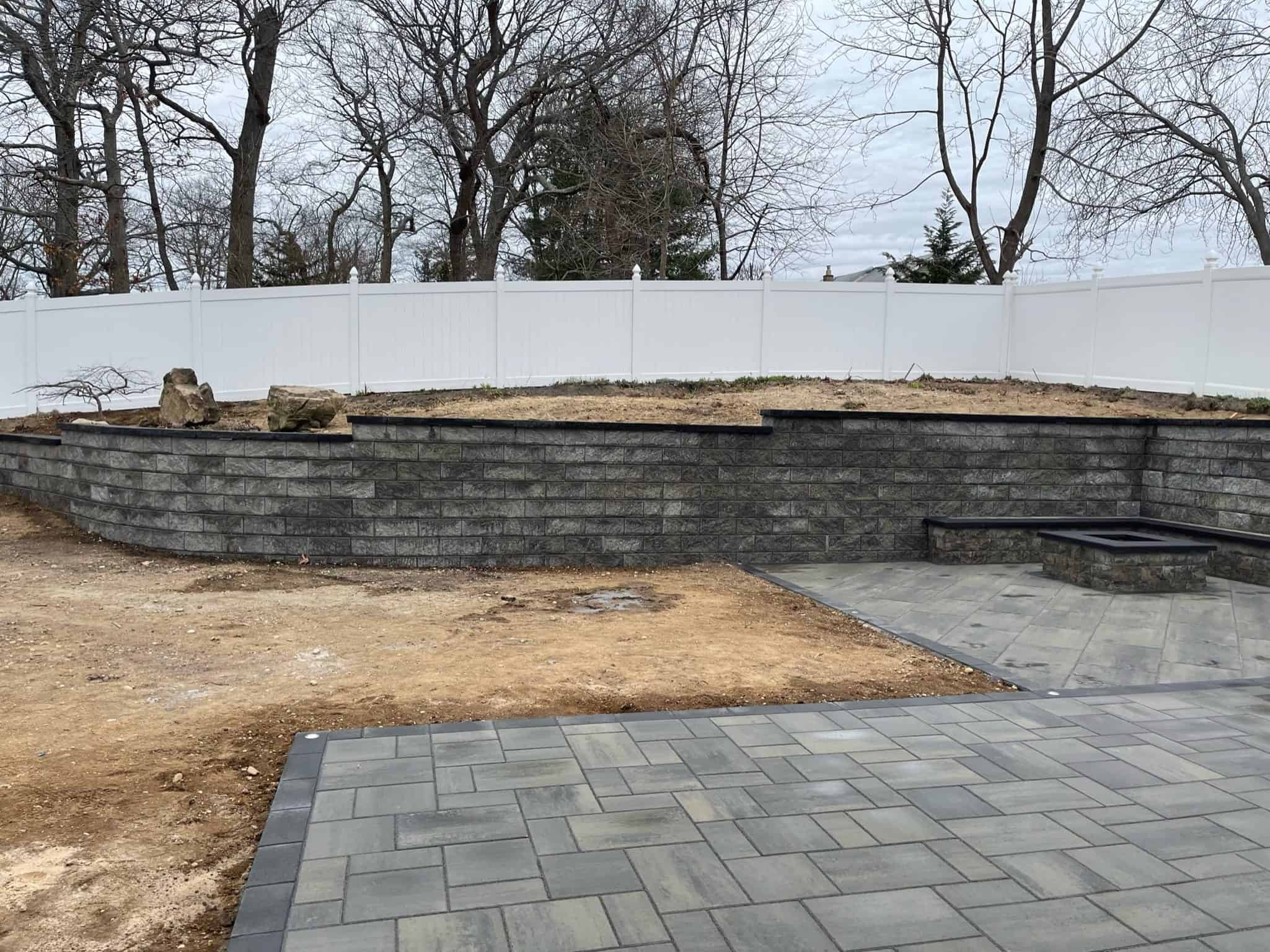
Retaining walls take more abuse from freeze-thaw cycles than almost any other masonry structure on a property. They’re holding back soil — which means they’re already under constant lateral pressure — and they’re exposed to moisture from both sides. When water gets into the wall system and freezes, the expansion pushes outward. Do that enough times and you get bowing, cracking, and eventually failure.
In Suffolk County, the sandy soil conditions compound the problem. Water moves quickly through sandy substrate, which means retaining walls here are exposed to more frequent moisture infiltration than walls built in clay-heavy soils. Proper drainage — weep holes, drainage aggregate behind the wall, and a correctly graded surface above — is essential, not optional.

The material you choose for a retaining wall matters a lot in a freeze-thaw climate, and the cost differences between options are real. Concrete retaining wall systems are the most common choice for residential applications across Suffolk County — they’re durable, relatively cost-effective, and when properly installed with a compacted aggregate base and adequate drainage, they hold up well through Long Island winters. Block wall systems from manufacturers like Unilock and Techo-Bloc are engineered specifically for freeze-thaw resistance and carry their own performance ratings.
Natural stone retaining wall cost is a premium option — both in material and installation. They’re extremely durable when properly installed, and in areas like Southampton and East Hampton where curb appeal and property value carry significant weight, the investment often makes sense. The key with natural stone is proper base preparation and drainage, because even the most beautiful stone wall will fail if water is allowed to pool behind it and freeze.
Timber retaining wall cost might look attractive upfront, but we generally steer clients away from timber in coastal Suffolk County. Wood is inherently porous, absorbs moisture readily, and cycles of freezing and thawing accelerate rot and structural degradation significantly. A timber wall might look fine for five to eight years, but it rarely holds up through a full decade of Long Island winters without serious deterioration. For anything structural or long-term, concrete block or natural stone is the right call.
Regardless of material, the frost depth in Suffolk County is approximately 36 inches. Any structural retaining wall footing needs to extend below that depth — otherwise frost heave will work on the footing itself, and no amount of quality material above grade will prevent movement over time.
Foundation concerns are the ones that tend to keep homeowners up at night — and understandably so. But not every crack in a foundation wall is a crisis. Knowing the difference between what’s normal and what needs attention is genuinely useful.
Hairline cracks in poured concrete foundations are common and often the result of normal concrete shrinkage during curing. They’re worth sealing to prevent moisture entry, but they’re not typically structural. The signs of home foundation problems that do warrant immediate attention are more specific: horizontal cracks anywhere in a foundation or basement wall, cracks wider than about a quarter inch, any crack where one side has shifted relative to the other (called displacement), and cracks that are visibly wet or actively allowing water into the space.
On Long Island’s South Shore — in communities like Babylon, Islip, and Bay Shore — properties sit closer to the water table, and foundation moisture issues are more common than in inland areas. Salt air and coastal moisture also accelerate the deterioration of foundation masonry in ways that don’t affect properties further inland. If you’re in one of these areas and you’re seeing cracks that are growing or weeping moisture, getting an in-person assessment before winter is the right move.
Masonry restoration contractors who specialize in this work approach foundation cracks differently than general contractors. The assessment matters as much as the repair. Understanding whether a crack is active or dormant, what caused it, and whether the underlying condition has stabilized is what determines the right repair approach. A patch over an active structural problem is just a temporary cover — it won’t hold, and it won’t protect you.
Freeze-thaw damage is predictable, it’s cumulative, and it’s largely preventable when masonry is installed correctly and maintained over time. The challenge on Long Island is finding a contractor who actually understands the local conditions — the sandy soil, the coastal moisture exposure, the frost depth requirements, the specific licensing that’s required in Suffolk County, Nassau County, Southampton, and East Hampton — and who installs to a standard that holds up through real winters, not just looks good on day one.
That’s the work we do at Stone Escapes Masonry & Outdoor Design Inc. Iain Traynor is on every estimate and every job site — not a salesperson, not a project manager. Every installation starts with excavation to 8 to 10 inches, proper base layering, drainage planning, and edge restraint installation, because those are the steps that actually determine whether your masonry lasts. We hold manufacturer certifications from Cambridge, Techo-Bloc, Unilock, Nicolock, Eldorado, and Boral, and we’ve built a 5.0 Google rating across 129 reviews by doing the work the right way, consistently.
If you’re seeing cracks, heaved pavers, a leaning retaining wall, or anything else that showed up after this past winter, reach out to us for an honest, in-person assessment. No call centers, no automated systems — just a direct conversation with someone who knows Long Island masonry and will tell you exactly what you’re looking at.
—
FREQUENTLY ASKED QUESTIONS
**Is a licensed masonry contractor required for work in Suffolk County, NY?**
Yes — and licensing requirements on Long Island are more fragmented than most homeowners realize. Suffolk County, Nassau County, Southampton Township, and East Hampton Township each have their own licensing requirements. A contractor who holds a Suffolk County license isn’t automatically permitted to work in the Hamptons townships, and vice versa. Before hiring anyone for masonry work, it’s worth asking specifically which jurisdictions they’re licensed in. We hold licenses in all four, which means we’re legally permitted to work anywhere on Long Island — including areas where many contractors simply aren’t covered.
**What should I do if I have a crack in my foundation leaking water?**
Don’t wait on it. A foundation crack that’s actively allowing water in is telling you that the crack is open enough for moisture to pass through — and in Suffolk County, where the water table is relatively high in many South Shore and coastal communities, that moisture has somewhere to come from. Water infiltration through a foundation crack feeds freeze-thaw damage from the inside: it gets in, freezes, expands, and widens the crack further. Over a single winter, what starts as a minor seep can become a significant structural issue. The right step is an in-person assessment to determine whether the crack is active or stabilized, what caused it, and what the appropriate repair method is. Patching over an active crack without addressing the underlying cause is a short-term fix that rarely holds.
Article details:
Share:
Continue learning: