Most Hamptons homeowners don't realize their contractor needs more than a Suffolk County license. Here's what to check before you hire.
Share:
Summary:
Most homeowners in East Hampton ask the right question — “are you licensed and insured?” — but stop there. The problem is that in Suffolk County, that question alone doesn’t tell you nearly enough. Suffolk County has its own home improvement licensing requirements. The Town of East Hampton has its own. The Village of East Hampton has its own annual contractor registry on top of that. A contractor can hold a valid county license and still be operating without the proper credentials for work done inside East Hampton’s town or village limits. This guide explains how that layered system works, what it means for your project, and what to actually verify before any work begins.
Suffolk County requires home improvement contractors to pass a written exam, carry at least $500,000 in public liability insurance, and maintain workers’ compensation coverage before they can legally work in the county. That’s a real credential — not a rubber stamp. But it doesn’t automatically cover every jurisdiction within Suffolk County’s borders.
East Hampton, Southampton, and Shelter Island each require their own separate licenses beyond the county-level credential. This catches a lot of homeowners off guard, and honestly, it catches some contractors off guard too. If you’re hiring someone to install a paver patio, retaining wall, or outdoor kitchen on a property in East Hampton, the contractor needs to hold the right credentials at the county level and at the local level — not just one or the other.
The Town of East Hampton issues its own home improvement contractor license through the Town Clerk’s office, governed by Chapter 156 of the East Hampton Town Code. To work legally within town limits, a contractor must hold this license — and it must be available on-site during any active project. If an inspector shows up and the contractor can’t produce it, that’s a violation.
What makes this worth understanding as a homeowner is that the town license exists separately from the Suffolk County system. A contractor who works all over Long Island but doesn’t regularly take on Hamptons projects may have never applied for it. They might genuinely not know it’s required, or they might assume the Suffolk County credential covers them. It doesn’t.
There’s also a subcontractor layer to this. Under East Hampton Town Code, subcontractors working on a project within town limits are generally required to hold their own licenses as well. So even if the general contractor is properly licensed, the crew they bring in needs to be squared away too. This is one of the reasons consistent, vetted crews matter more in this market than in most others on Long Island.
When you’re vetting a contractor, ask specifically for their East Hampton Town license number and ask how long they’ve held it. A contractor who works this market regularly will have it and won’t hesitate to give you the number. One who doesn’t serve the East End regularly may not know what you’re talking about — and that tells you something important.
We hold East Hampton Town license #9808. We’ve worked in this market long enough to know the compliance requirements at every level, and we’re happy to walk through any of them with you before an estimate is even scheduled.
Beyond the Town license, the Village of East Hampton maintains a separate Annual Contractor Registry. If your property falls within village limits — which includes much of the historic core of East Hampton — your contractor needs to be registered there as well. This is a distinct requirement from both the county license and the town license.
The village registration process includes a specific insurance requirement that many contractors miss: the Village of East Hampton must be named as additionally insured on both the contractor’s liability policy and their workers’ compensation certificate. Not just listed — additionally insured. That’s a meaningful distinction from an insurance standpoint, and it’s one that contractors who don’t regularly work within the village often fail to meet.
Why does this matter to you as a property owner? Because if a contractor’s worker is injured on your property and the contractor doesn’t have proper workers’ compensation coverage, you can be held liable for lost wages and medical expenses. Your homeowner’s insurance may not defend you in that situation. In a market where properties regularly exceed $2 million in value, that’s a risk worth taking seriously.
The village registration also provides a layer of accountability that benefits homeowners. Registered contractors have been vetted by the village, and complaints can be filed through official channels if something goes wrong. Unregistered contractors operating in the village leave you with fewer options if the work is substandard or the contractor disappears.
Ask your contractor directly: are you registered with the Village of East Hampton? Do you have the Village named as additionally insured on your liability and workers’ comp certificates? If they don’t know what you’re asking about, that’s your answer.
Licensing tells you a contractor is allowed to work in East Hampton. It doesn’t tell you they understand what makes this market different from the rest of Long Island — and there are real differences that affect how outdoor construction should be approached.
East Hampton properties sit in a coastal environment shaped by sandy glacial soil, salt air off the Atlantic and Peconic Bay, elevated humidity, and freeze-thaw cycles that stress any improperly built structure every single winter. A contractor who installs driveways and patios inland and occasionally takes on Hamptons work may not account for any of that. The result looks fine in May. By March, you start to see the problems.
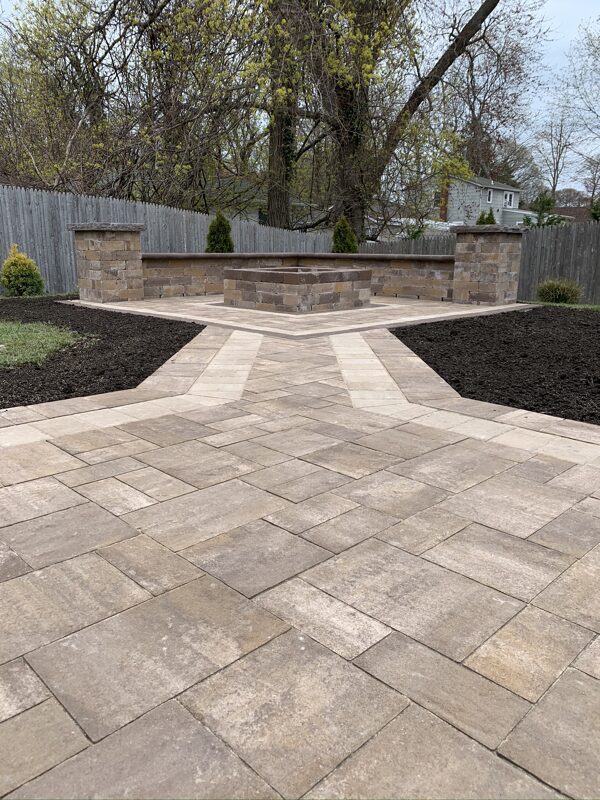
Long Island’s soil is predominantly sandy glacial outwash — loose, shifting, and unforgiving for hardscape installations that aren’t built with it in mind. Unlike dense, clay-heavy soils that provide natural resistance to movement, sandy soil requires a more robust base preparation to keep pavers stable over time. When that preparation is skipped or done too shallowly, the base shifts. The pavers shift with it.
Within a few seasons, you’re looking at an uneven surface, cracked joints, and water pooling in places it shouldn’t be. The freeze-thaw cycle compounds this problem. Water infiltrates gaps in improperly installed pavers, freezes, expands, and forces the pavers apart. It happens gradually — sometimes you don’t notice it until the second or third winter. By then, the base has already been compromised and a surface repair won’t fix it. You’re looking at a full reinstallation.
Salt air and coastal moisture add another layer. Materials that perform well in inland environments can degrade faster near the ocean or bay if they’re not rated for that exposure. This is one of the reasons manufacturer certifications matter — not just as a trust signal, but because certified installers are trained in the specific installation requirements for each product line, including which products are appropriate for coastal environments.
Our standard on every project is excavation to 8–10 inches, with proper base layering, drainage planning, and edge restraint installation throughout. That depth isn’t arbitrary — it’s what Long Island’s soil conditions and climate actually require to produce hardscape that holds up over time. It’s also more than what some contractors in this market are willing to do, because it takes longer and costs more upfront. But it’s the difference between a patio that looks the same in year ten as it did in year one, and one that starts showing problems by year three.
The Hamptons contractor market is tight. Quality contractors are often booked months in advance, especially heading into spring when homeowners are preparing properties for summer. That time pressure can push people to make decisions faster than they should, and some contractors count on it.
A few questions worth asking before you commit to anyone. First: can you provide your Suffolk County license number, your East Hampton Town license number, and confirmation that you’re registered with the Village if the work is within village limits? A contractor who works this market regularly will answer that without hesitation.
Second: what is your standard excavation depth, and how do you handle drainage on properties with sandy soil? If the answer is vague or they pivot to talking about materials instead of base preparation, that’s worth noting. Third, and this one matters more than most homeowners realize: who will actually be on my property, and will it be the same crew from start to finish? In the Hamptons, where many property owners aren’t on-site every day, a rotating cast of subcontractors is a real accountability problem. You want to know that the person who gave the estimate is the person overseeing the work, and that the crew who starts your project is the crew who finishes it.
We’re personally present on every estimate and every job site. The same crew works a project from beginning to end. There are no client portals or automated check-in systems — if you have a question during your project, you reach us directly. We hold certifications from Cambridge, Techo-Bloc, Unilock, Nicolock, Eldorado, and Boral, and we’re licensed in Suffolk County (#HI-62761), Nassau County (#167041), Southampton (#L005914), and East Hampton (#9808). Those aren’t claims — they’re verifiable numbers you can look up.
The licensing system in East Hampton is more layered than most homeowners expect, and the construction environment here is more demanding than most of Long Island. Neither of those things has to be a problem — as long as you know what to ask before anyone starts digging.
Verify the county license, the town license, and the village registration if it applies. Ask about base preparation and drainage, not just materials. Find out who will actually be on your property and whether that stays consistent throughout the project. These aren’t complicated questions, but they separate contractors who know this market from those who are figuring it out on your property.
If you’re planning a paver patio, driveway, retaining wall, or outdoor kitchen in East Hampton or anywhere on the South Fork, we’re ready to walk through the details with you — starting with a free onsite estimate, scheduled directly with the owner.
Article details:
Share:
Continue learning: