Planning a pool patio in Suffolk County, NY? Here's an honest breakdown of costs, materials, and what actually drives the price — before you request a single quote.
Share:
Summary:
Getting a pool built is exciting. Figuring out what to do with the ground around it — and what that’s going to cost — is where things get murky fast.
Most homeowners in Suffolk County, NY start searching “pool patio cost” after getting a quote that either shocked them or left them wondering if they were comparing apples to apples. The honest answer is: pool patio cost on Long Island varies a lot, and the range is wide for legitimate reasons. Material choice, project size, drainage requirements, and the quality of what’s underneath the surface all play a role.
We’ve walked hundreds of homeowners through this decision, and we’ve learned that the difference between a patio that lasts and one that fails usually comes down to what’s invisible — the base preparation, the drainage planning, and the contractor’s understanding of how Suffolk County’s soil and freeze-thaw cycles actually work.
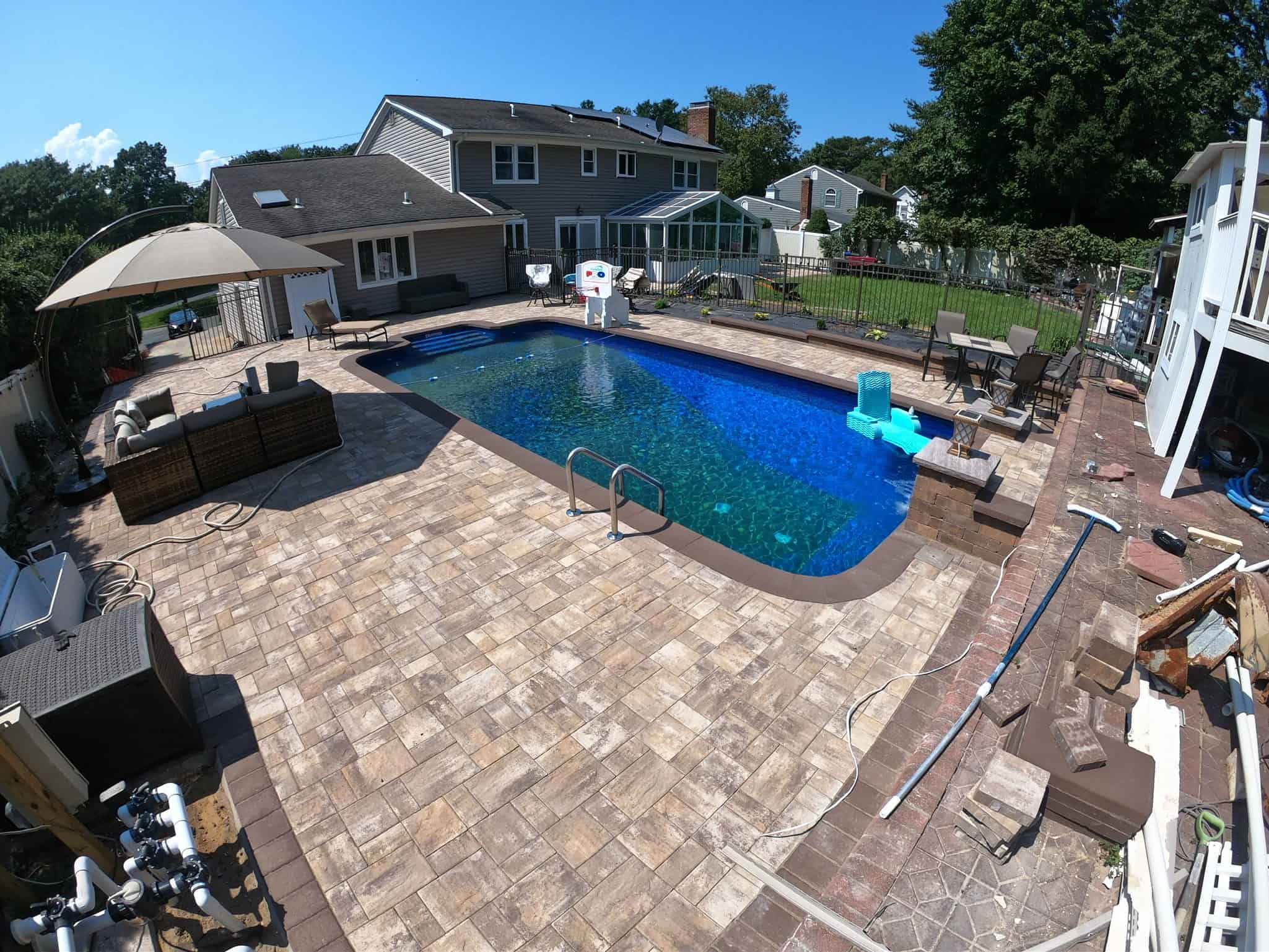
A pool surround in Suffolk County typically runs between $20 and $60 per square foot installed, depending on the material you choose and the scope of the project. For a standard 16×32 pool with roughly 600 square feet of surrounding deck, that puts most projects somewhere between $15,000 and $50,000 or more before coping is factored in.
That range isn’t vague — it reflects real differences in what’s going into the ground. When we install a proper base on Long Island’s sandy, glacially deposited soil, we’re doing meaningfully more work than a contractor who skips depth and drainage. The material on top is visible. The base preparation is not. But the base is what determines whether your patio looks the same in five years as it did the day it was finished.
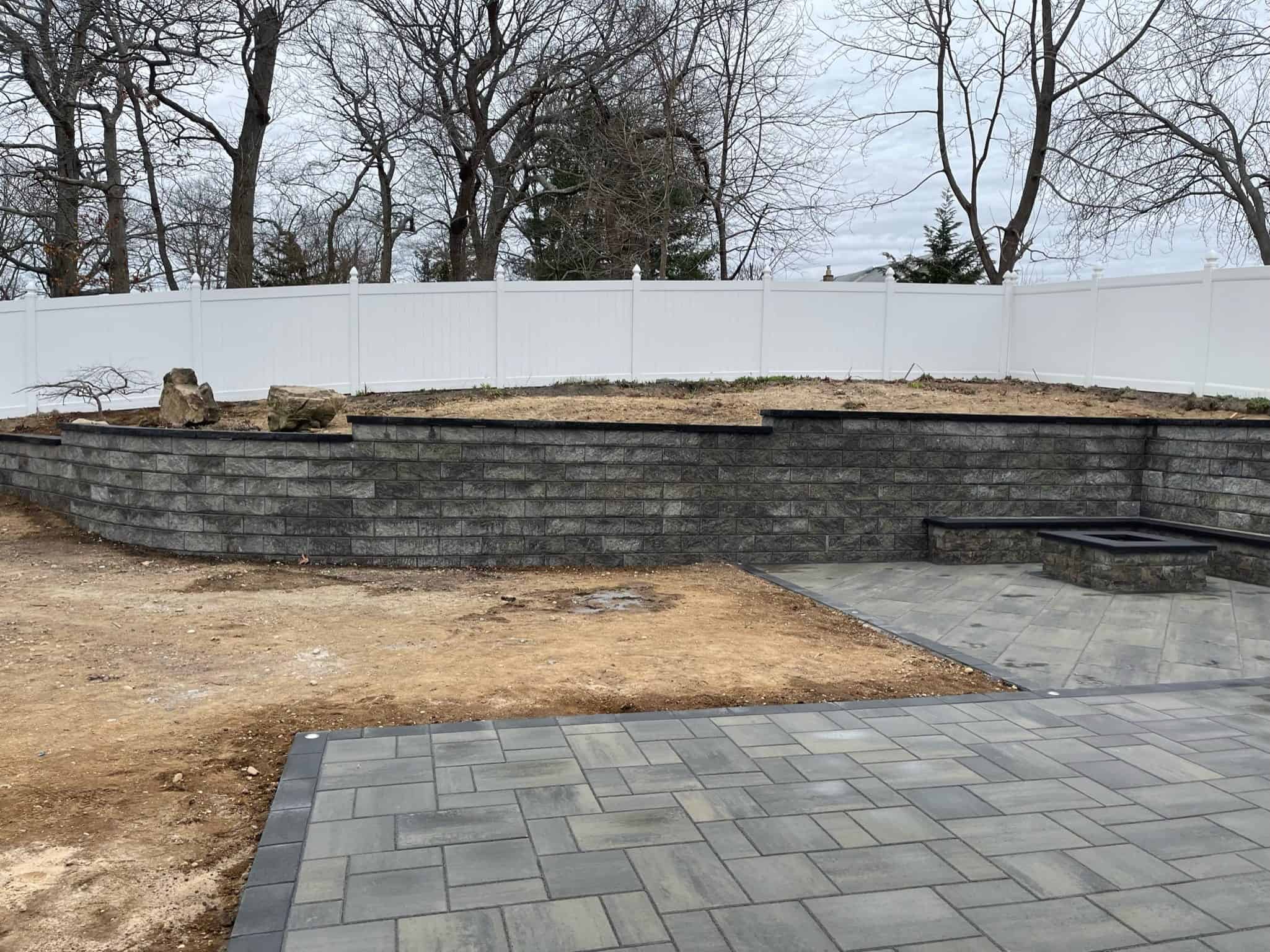
Concrete pavers are the most common choice for pool surrounds in Suffolk County, and for good reason. Installed, they typically run $20 to $35 per square foot in this market. They’re slip-resistant, freeze-thaw rated, and — unlike poured concrete — can be repaired in sections if one unit shifts or cracks without tearing out the entire surface. That last point matters more than most homeowners realize until their third Long Island winter.
Travertine runs $25 to $45 per square foot installed and has a natural, high-end look that photographs well and stays cool underfoot on hot summer days. It’s a popular choice in Southampton and East Hampton, where the aesthetic standard for outdoor spaces tends to be higher. The tradeoff is that travertine requires proper sealing and is more sensitive to salt air exposure if it’s not maintained.
Bluestone comes in at $30 to $50 per square foot installed and is a classic Long Island choice — durable, beautiful, and well-suited to Suffolk County’s climate when installed correctly. Porcelain is the newest material gaining traction in the area, typically in the $25 to $45 range installed, and offers excellent resistance to staining and moisture.
What all of these materials have in common is this: they’re only as good as the base beneath them. On Long Island, where the soil is sandy and the frost line sits 30 to 36 inches deep, proper excavation to 8 to 10 inches, compacted base layers, and drainage planning aren’t optional extras — they’re what separates a patio that lasts from one that starts heaving after the first hard winter. Labor accounts for roughly half of total project cost, which is partly why the cheapest quote is rarely the best deal.
If you’re choosing pavers from a manufacturer like Cambridge, Techo-Bloc, Unilock, or Nicolock, we can often pass the manufacturer’s warranty through to you as a certified installer. That’s not something every contractor in Suffolk County can offer.
This is the part most cost guides skip. The cheapest quote you receive for a pool patio in Suffolk County is usually cheap for a reason — and the reason is almost always in what’s not included.
A thin base. No drainage plan. No edge restraints to keep the pavers from spreading laterally over time. These are the components that fail first, and they’re the components you can’t see once the job is done. A contractor who skips proper excavation depth or compaction can finish a patio that looks identical to one done correctly — until the second or third winter puts pressure on it.
Long Island’s freeze-thaw cycle is not forgiving. From November through March, temperatures regularly cross above and below freezing, and every cycle puts stress on whatever is in the ground. A properly installed paver surface handles this well because individual units can flex slightly as the ground moves. A monolithic concrete slab cannot — it cracks, and those cracks spread. But even pavers installed on a shallow or poorly compacted base will shift and settle in ways that are expensive to fix after the fact.
The other thing the cheapest quote often reflects is a contractor who won’t be easy to reach once the project is done. Warranty follow-through, touch-up work, and accountability after completion are things that cost nothing to promise and everything to deliver. We’ve seen countless homeowners in Suffolk County who went with the lowest bid the first time and are now doing it again, correctly.
Pool coping is the cap that runs along the edge of the pool — the transition between the water and the surrounding deck. It’s both a structural element and an aesthetic one, and it’s often underestimated in cost planning.
Coping cost varies by material: concrete paver coping typically runs $15 to $40 per linear foot installed, brick coping runs $45 to $65 per linear foot, and natural stone options like bluestone, limestone, or granite come in at $60 to $80 per linear foot. For a standard 16×32 pool, that’s roughly 96 linear feet of coping — a line item that adds up quickly and deserves its own place in your budget conversation.

The right coping choice depends on three things: your material budget, the look you’re going for, and how the coping will interact with your pool’s structure and water chemistry.
Bullnose coping — where the edge curves down over the pool wall — is the most common style and works well with both concrete pavers and natural stone. It’s clean, safe for bare feet, and directs water away from the pool structure when installed with the right slope. Cantilevered coping, which overhangs the pool edge slightly, gives a more finished look and is popular in newer installations across Suffolk County. Drop-face coping is used where the pool deck sits higher than the waterline and needs a more substantial visual transition.
For saltwater pools, material selection becomes more important. Salt systems are gentler on swimmers but harder on certain materials — particularly metals and some natural stones that haven’t been properly sealed. Concrete pavers from certified manufacturers are generally a safe choice because they’re engineered to handle the exposure. If you’re installing travertine or bluestone around a saltwater pool, sealing becomes a non-negotiable maintenance step, not an optional one.
The coping also has to be coordinated with the pool contractor’s work — specifically, where the pool wall ends and the coping begins. This is one of the places where having a masonry contractor who has worked alongside pool companies before makes a real difference. When those two scopes of work aren’t coordinated, you end up with gaps, improper slopes, or coping that doesn’t sit flush — problems that are visible every time someone walks out to the pool.
The most common source of budget surprises in pool patio projects isn’t the material cost — it’s everything that comes up once the ground is opened. Unexpected drainage issues, existing concrete that needs to be broken up and removed, or a grade that requires more base material than anticipated can all add to the final number. Building in a 5 to 10 percent contingency on top of your quoted price is a reasonable approach for any project in Suffolk County.
A few things worth asking about before you sign a contract: What is the excavation depth included in this quote? What base materials are being used and how many layers? Is drainage planning included, or is that a separate line item? What edge restraint system is being used? These aren’t trick questions — a contractor who knows what they’re doing will answer them without hesitation.
It’s also worth understanding the ROI side of the equation. Paver patios consistently recover 70 to 80 percent of project cost at resale, and in a market where Suffolk County median home values exceed $550,000, a well-executed pool patio is one of the outdoor improvements that buyers notice and respond to. Sixty percent of homeowners who installed pavers in the last five years reported a 15 percent increase in their home’s value. That doesn’t mean the project pays for itself, but it does mean it’s not money that disappears when you sell.
One more thing that doesn’t show up in most cost guides: the value of having a single point of contact through the entire project. We offer a bundled Pool + Patio package in partnership with a pool company — meaning the pool and the surrounding patio are designed together, scheduled together, and installed with both crews coordinating from the start. For homeowners who’ve dealt with the headache of managing two separate contractors who’ve never spoken to each other, this is the part that tends to matter most.
If you’ve made it this far, you have a clearer picture of what pool patio cost actually means on Long Island — not just a number, but what’s behind it. Material choice, base preparation, drainage, coping, and contractor coordination all factor into whether a project holds up or needs to be redone in a few years.
The most important thing you can do before signing a contract is ask the right questions and make sure the answers are specific. Vague answers about “quality materials” and “experienced crews” are easy to give. Specific answers about excavation depth, base layering, drainage planning, and warranty coverage are harder to fake.
If you’re planning a pool patio in Suffolk County, NY and want a straight conversation about what your project would actually involve, we at Stone Escapes Masonry & Outdoor Design Inc offer free onsite estimates scheduled directly with the owner — no phone quotes, no generic pricing, and no surprises once the work begins.
Article details:
Share:
Continue learning: