Not sure if your driveway needs a repair or a full replacement? Here's how to tell the difference — and what to look for in a contractor before you commit.
Share:
Summary:
You noticed the crack last fall. Maybe you told yourself it wasn’t that bad. Then winter came, and now you’re looking at something that clearly got worse.
That’s a familiar story for a lot of homeowners across Suffolk County. Long Island’s winters don’t have to be brutal to do serious damage — the repeated freeze-and-thaw cycle does more harm than a hard freeze ever would. And once water gets into a crack, it works fast.
This page is here to help you understand what you’re actually dealing with, when repair makes sense versus when it doesn’t, and what separates a fix that lasts from one that fails before next spring.
Most asphalt driveways are built to last 15 to 25 years. A lot of driveways across Suffolk County don’t make it that long — and it’s not because asphalt is a bad material. It’s because of how they were installed, and the specific conditions they’re installed into.
Long Island’s soil is glacial in origin, which means it’s predominantly sandy. Sandy soil shifts. It doesn’t provide the same load-bearing support as clay-heavy soil, and when a driveway is built over a shallow, poorly compacted base, the ground underneath moves with every vehicle pass and every weather swing. The surface above it cracks, sinks, and develops low spots where water pools and sits.
That’s the foundation problem. But the climate compounds it.

People assume Long Island’s mild winters are easy on driveways. The opposite is true. Deep, sustained freezes — the kind you get upstate — are actually less destructive than temperatures that hover near 32°F and swing back and forth. That’s exactly what Suffolk County gets from roughly November through March.
Here’s the mechanics of it: water finds its way into small surface cracks. When temperatures drop, that water freezes and expands — water expands about 9% when it freezes. When it thaws, it contracts. Then it freezes again. This cycle can repeat dozens of times in a single winter, and each time it does, the crack gets a little wider and a little deeper. A hairline crack in October can be a half-inch gap by March. Left another season, that gap becomes a pothole.
The damage isn’t random. It follows the water. Wherever moisture can get in — a small crack, a low spot where water pools, an edge without proper restraint — that’s where the freeze-thaw cycle does its work. Communities along the South Shore like Bay Shore, Sayville, and Patchogue, or North Shore towns like Huntington and Northport, add salt air to the equation. Salt air accelerates the oxidation of asphalt’s binder, making the surface brittle and more prone to cracking even before the freeze-thaw cycle gets involved.
The takeaway: what looks like surface damage is often a symptom of something deeper. Filling the crack without addressing the water infiltration or the base condition underneath is why so many driveway repairs fail within a season or two.
This is the question that matters most when you’re deciding whether to repair or replace. And the honest answer is: it depends on what’s actually failing — the surface, or the base underneath it.
Surface-level damage looks like narrow cracks (less than a quarter-inch wide), minor edge crumbling, or fading and oxidation. If your driveway is under 15 to 20 years old, the base is solid, and less than about a quarter of the surface is affected, you’re likely a good candidate for targeted repair or resurfacing. The structure is still sound — you’re just addressing what’s happening on top.
Structural damage is different. If you’re seeing what’s called alligator cracking — that interconnected, scale-like pattern that looks like a dried lakebed — that’s the surface telling you the base underneath has failed. The asphalt is flexing because there’s nothing solid supporting it. You can fill those cracks, but they’ll come back, usually within a season, because you haven’t fixed the actual problem.
Other signs that point toward replacement rather than repair: potholes that keep returning after being patched, sections of driveway that have sunk or heaved, chronic water pooling in the same spots, or a driveway that’s 20-plus years old and showing widespread deterioration. The industry rule of thumb is that once more than 25% of your driveway surface is damaged, repeated repairs become more expensive over time than a full replacement with a proper base.
One more thing worth knowing: if a contractor recommends patching alligator cracking with cold-patch filler from a bag, that’s a red flag. Cold patch is a temporary material that typically lasts one to two seasons at best. It has its place as a stopgap, but it’s not a real repair. Proper pothole and full-depth repair requires saw-cutting the damaged section, removing it, addressing the base, and repaving with hot-mix asphalt. It takes more time and costs more upfront. It also actually holds.
Once you’ve figured out what your driveway needs, the next question is who you trust to do it. That’s where a lot of homeowners get burned — not because they made an obviously bad choice, but because they didn’t know what questions to ask.
The contractor market on Long Island has a wide range. There are experienced, licensed companies that do the job right. There are also traveling crews — sometimes called blacktop bandits — who show up with a low price and leftover materials, do surface-level work, and are unreachable when it fails six months later. The finished product can look similar on day one. The difference shows up by the following spring.
Knowing what separates them matters before you sign anything.
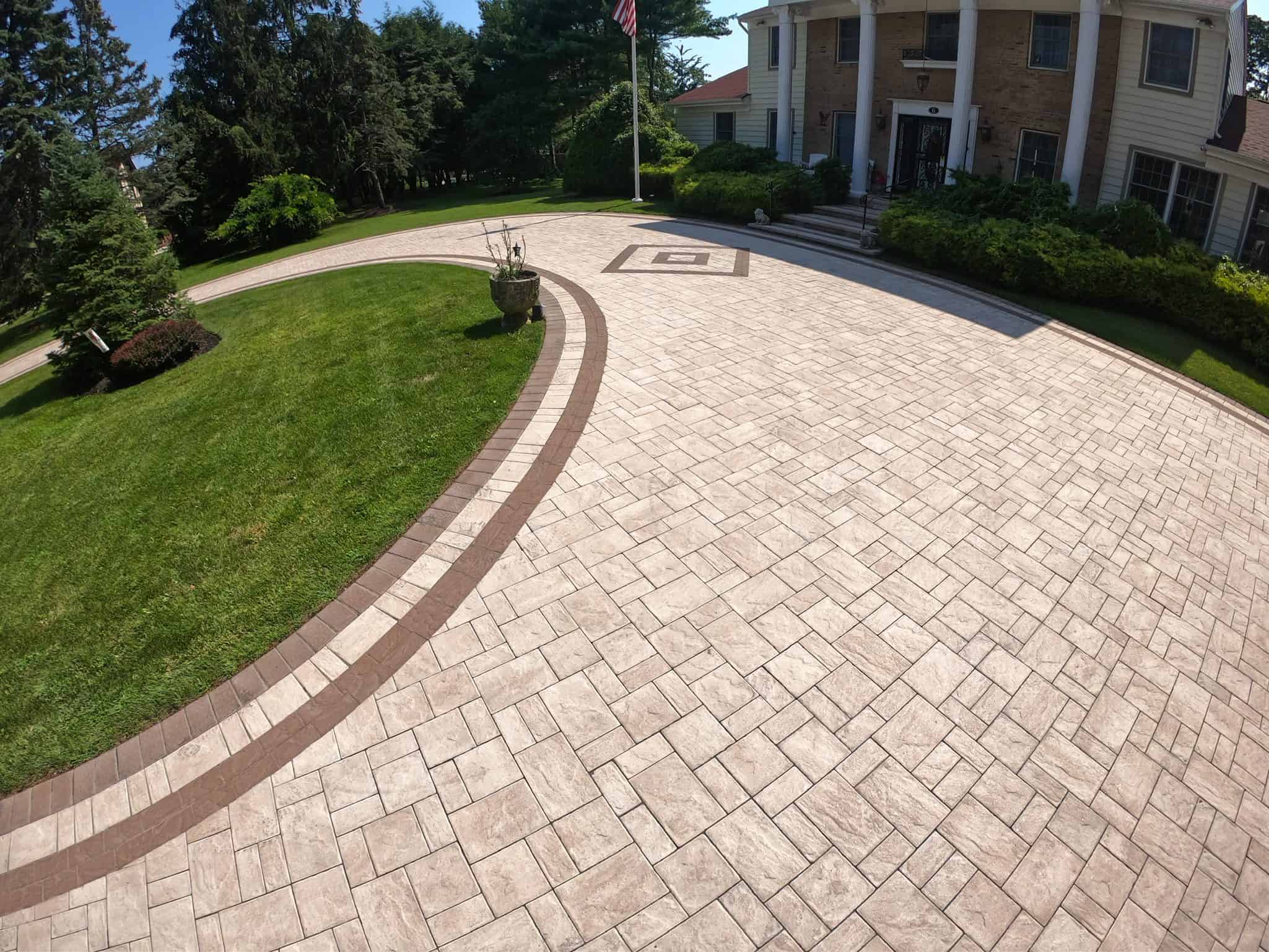
The single most telling question you can ask a contractor is: how deep are you going to excavate? For Long Island’s sandy soil conditions, the answer should be 8 to 10 inches. That’s not a premium upgrade — it’s the minimum that actually works here. A contractor who’s planning to skim 2 to 4 inches off the surface and repave over an unstable base is setting you up for the same failure you’re already dealing with, just with a fresh coat on top.
Ask about drainage too. Proper driveway installation includes grading the surface so water moves away from your foundation and doesn’t pool anywhere on the driveway itself. If a contractor doesn’t mention drainage as part of their process, that’s worth pressing on. Standing water is one of the fastest ways to accelerate base deterioration, especially in areas of Suffolk County with a higher water table — places like Medford, Holbrook, and Ronkonkoma where the ground doesn’t drain as freely.
Ask whether they’ll be using hot-mix asphalt or cold patch for repairs. Hot mix is the professional standard for anything beyond a temporary fix. It compacts properly, bonds to the surrounding material, and holds up through temperature swings. Cold patch doesn’t.
Licensing matters too, and not just generically. If you’re in Southampton or East Hampton, make sure the contractor is specifically licensed to work in those townships — the permitting requirements there are stricter than in most of Suffolk County, and not every contractor has navigated them. Working with someone who isn’t properly licensed in your municipality can create real headaches if you ever go to sell the property.
Finally, ask who will actually be on the job. Some contractors win bids and hand the work off to subcontractors. Consistent crews with direct oversight from someone who knows the project produce better results than rotating workers who are meeting your driveway for the first time.
We’ve been working on Long Island driveways long enough to know that the shortcuts that might hold up elsewhere simply don’t hold up here. The sandy soil, the freeze-thaw cycles, the coastal exposure — these aren’t abstract conditions. They’re the reason we excavate to 8 to 10 inches as standard practice, plan drainage into every project, and install edge restraints to keep the perimeter from spreading and crumbling over time.
Iain Traynor, who owns and runs Stone Escapes, came up through Local 1 of the Bricklayers Union and has a background in both masonry and carpentry. That training shapes how we approach every project — not just what goes on top, but what goes underneath and around it. He’s on every estimate and every job site. You’re not dealing with a salesperson who hands you off to a crew you’ve never met. The person who looks at your driveway and tells you what it needs is the same person overseeing the work.
We hold certifications from Cambridge, Techo-Bloc, Unilock, Nicolock, Eldorado, and Boral — manufacturers who vet the contractors they certify. We’re licensed in Suffolk County, Nassau County, Southampton, and East Hampton, which means we’ve done the work to operate properly across Long Island’s range of permitting environments. A large portion of our work comes from referrals, which is the kind of track record that’s hard to fake.
We’re not the right call for a quick patch job that just needs to look okay for a season. But if you want a repair or installation that’s built to actually last on Long Island — done by people who understand why other repairs here keep failing — that’s exactly what we do.
The short version: if the damage is limited, the base is solid, and the driveway is under 20 years old, targeted repair is often the right move. If you’re seeing widespread cracking, recurring potholes, or signs of base failure, replacement with proper excavation and drainage planning will cost you less over time than repeated patches that don’t hold.
What matters most is getting an honest read on which situation you’re actually in — from someone who understands Suffolk County’s conditions and isn’t trying to sell you more than you need.
If you’re in Suffolk County and want a straightforward answer about what your driveway actually needs, reach out to Stone Escapes Masonry & Outdoor Design Inc. Estimates are done in person, and you’ll talk directly with the people doing the work.
Article details:
Share:
Continue learning: