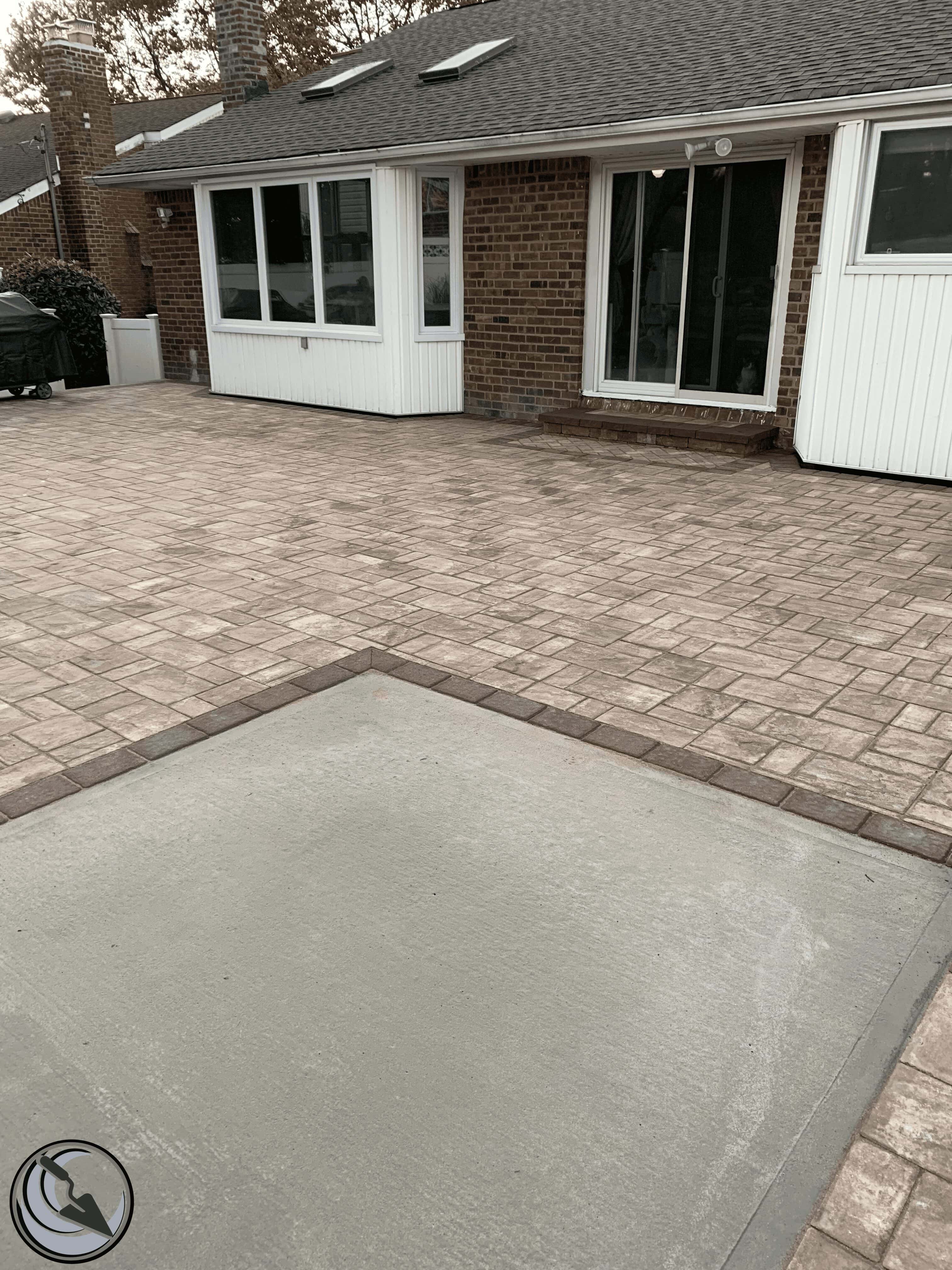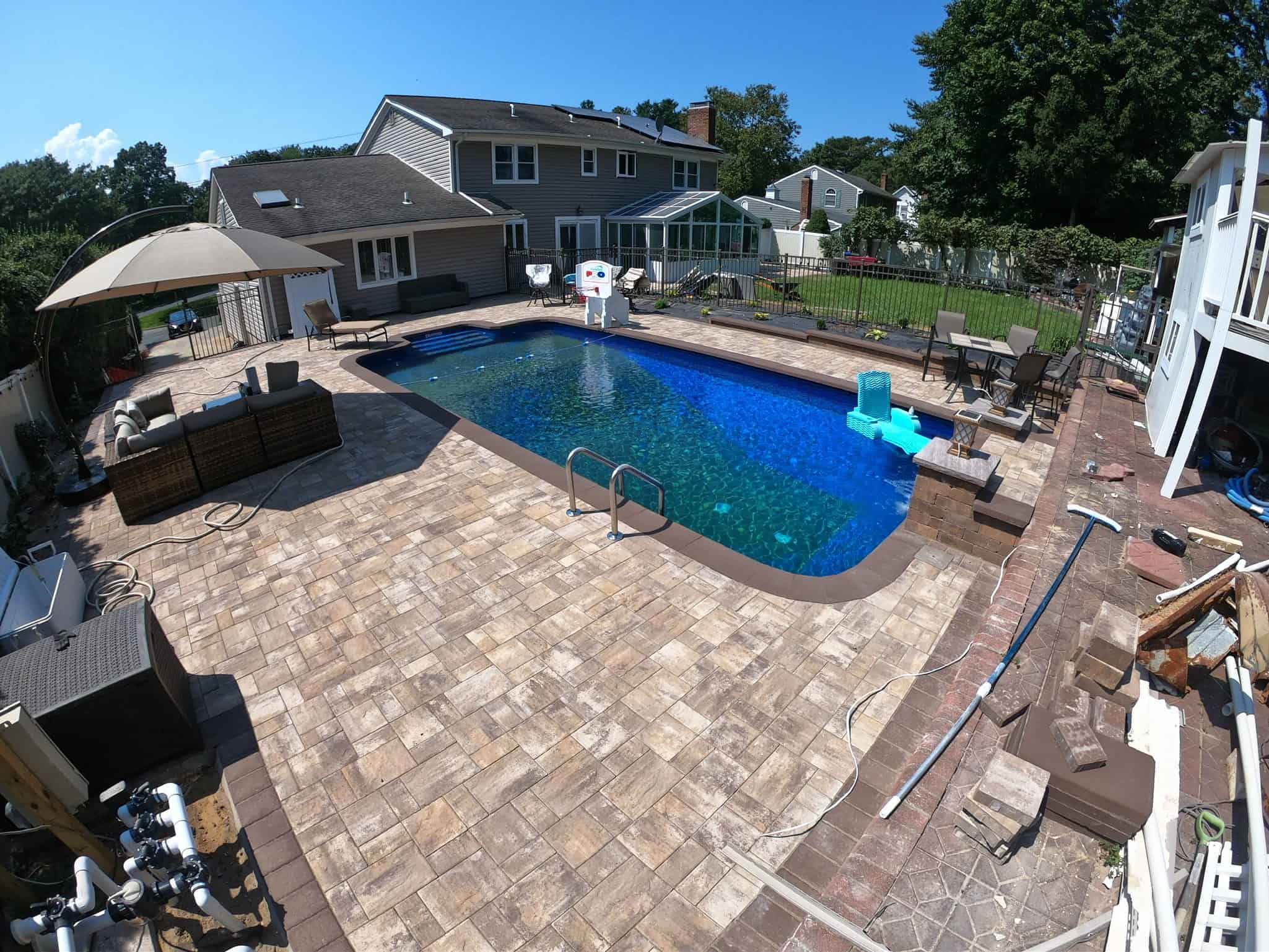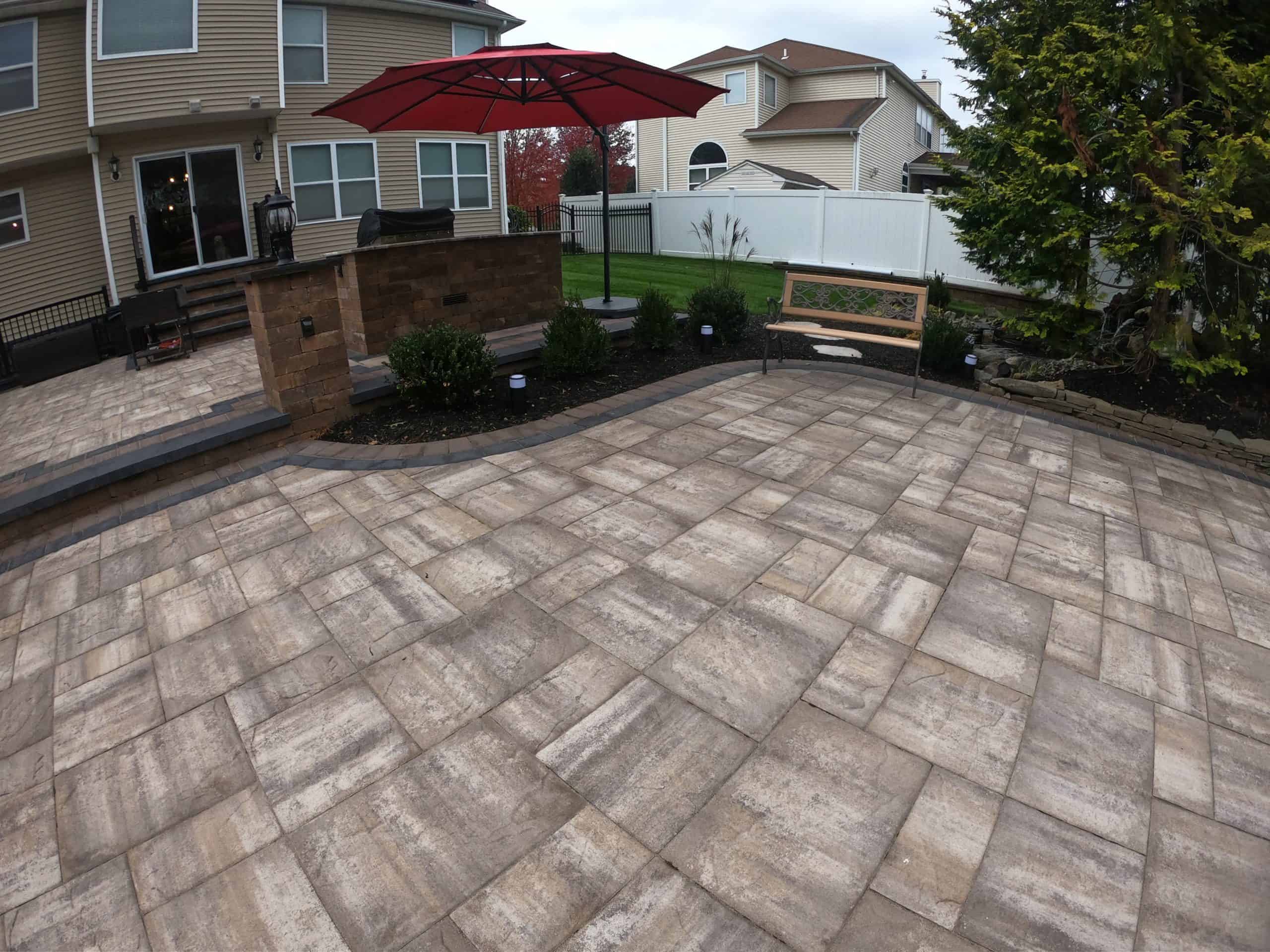
Not all paver materials perform the same, especially on Long Island. Here is what to know before you choose a contractor or a single stone.
Share:
Summary:
Most homeowners searching for “pavers near me” already know what they want it to look like. The Pinterest board is ready. The backyard vision is clear. What is less clear is which material will hold up over time, and which contractor will install it in a way that lasts longer than a few Long Island winters.
That gap between a beautiful patio and a durable one is where a lot of money gets lost. We have designed this guide to close it. By the end, you will know what to look for in a material, what questions to ask before anyone breaks ground, and why installation quality matters more than most buyers realize.
Long Island’s climate is harder on outdoor surfaces than most people account for when they are choosing materials. You are dealing with roughly 30 to 40 freeze-thaw cycles every year, coastal salt air if you are anywhere near the South Shore or the East End, and sandy glacial soil underneath it all that shifts more than the clay-heavy ground found in other parts of the Northeast.
That combination means the material that looks great in a showroom or on a neighbor’s patio in New Jersey might behave completely differently under your backyard in Holbrook, Huntington, or out in Southampton. The right choice depends less on aesthetics and more on how a material handles water infiltration, temperature swings, and the specific drainage conditions on your property.
Concrete pavers are the most widely used option in Suffolk County, and for good reason. They are manufactured to meet strict performance standards. For example, ASTM C936 requires a minimum compressive strength of 8,000 psi and resistance to at least 50 freeze-thaw cycles. This means a quality concrete paver is engineered specifically to handle the kind of seasonal stress Long Island dishes out. They are also available in a wide range of styles, colors, and textures, which is why manufacturers like Cambridge, Techo-Bloc, Unilock, and Nicolock have built such strong followings here.
Natural stone choices like bluestone, granite, and travertine carry a different kind of appeal. They look genuinely distinct, and certain stones like bluestone have a long history on Long Island properties. The tradeoff is variability. Natural stone is not uniform the way manufactured pavers are, which means installation requires more skill to get a level, stable surface. Some natural stones are also more porous than concrete pavers, which can work against you in a climate with repeated freeze-thaw cycles if the stone isn’t properly sealed and maintained.
Porcelain pavers have grown in popularity over the last several years, especially for pool decks and modern outdoor designs. They don’t require sealing, they are highly stain-resistant, and they hold color well over time. The catch is that they demand a more precise base preparation than concrete or natural stone. Porcelain has very little flex, so if the base settles unevenly at all, you will see it in the surface. On Long Island’s sandy soil, that means the base work underneath a porcelain installation has to be done exactly right, or you will be dealing with cracked tiles within a few seasons.
None of these options is universally better than the others. The right material depends on how you are using the space, what your property’s drainage situation looks like, and how much ongoing maintenance you are willing to do. A paver patio in a backyard entertaining area has different demands than a pool deck in a coastal community in Mastic Beach or a driveway in Stony Brook that needs to handle vehicle weight through every winter.
Here is something most buyers don’t find out until it is too late: the material sitting on top of your patio is almost never the reason it fails. The reason patios fail, experiencing shifting pavers, uneven surfaces, water pooling, or edges spreading apart, is almost always what is happening underneath.
Long Island’s soil is the product of glacial deposits. It is loose, sandy, and doesn’t compact the way denser soils do in other parts of the country. That means a paver installation here needs a deeper, more carefully constructed base than the same job might require elsewhere. We work to a standard of 8 to 10 inches of excavation, with a base built from state-approved RCA, which is Recycled Concrete Aggregate that is 95% concrete. That is different from the cheap fill some contractors use, which is mostly dirt and clay and goes by a similar name. The difference in long-term performance is significant.
Drainage planning is part of this too. Before a single paver goes down, the slope, runoff direction, and outlet points need to be accounted for. On a property with a high water table, which is common in parts of Suffolk County near the South Shore bays, skipping this step means the base gradually undermines itself every time it rains. Edge restraints are the other piece most buyers never think to ask about. Without them, pavers on sandy soil migrate laterally over time. It is slow, but it is inevitable if they are not there.
The reason this matters when you are comparing quotes is that none of this is visible once the job is done. A contractor who excavates four inches instead of eight, uses inferior fill, skips the drainage planning, and leaves out the edge restraints will hand you a finished product that looks identical to one done correctly for the first year or two. After that, the difference becomes obvious and expensive. When you are getting estimates, ask specifically about excavation depth, what aggregate they use, and how they are handling drainage. A contractor who knows what they are doing will answer those questions without hesitation.
The market for paving contractors on Long Island is crowded. Most of them have websites, most of them say they are licensed and insured, and most of them offer free estimates. Sorting through that to find someone who will genuinely do the job right takes a little more than a Google search.
Licensing in Suffolk County is more complicated than it sounds. The county has its own licensing requirements, but so do Nassau County, Southampton, and East Hampton. Those are separate jurisdictions, not covered by a single Suffolk County license. If your property is in the Hamptons or on the East End, you need a contractor who holds the specific township license for where you are, not just a general Long Island contractor.
The most useful questions are the ones that reveal how a contractor operates in practice, not just what they claim on their website. Ask how deep they excavate for a project like yours, and what aggregate they use for the base. Ask if the same crew will be on your job from start to finish, or if different phases get handed off to subcontractors. Ask if they hold manufacturer certifications, and if so, which ones, because that affects if the manufacturer’s warranty on your materials is strictly valid.
That last point catches a lot of buyers off guard. Most major paver manufacturers, such as Cambridge, Techo-Bloc, Unilock, and Nicolock, only honor their full material warranties when the product is installed by a certified contractor. Hiring someone without that certification doesn’t mean the materials won’t be installed, but it means if something goes wrong with the materials, you may be on your own. It is a detail most contractors don’t bring up voluntarily.
You should also ask about drainage planning and edge restraints specifically. Not just if they do drainage in a general sense, but how they are planning for it on your specific property. A contractor who has done a lot of work in Suffolk County will understand the soil conditions, the water table variability, and the freeze-thaw demands here in a way that someone without that local experience simply won’t. That familiarity shows up in the details of how a job is scoped, not just in how it is priced.
Finally, pay attention to who shows up to your estimate. If it is a salesperson who hands things off to a crew you’ve never met, that is a different experience than working with an owner-operator who is personally on every estimate and every job site. Both exist in this market. The difference in accountability and communication tends to be significant.
The short answer is yes, but the longer answer is more useful. A well-installed paver patio, driveway, or poolscape adds value in two ways: it increases the enjoyment of the property while you are living in it, and it can strengthen resale appeal when you are ready to move. The National Association of Realtors has consistently found upgraded hardscape among the outdoor improvements that buyers find most appealing and that Realtors agree can support asking prices.
On Long Island specifically, that dynamic is amplified by the outdoor living culture here. The spring-to-fall season is long enough that a well-designed backyard featuring a paver patio, fire pit area, outdoor kitchen, or pool surround gets real use, not just occasional weekend visits. Homeowners in communities like Huntington, Stony Brook, and out in Southampton invest in these spaces because they genuinely extend how much of the year you can enjoy your property.
The caveat is that the value only holds if the installation holds. A patio that starts settling, cracking, or pooling water within a few years doesn’t add value because it creates a liability and a repair cost. This is where the base preparation conversation comes back around. An installation done correctly on Long Island’s sandy soil, with proper excavation depth, quality aggregate, drainage planning, and edge restraints, should last decades without significant intervention. One done to a lower standard might look fine for a year or two before the problems become visible.
It is also worth knowing that 81% of homeowners who have installed pavers say they would highly recommend the product to others, praising not just the finished look, but the durability and low maintenance compared to poured concrete. Concrete slabs crack. When they do, the repair options are limited and the results rarely look seamless. Pavers, by contrast, can have individual units replaced if something does go wrong, which makes them a more forgiving long-term surface, especially in a climate that stresses outdoor materials the way Long Island’s environment does.
Choosing the right patio material comes down to understanding your property’s specific conditions like the soil, the drainage, and the climate demands, and then finding a contractor who will build the base correctly underneath whatever material you choose. On Long Island, those details matter more than they do in most markets.
The material you pick matters, but the contractor you hire matters more.
If you are in Suffolk County and ready to talk through your project, we at Stone Escapes Masonry & Outdoor Design Inc are happy to come out, look at your property, and give you a straight answer about what will work and what will not. Every estimate is done in person, by the owner, with no sales pressure and no surprises. Contact Stone Escapes Masonry & Outdoor Design Inc today to schedule your consultation and get your project started the right way.
Article details:
Share:
Continue learning: