Thinking about redesigning your backyard on Long Island? Here's a practical starting point — from planning to materials to what actually holds up in Suffolk County's climate.
Share:
Summary:
Most Suffolk County homeowners don’t start with a contractor. They start with a vague feeling — the backyard isn’t working, the patio is cracked, there’s a lot of wasted space — and a rough idea of what they’d like it to look like instead. That’s a perfectly normal place to begin.
What trips people up is everything that comes after. What should you design first? What materials hold up on Long Island? What’s actually possible on your property? We’ve written this guide to help you think through those questions clearly, before you start collecting quotes or scrolling through Instagram for inspiration.
The best starting point isn’t a mood board — it’s your property. Before anything else, think about how you actually use your backyard, or how you want to. Do you need a space for dining outside? Somewhere for the kids to play? A spot to sit around a fire at night? A pool surround that doesn’t look like an afterthought?
Getting specific about function before you get into materials or aesthetics saves a lot of time. It also helps when you eventually sit down with a contractor, because the conversation becomes about your actual life rather than abstract design preferences.
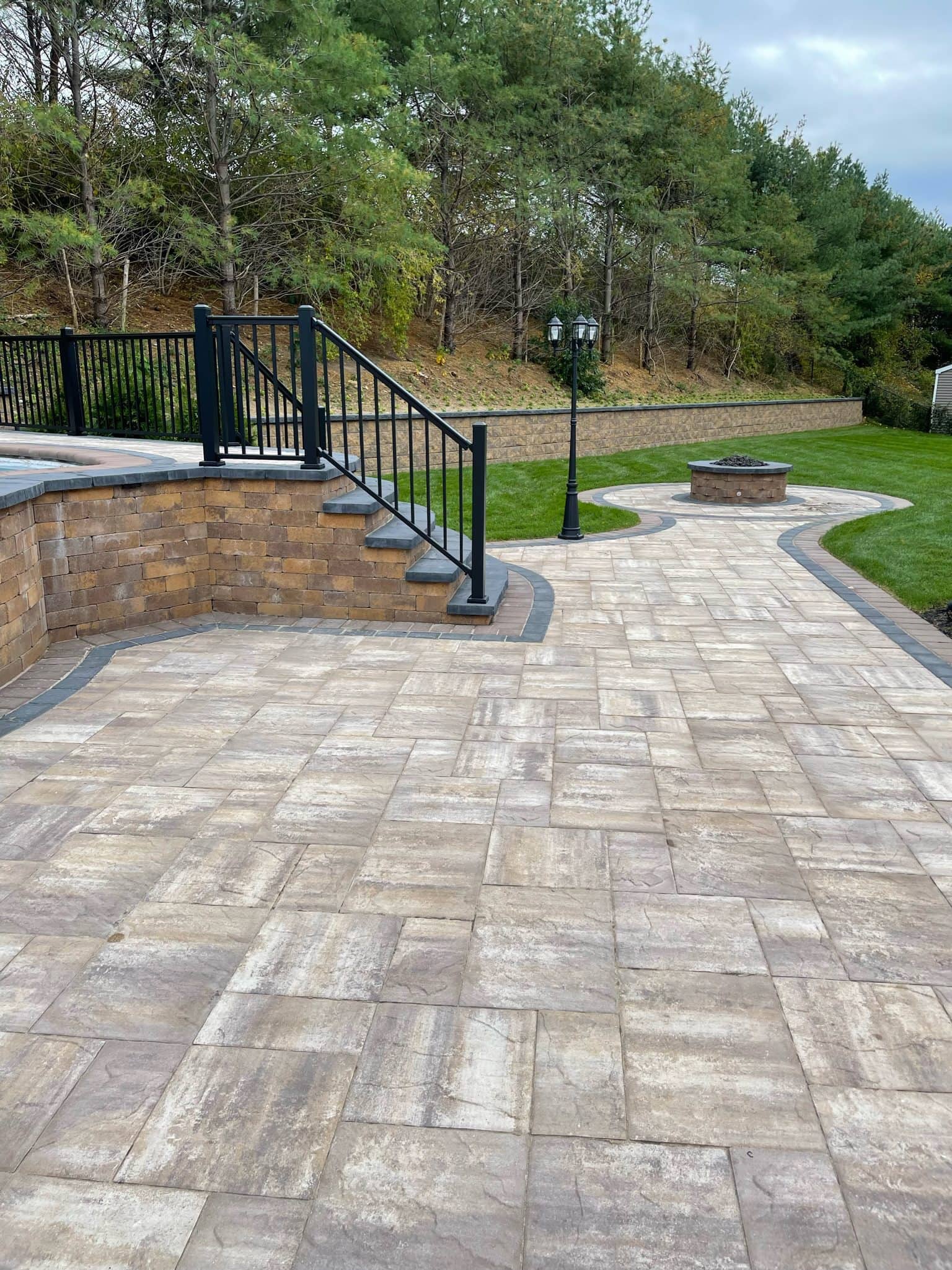
A general rule in the industry is that your patio should cover no more than 25 to 30 percent of your total backyard area. That keeps the space functional without swallowing your yard entirely.
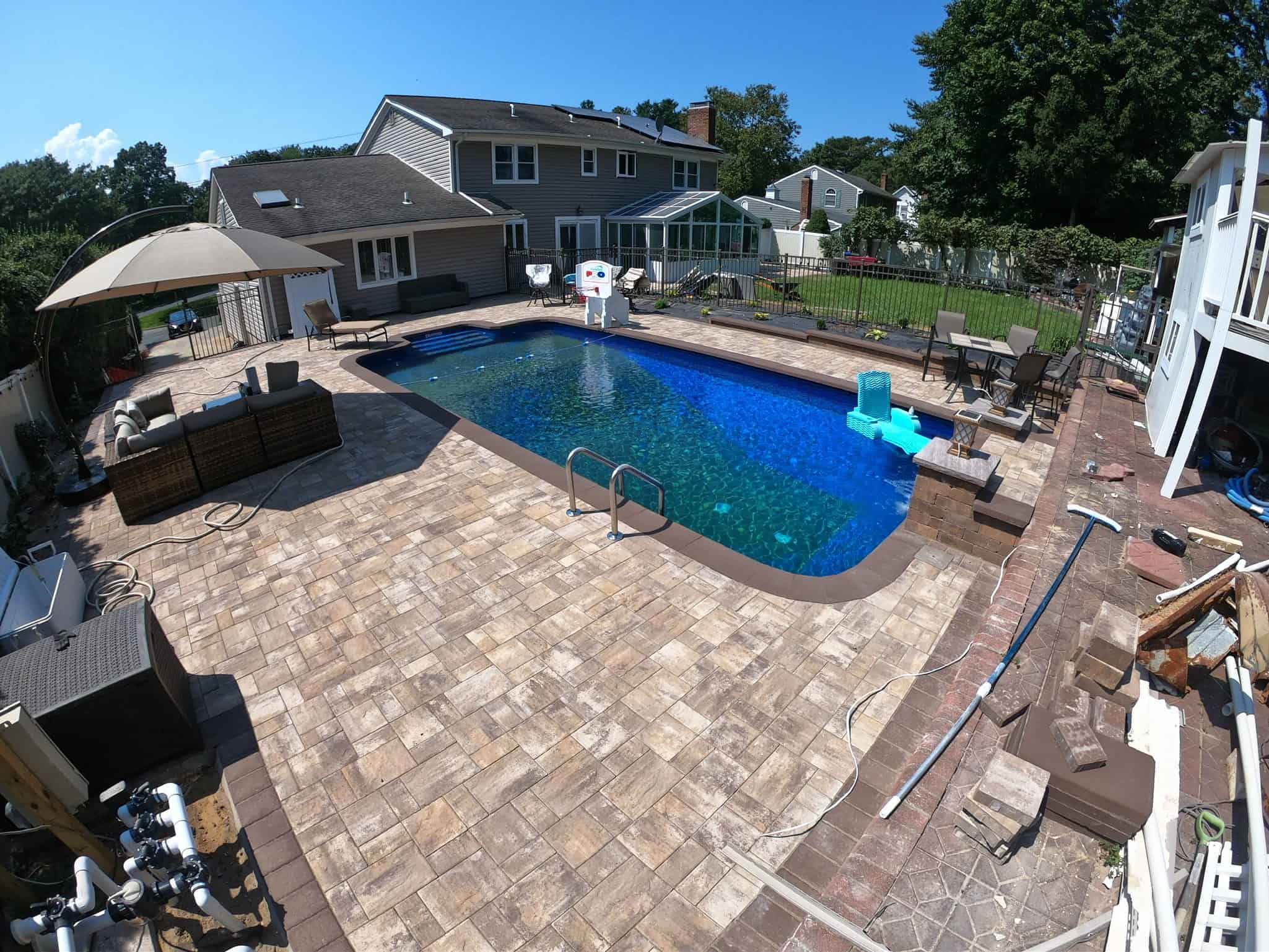
For a dining setup — a table, chairs, maybe a grill nearby — you’re looking at a minimum of 12 by 12 feet. If you want a lounging area with multiple seating pieces, plan for at least 16 by 16 feet. Anything larger than that, and you’re moving into full outdoor room territory, which is entirely achievable but requires more thought around layout, drainage, and how the space connects to the rest of the property.
On Long Island, there’s an additional consideration most people don’t think about until it’s too late: your patio’s footprint affects drainage. Suffolk County’s topography is relatively flat, and the soil is predominantly sandy — a legacy of the glacial deposits that formed Long Island. That combination means water doesn’t always have an obvious place to go. A patio that’s sized or graded incorrectly can redirect runoff toward your foundation, which creates problems well beyond a wet lawn.
This is why sizing a patio isn’t just an aesthetic decision. It’s a structural one. The square footage, the slope, and the drainage plan all need to work together from the start — not as an afterthought once the pavers are already down.
Long Island’s climate is harder on outdoor materials than most homeowners realize. From roughly October through April, Suffolk County goes through repeated freeze-thaw cycles — temperatures drop below freezing, water that’s worked its way into small cracks or beneath improperly set pavers expands as it freezes, and when it thaws, it leaves behind slightly larger openings. Repeat that process dozens of times over a winter, and you end up with cracked concrete, shifted pavers, and a patio that looks years older than it is.
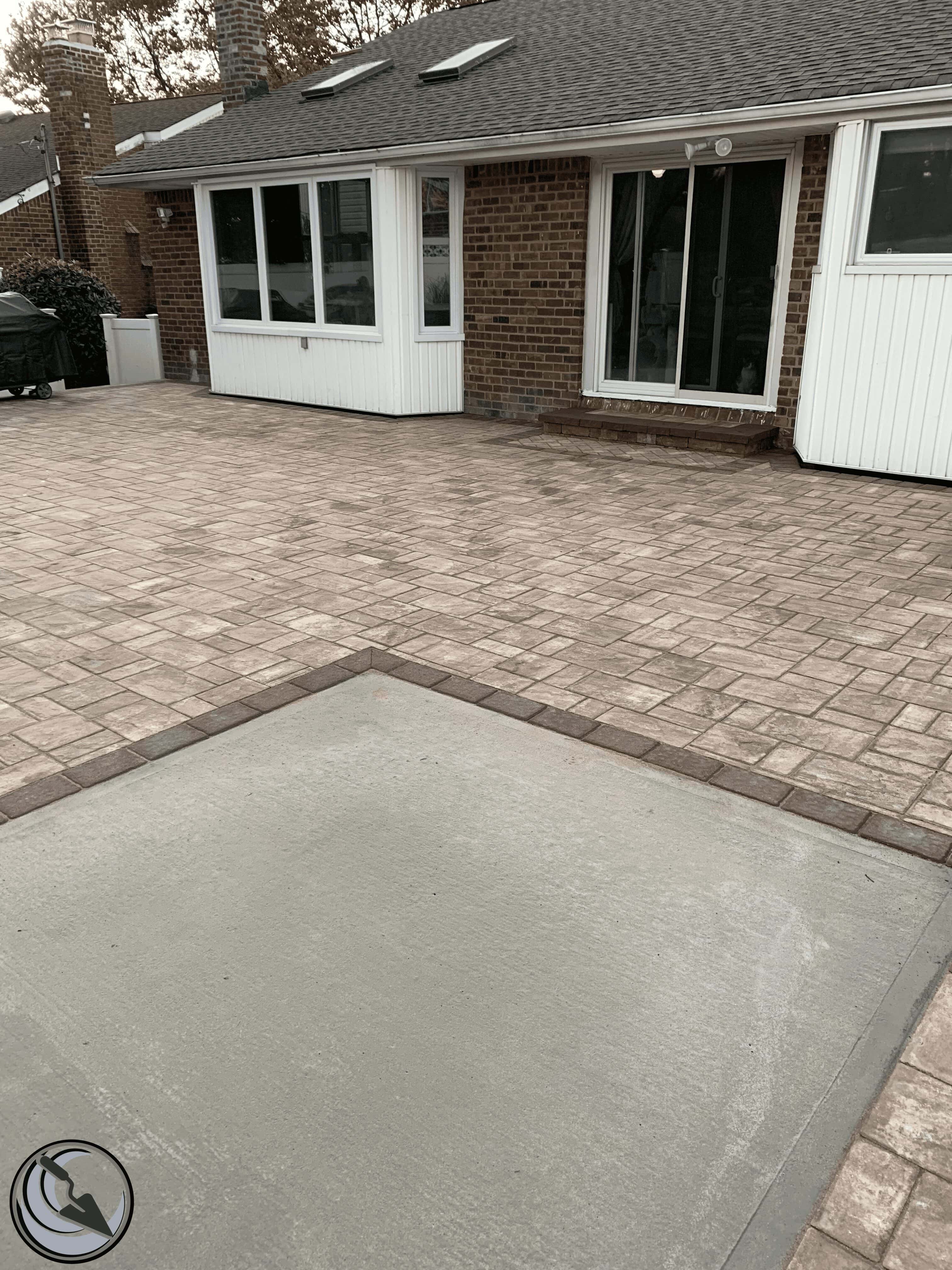
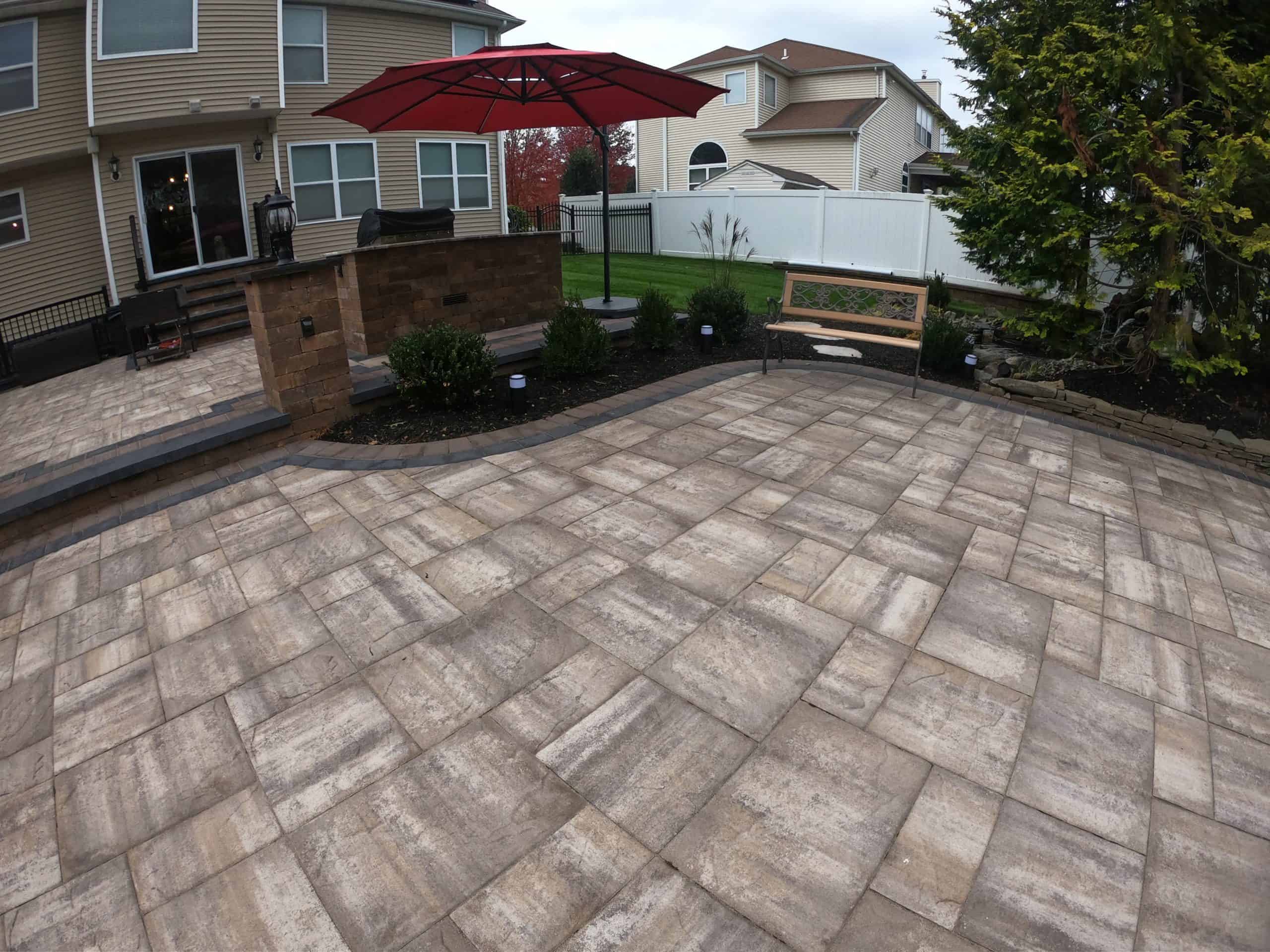
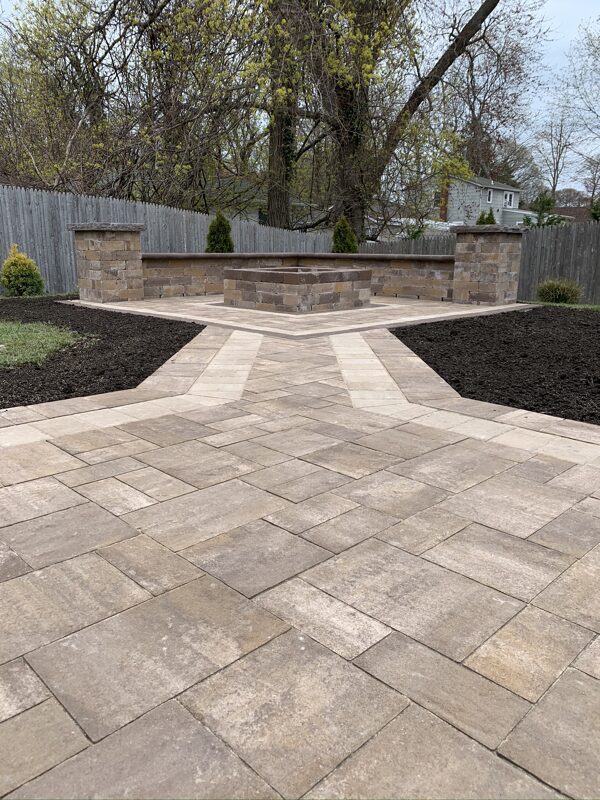
Paving stones — from manufacturers like Cambridge, Techo-Bloc, Unilock, and Nicolock — hold up better in this climate than poured concrete for a few reasons. They’re installed as individual units rather than one continuous slab, so minor movement in the base doesn’t crack the surface the way it would with concrete. And when a paver does need to be replaced, it can be swapped out individually rather than requiring a full section repair.
For properties closer to the water — South Shore beach communities, the Hamptons, waterfront neighborhoods throughout Brookhaven and Islip — salt air is another factor. Not all materials are rated for coastal conditions, and the ones that aren’t will show it within a few seasons. Specifying the right product for your specific location in Suffolk County matters more here than it does in most other markets.
The other variable is your base. This is where most patio failures actually originate — not the pavers themselves, but what’s underneath them. Proper installation in Suffolk County means excavating 8 to 10 inches deep, laying the right base materials in the right sequence, planning for drainage, and installing edge restraints to keep everything in place. A patio built on a shallow or poorly compacted base won’t last, regardless of how good the pavers look on the surface.
Once you have a rough sense of what you want, the contractor selection process is where things can go sideways fast. Quotes vary enormously on Long Island — sometimes by thousands of dollars for what appears to be the same project — and without understanding what drives those differences, it’s nearly impossible to evaluate them honestly.
The gap is almost never in the materials. It’s in the labor and the base preparation. A contractor who quotes significantly less than others is usually cutting somewhere in the excavation depth, the base layering, or the drainage planning. Those shortcuts aren’t visible once the pavers are down, but they show up within a season or two.
It depends on the scope of the project and where in Suffolk County you’re located. For a standard paver patio, permits are often not required — but structures like retaining walls above a certain height, outdoor kitchens with gas lines, or covered pergolas typically do require permits, and the rules vary by township.
What makes this more complicated on Long Island than in most markets is that some municipalities have their own licensing requirements on top of the county’s. Southampton and East Hampton, for example, require separate municipal licenses that are distinct from Suffolk County’s home improvement contractor license. A contractor who holds a Suffolk County license but not a Southampton or East Hampton license cannot legally work in those municipalities — and plenty of homeowners have discovered this the hard way, mid-project.
When you’re vetting contractors, ask specifically whether they’re licensed in your township, not just in the county. The answer tells you a lot about how seriously they take compliance, and it protects you if anything goes wrong. A reputable contractor will handle the permit process for you — preparing the application, submitting plans, and coordinating with the local building department — rather than leaving that to you to figure out.
We hold active licenses in Suffolk County (#HI-62761), Nassau County (#167041), Southampton (#L005914), and East Hampton (#9808). That coverage matters when a project crosses municipal lines or when a homeowner in the Hamptons needs work done without the headache of chasing down a contractor’s credentials.
Reviews are a starting point, but the number of reviews matters as much as the rating. A perfect five-star average from three people doesn’t tell you much. A strong average across dozens of detailed reviews — ones that mention the crew by name, describe specific moments from the project, call out whether cleanup happened daily — tells you a lot more about what working with that contractor is actually like.
Beyond reviews, ask whether the same crew will be on your project from start to finish, or if the company rotates subcontractors. A consistent crew builds familiarity with the project details, quality standards, and site conditions. Rotating crews don’t have that continuity, and the work tends to reflect it.
Ask whether the owner will be involved directly — not just at the estimate, but on-site during the project. In a lot of contracting businesses, the owner shows up to sell the job and then hands it off entirely. That’s when communication gaps and quality slippage tend to happen. The contractors who stay involved throughout tend to produce better results, because there’s direct accountability at every stage.
It’s also worth asking about manufacturer certifications. Cambridge, Techo-Bloc, Unilock, and Nicolock all run certified installer programs that require contractors to demonstrate product knowledge and installation quality. Being a certified installer isn’t just a credential on a website — it often means the manufacturer will back the installation with additional warranty coverage. That’s a meaningful protection for a project that’s meant to last 20 to 30 years.
Finally, ask how they communicate during the project. Direct access to the person responsible for the work — not through project managers or client portals — is rarer than it should be, and it makes a real difference.
Designing your backyard on Long Island doesn’t have to be overwhelming. The key is starting with the right questions — about how you want to use the space, what your property’s conditions actually require, and what to look for in a contractor before you commit to anything.
Suffolk County’s climate, soil, and municipal landscape are specific enough that the contractor you choose matters more here than it might in a more forgiving market. The difference between a patio that looks great for twenty years and one that starts cracking after the first winter usually comes down to decisions made before a single paver goes down.
If you’re at the beginning of this process and want to talk through what’s possible on your property, Stone Escapes Masonry & Outdoor Design Inc offers free in-person estimates scheduled directly with the owner — no phone quotes, no sales team, just a straightforward conversation about your project and what it actually takes to do it right.
Article details:
Share:
Continue learning: