Getting wildly different quotes for a retaining wall in Suffolk County? Here's what's actually driving those price gaps — and how to read them.
Share:
Summary:
You’ve probably already looked up retaining wall costs online and walked away more confused than when you started. One source says $40 per linear foot. Another says $225. A contractor quoted you $5,000. A second one quoted $13,000. Same yard, same wall height, completely different numbers.
Here’s the honest answer: both quotes might be legitimate — they’re just not for the same wall. The difference usually comes down to what’s underneath it, what’s behind it, and whether the contractor is cutting corners you won’t notice until year three.
This guide walks you through what actually drives retaining wall cost per foot on Long Island, so you can read a quote intelligently instead of just picking the number that feels right.
A retaining wall quote isn’t just for the blocks you see. It covers excavation, base preparation, drainage, labor, materials, and — for walls over a certain height — permits and engineering drawings. When one contractor quotes $5,000 and another quotes $11,000, the difference is almost never profit margin. It’s usually what’s been left out of the cheaper number.
On Long Island, most retaining wall contractors have a project minimum somewhere between $1,500 and $3,000. From there, costs scale with wall height, material choice, drainage requirements, and site conditions. The regional average range runs $35 to $65 per square foot, but Suffolk County projects consistently run higher due to local labor rates, material costs, and the site-specific prep work that Long Island soil and climate demand.
The most common reason homeowners feel paralyzed after collecting estimates is that each quote is built on different assumptions. One contractor plans to excavate 8 to 10 inches and install a proper drainage system. Another plans to go 4 inches deep, skip the drainage, and move on to the next job. Both will hand you a piece of paper with a number on it. Only one of them is quoting you a wall that will still be standing in ten years.
The single biggest predictor of retaining wall failure on Long Island isn’t the material — it’s drainage. Hydrostatic pressure builds up behind a wall when water has nowhere to go. Over time, that pressure pushes the wall outward. If the drainage system wasn’t installed during construction, it can’t be added later without tearing the wall down and starting over.
The other variable that separates a real quote from a low-ball number is foundation depth. Long Island’s frost line sits between 30 and 36 inches below grade. Structural retaining walls need to be founded below that line, or the freeze-thaw cycles that hit Suffolk County every winter will heave the base, crack the wall, and tilt the entire structure over a few seasons. Contractors who excavate to 4 or 5 inches are not building to that standard.
When you’re comparing quotes, the right question isn’t “why is this one so expensive?” It’s “what does the cheaper one not include?” Ask every contractor the same three things: How deep are you excavating? What drainage system are you installing? Are you pulling a permit? The answers will tell you more than the number at the bottom of the page.
Height is the most significant cost driver in any retaining wall project, and the relationship isn’t linear. A wall that’s six feet tall doesn’t cost 50% more than a four-foot wall — it costs roughly two to three times as much. The reason is physics. Lateral soil pressure increases with the square of wall height, which means a six-foot wall is holding back approximately 225% more force than a four-foot wall. That requires more material, deeper footings, geogrid reinforcement layers woven into the backfill, and in most Suffolk County municipalities, a permit and engineer-stamped drawings.
For smaller garden-level walls under two feet — the kind used to edge a planting bed or define a patio border — installed cost on Long Island typically runs $40 to $65 per square foot. Medium structural walls between two and four feet, which are the most common residential application, generally fall in the $65 to $110 per square foot range.
Once you get above four feet, you’re looking at $110 to $160 per square foot for walls in the four-to-six-foot range, and $160 to $225 or more for anything taller or more complex. Those numbers also reflect the permit reality in Suffolk County. Most towns — Huntington, Smithtown, Brookhaven, Islip, Babylon, Southampton, and East Hampton — require a permit for retaining walls above three to four feet. Some villages require permits for anything over 24 inches.
Permit fees in Suffolk County typically run between $50 and $450 depending on the municipality, and walls over four feet usually require engineer-sealed drawings, which add another $500 to $1,500 to the project cost. A contractor who tells you no permit is needed for a five-foot wall in Huntington is either uninformed or hoping you won’t ask.
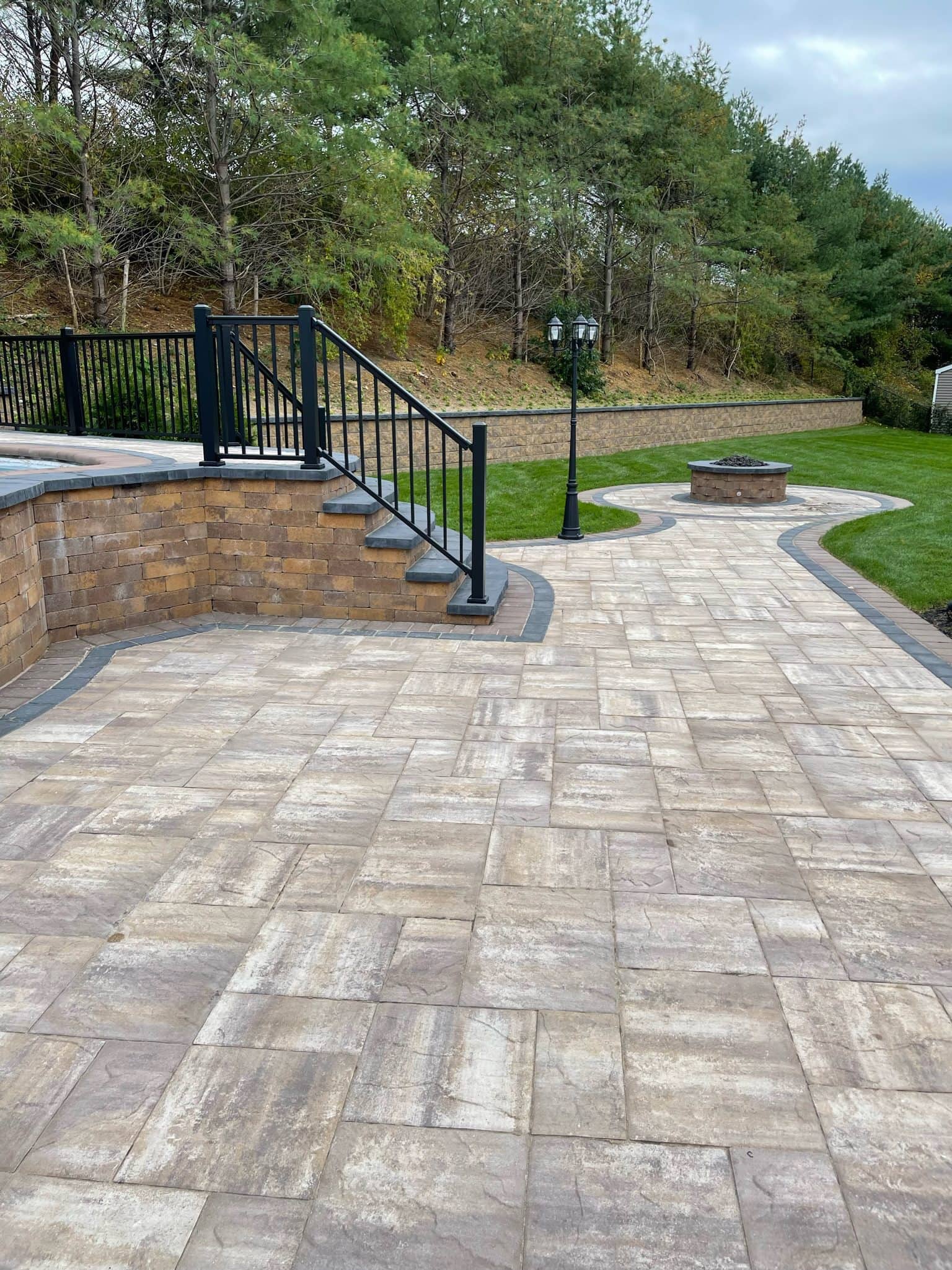
Segmental concrete block is the most widely used material for residential retaining walls in Suffolk County, and for good reason. Interlocking block systems — from manufacturers like Techo-Bloc, Cambridge Pavers, Unilock, and Nicolock — are engineered for freeze-thaw climates, designed with a built-in backward lean (called batter) for structural stability, and can be reinforced with geogrid fabric for taller walls. Installed cost for segmental block on Long Island typically runs $25 to $45 per square foot for standard residential heights, though complex sites and premium product lines push that higher.
Poured concrete walls are less common in residential applications but show up on commercial projects or where a very clean, monolithic look is needed. They require formwork, rebar reinforcement, and more labor-intensive installation, which makes them costlier per foot. The tradeoff is a seamless, highly durable structure when done correctly.
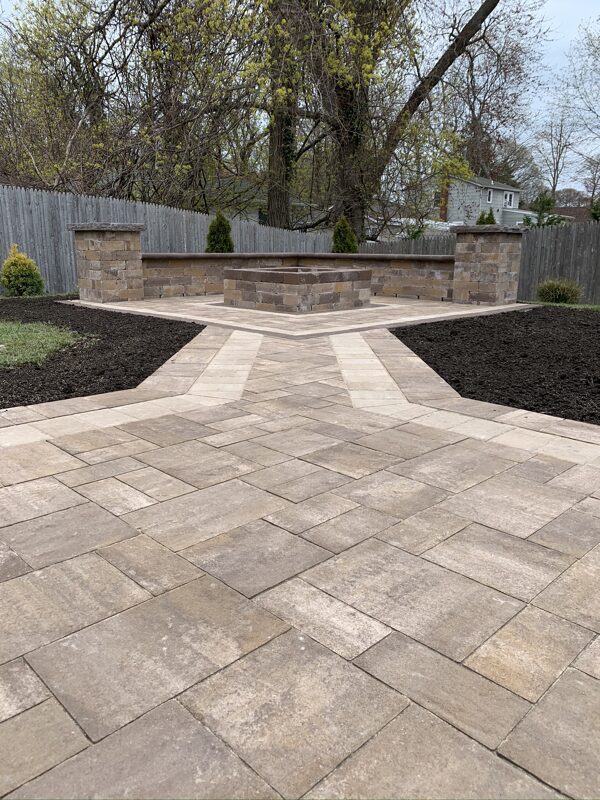
Most homeowners don’t know that manufacturer warranties on concrete block products are only valid when the product is installed by a certified contractor. If an uncertified installer puts down Techo-Bloc or Unilock product and something goes wrong — cracking, settling, color failure — the manufacturer’s warranty is void. You’re left with a claim against a contractor’s general liability policy, which is a much harder conversation than a manufacturer warranty claim.
Certified installer programs require contractors to complete product-specific training and meet installation standards set by the manufacturer. It’s not just a marketing badge. It means the contractor knows the specific base requirements, drainage specifications, and installation tolerances for that product — and that the manufacturer stands behind the result.
We hold certified installer status with Cambridge Pavers, Techo-Bloc, Unilock, and Nicolock. When we install one of those products, the manufacturer warranty is intact from day one. For a homeowner investing $8,000 to $15,000 in a retaining wall, that’s not a small detail. It’s the difference between having recourse if something goes wrong and having none.
Certified training also means we know how each product system is designed to perform — the setback angle, the pin placement, the drainage integration points. These aren’t things you figure out on the job. They’re things you learn in training and apply consistently across every project.
Natural stone retaining walls — fieldstone, bluestone, granite, or limestone — are labor-intensive to build because each piece has to be individually fitted. There’s no interlocking system, no uniform dimensions, no manufacturer guide. The wall’s structural integrity depends entirely on the mason’s ability to select, place, and set each stone correctly. That skill takes years to develop, and it shows up in the price. Natural stone walls on Long Island typically run at the higher end of the cost range, and the labor component is a significant portion of that.
The appeal is obvious. A well-built natural stone wall looks like it belongs on the property — not like it was installed last spring. For North Shore properties with existing stone features, or for East End homes where the landscape aesthetic matters as much as the function, natural stone is often the right call regardless of cost.
Manufactured stone veneer — products from Eldorado Stone and Boral, both of which we’re certified to install — offers a middle path. The structural core of the wall is built from concrete block or poured concrete, and the veneer is applied over it to achieve the look of natural stone. It’s more cost-effective than full natural stone, more consistent in appearance, and performs well in coastal conditions where salt air exposure is a real factor.
For Suffolk County properties near the water — whether you’re in Bay Shore, Sayville, Setauket, or anywhere along the Sound or the South Shore bays — material selection for a retaining wall isn’t just aesthetic. Salt air accelerates corrosion in metal wall ties and can degrade certain surface finishes over time. Choosing the right material for your specific location, not just the cheapest option available, is part of what separates a wall that holds up for 20 to 30 years from one that starts showing problems in five.
By now you have a clearer picture of what drives the numbers. Material, height, drainage, permits, foundation depth, and local conditions all factor in — and the cheapest quote is rarely accounting for all of them. A wall built without proper drainage or a below-frost-line foundation isn’t a bargain. It’s a future replacement project.
When you’re ready to move forward, look for a contractor who holds a valid Suffolk County Home Improvement License, can pull the permit for your project, and will walk you through their installation process in plain terms. If they can’t explain their excavation depth, their drainage plan, and their base preparation, that’s worth noting before you sign anything.
Stone Escapes Masonry & Outdoor Design Inc offers free in-person estimates directly with the owner — no project managers, no automated systems, just a straightforward conversation about your yard and what it actually needs. We’re based in Suffolk County and work throughout Long Island. Financing is also available for qualifying projects. If you’re in the area and want a quote you can actually evaluate, reach out and we’ll come take a look.
Article details:
Share:
Continue learning: