Not all driveway contractors are built the same. Here's what Suffolk County homeowners need to know before signing anything.
Share:
Summary:
Most homeowners don’t think about their driveway until something goes wrong — a crack that keeps spreading, pavers that have shifted after a rough winter, or a surface that’s starting to look like it belongs to a different house entirely. When that moment comes, the pressure to just hire someone and get it done can lead to decisions you’ll regret by next spring.
The contractor you choose matters more than the material you pick. In Suffolk County, where sandy soil, coastal moisture, and freeze-thaw cycles do real damage to poorly installed driveways, the difference between a good hire and a bad one is the difference between a driveway that holds up for decades and one you’re replacing again in five years. Here’s what you need to know before you make that call.
There’s no shortage of contractors willing to give you a quote. The challenge is figuring out which ones will still be standing behind their work two winters from now. We don’t just show up with equipment and materials — we assess your specific property, plan for drainage, and build a foundation that’s engineered to last.
What separates our approach from the rest usually happens underground, where you can’t see it. Proper excavation, base preparation, and drainage design are the unglamorous parts of the job that determine everything about how long your driveway actually lasts. If a contractor’s quote seems unusually low, that’s almost always where the money was cut.
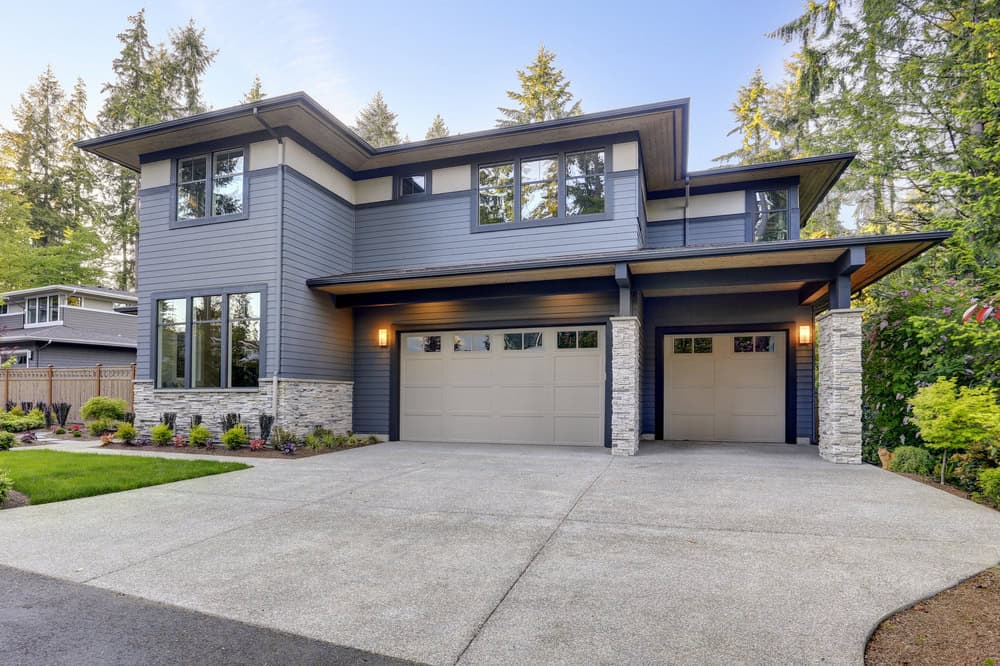
Concrete is a popular choice for a reason — it’s durable, low-maintenance, and handles heavy loads well. A properly installed concrete driveway can last 25 to 30 years. But on Long Island, it comes with a caveat worth knowing before you commit.
Concrete is more vulnerable to freeze-thaw damage than either asphalt or interlocking pavers. When water gets into small cracks and freezes, it expands — and concrete, being a rigid material, absorbs that stress in ways that eventually cause cracking and surface deterioration. In Suffolk County’s climate, where temperatures can drop into the single digits during harsh winters and then swing back above freezing within days, that cycle happens repeatedly every season. If your soil drainage isn’t handled correctly beneath the slab, you’re accelerating that process.
That doesn’t mean concrete is the wrong choice — it means the installation has to be done right. Proper sub-base compaction, adequate slab thickness, control joint placement, and a drainage plan that accounts for Long Island’s sandy, shifting soil are non-negotiable. A concrete driveway replacement contractor who skips any of those steps is setting you up for premature failure, regardless of how good the surface looks on day one.
Decorative concrete options — exposed aggregate, stamped patterns, colored finishes — can add real curb appeal and are worth considering if you want something more distinctive than plain gray. They add cost, but they also add meaningful value at resale. Just make sure the contractor has specific experience with decorative finishes, not just standard flatwork. The techniques are different, and the margin for error is smaller.
If you’re comparing concrete to pavers, the honest answer is that pavers handle Long Island’s conditions better over the long term. Individual paver units can flex slightly under freeze-thaw stress without cracking the entire surface. They also allow spot repairs — if one section settles or a unit cracks, you replace that section, not the whole driveway. Concrete doesn’t offer that flexibility. Neither choice is universally right; it depends on your property, your budget, and how long you plan to stay in the house.
This is the question most homeowners are quietly asking when they start getting estimates — and it’s also the question that some contractors are incentivized not to answer honestly. Knowing the difference protects you.
Surface-level damage — minor cracks, small potholes, cosmetic fading — is usually repairable. If the damage is isolated and covers less than about 25% of the total surface area, targeted repairs often make sense. Crack filling, patching, and resealing can extend a driveway’s life by several years at a fraction of replacement cost. That’s a legitimate option, and any contractor worth hiring will tell you so if it applies to your situation.
The calculus changes when the damage is widespread or when it signals base failure. Alligator cracking — that pattern of interconnected cracks that looks like, well, alligator skin — is almost always a sign that the sub-base beneath the surface has failed. You can patch the top all day long, but if the foundation is compromised, those repairs will fail right along with it. The same goes for driveways that are heaving, sinking in sections, or showing significant lateral shifting in paver installations.
In Suffolk County, freeze-thaw cycles accelerate base failure in driveways that weren’t properly installed to begin with. If your driveway was installed with a shallow base — say, 2 to 4 inches of excavation instead of the 8 to 10 inches that Long Island’s sandy soil actually requires — it was already on borrowed time. The freeze-thaw damage you’re seeing now isn’t bad luck; it’s the predictable result of a foundation that was never built to handle the conditions here.
The general rule: if repair costs would run 40 to 50 percent of full replacement cost and the base is compromised, replacement is the smarter long-term investment. A good contractor will assess the sub-base condition before recommending either path — and if they’re pushing full replacement without checking what’s underneath, that’s worth questioning.
The driveway contractor space has a real fraud problem. The BBB has documented homeowners losing thousands of dollars to contractors who take deposits and disappear, use inferior materials, or do work so shallow it fails within a season. Door-knockers claiming they have “leftover materials” from a nearby job are a well-documented scam pattern — and Suffolk County homeowners are not immune to it.
Vetting a contractor properly takes maybe 20 minutes and can save you from a genuinely painful experience. Here’s what that actually looks like in practice.

This is where a lot of homeowners get caught off guard, and it’s worth understanding before you hire anyone.
Suffolk County requires a Home Improvement Contractor License for all residential driveway and masonry work. The relevant categories are H7 for driveways and H8 for masonry — these are distinct sub-categories, not a single blanket license. The licensing process requires proof of insurance (minimum $500,000 general liability), workers’ compensation coverage, a background check, and passing a written exam based on Suffolk County’s Home Improvement Law and New York State General Business Law. This isn’t a formality — it’s a meaningful filter that unlicensed operators can’t pass.
Here’s the part that trips people up: a Suffolk County license does not cover work in Southampton or East Hampton. Those townships require separate licenses, and working without them has real consequences. A contractor operating in the Hamptons without the proper township license cannot legally enforce their contract or file a lien — but that also means you may have limited legal recourse if the work goes wrong. If you’re in Southampton, East Hampton, or anywhere in that eastern stretch of the county, confirm that your contractor holds both the county license and the applicable township license before anything else.
You can verify Suffolk County contractor licenses through the Department of Labor, Licensing & Consumer Affairs. It takes two minutes and it’s the single most important check you can do. Beyond licensing, confirm they carry current general liability and workers’ comp insurance — ask for certificates directly, not just their word for it.
Reviews matter too, but not all reviews are equal. A contractor with 12 five-star reviews is a different story than one with 129. Volume and consistency over time is harder to fake and harder to dismiss. Look for reviews that mention the owner by name, describe specific project types, and reference how the work held up after a full winter — those are the ones that tell you something real.
Long Island’s geology is glacial. The island was formed by glacial deposits, which means the soil beneath most Suffolk County properties is sandy, loosely compacted, and structurally unstable under load without proper preparation. This is not a minor detail — it’s the central reason why so many driveways on Long Island fail before they should.
Sandy soil shifts. It compacts unevenly. When a driveway base is installed too shallow — which is the shortcut most low-bid contractors take — that shifting happens faster and more dramatically than it would in markets with clay or loam soil. Add coastal moisture from the Atlantic and Long Island Sound, salt air that degrades inferior materials, and repeated freeze-thaw cycles through the winter, and you have a set of conditions that punish poor installation quickly and visibly.
Proper driveway installation in Suffolk County requires excavation to 8 to 10 inches — not the 2 to 4 inches that gets quoted in low bids. That depth allows for a compacted gravel sub-base of 6 to 8 inches, a bedding layer, the paving material itself, and enough structural integrity to handle both vehicle loads and ground movement. Edge restraints are installed to prevent lateral spreading. Drainage is planned from the start, not improvised after the fact — particularly important for South Shore properties near the Great South Bay where water tables are higher and drainage challenges are more acute.
Properties in Huntington, Smithtown, Islip, Babylon — across the whole county — face these same soil and climate conditions. We understand that and build accordingly, which is why our work is still looking sharp five, ten, fifteen years later. Contractors who don’t account for these conditions are the reason so many homeowners are replacing driveways that were only installed a few years ago.
When you’re getting estimates, ask directly: how deep will you excavate, and what goes in the base? If the answer is vague or the number is under 6 inches, that tells you everything you need to know about how long the finished product will last.
The short version: the contractor matters more than the material, and what happens underground matters more than what you can see on the surface. In Suffolk County, where the soil, climate, and coastal conditions create a genuinely demanding environment for any paved surface, cutting corners on installation doesn’t save money — it just moves the cost a few years down the road.
Verify licensing at both the county and township level. Ask about excavation depth and base preparation before you talk about materials or finishes. Look for a contractor who shows up personally, communicates directly, and has a track record of reviews that hold up over time — not just on day one of the project.
We serve all of Suffolk County and bring the kind of hands-on, owner-involved approach that makes a real difference on a project like this. Reach out and have a real conversation — no automated systems, no sales handoffs, just a straight answer from someone who’s done this work across Long Island for years.
Article details:
Share:
Continue learning: