What looks like a weekend project can turn into a costly mistake. Here's what Suffolk County homeowners need to know before they pick up a shovel.
Share:
Summary:
You’ve been looking at that concrete slab — or worse, that patchy grass — long enough. A paver patio would fix it. You’ve watched the videos, priced out the materials, and done the mental math. It seems doable.
Here’s the thing: the surface part is doable. It’s everything underneath that gets people into trouble. And in Suffolk County, where the soil shifts, the winters are hard, and the water table doesn’t forgive shortcuts, “underneath” matters more than almost anywhere else.
This page is for homeowners who are genuinely weighing your options — not to talk you out of DIY, but to make sure you know what you’re actually signing up for.
Most people think of paver installation as a surface project. Pick your pattern, lay the stones, done. But the visible part — the part you walk on and photograph — is maybe ten percent of the job. The other ninety percent is what happens before a single paver touches the ground.
Professional paver contractors start with excavation. Not a few inches — in Suffolk County, the standard is 8 to 10 inches deep. That’s because Long Island’s soil is primarily sandy glacial outwash, and sand moves. It compresses unevenly, shifts with moisture, and responds poorly to freeze-thaw cycles. A shallow base that might hold up in other parts of the country will fail here, usually within the first couple of winters.
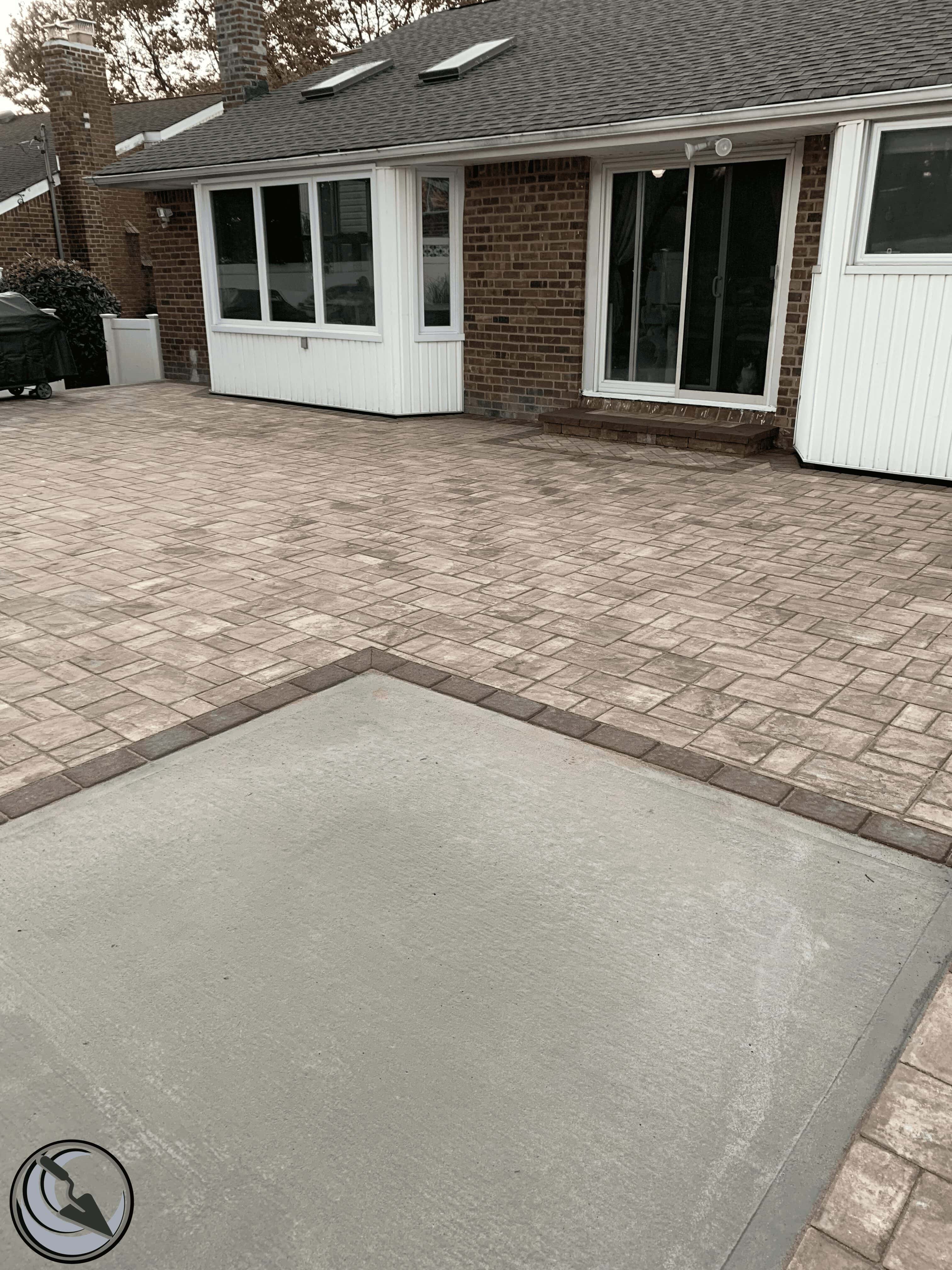
After excavation comes compacted gravel base material, bedding sand, proper pitch for drainage, edge restraints, and finally the pavers themselves. Each layer has to be done in the right sequence, with the right materials, and compacted correctly. Skip or rush any of it, and you’ll see the results — sinking pavers, spreading joints, standing water — sooner than you’d expect.
Long Island’s geology is not forgiving. The ground beneath most of Suffolk County is sandy, loose, and prone to shifting — especially in areas closer to the water, like Mastic Beach, Westhampton, or the coastal communities along the Great South Bay. Add in the freeze-thaw cycles that run from November through March, and you have a combination that will expose every weakness in a poorly built base.
When we install a paver patio in Suffolk County, drainage planning isn’t an afterthought — it’s built into the project from the start. The patio needs to slope away from your home at the right pitch, typically around one-eighth of an inch per foot, so water moves away from your foundation rather than pooling against it. That sounds like a small detail. It isn’t. Homeowners who’ve dealt with water in their basement or crawl space after a heavy rain often trace it back to a patio or driveway that was graded incorrectly.
The base material matters just as much as the pitch. Crushed gravel compacts in a way that sand and dirt simply don’t. It distributes weight evenly, resists shifting, and allows water to drain through rather than sit and freeze. When a plate compactor runs over a properly built gravel base, it creates a surface that stays stable through years of weather and use. When it runs over a shallow, poorly layered base — or when someone skips the compactor entirely — the pavers start to tell the story within a season or two.
Edge restraints are another piece that DIYers often skip because they don’t seem important until they are. Without them, pavers migrate outward over time. The gaps widen, the pattern breaks, and the whole surface starts to look like it’s slowly falling apart. Proper edge restraints lock the perimeter and keep everything in place for the long term.
None of this is complicated to explain. But doing it correctly — especially in Suffolk County’s specific conditions — takes equipment, experience, and a real understanding of what this soil and climate demand.
The most common call we get about failed patios starts the same way: “It looked great when we finished it.” A year later, the pavers are sinking in one corner. Two years later, there’s a drainage problem near the house. Three years in, the whole thing needs to come up and be redone.
The root cause is almost always the base. Either the excavation wasn’t deep enough, the base material wasn’t compacted properly, or the drainage slope was off. Sometimes all three. These aren’t things you can fix from the top — once the pavers are down and the problem shows up, the only real fix is to pull everything up and start over.
Renting a plate compactor and watching a tutorial gets you part of the way there. What it doesn’t give you is the experience of knowing how different soil types behave, how much compaction is actually enough, or how to read a site for drainage before you start digging. In a town like Copiague or North Patchogue, where the water table sits relatively high, that site-reading step can be the difference between a patio that drains cleanly and one that becomes a pond after every storm.
There’s also the material side. Homeowners shopping at a big box store are working with a limited selection, and they’re usually not getting guidance on what’s appropriate for their specific site and climate. We work with manufacturers like Cambridge Pavingstone, Techo-Bloc, and Unilock, and our certifications give us access to a broader range of products and the knowledge to match material to conditions. Manufacturer certifications also allow us to extend product warranties to our clients, which you can’t get with a DIY purchase.
The honest version of this isn’t that DIY is impossible. It’s that the margin for error is small, the consequences of getting it wrong are expensive, and Long Island’s conditions make it harder than most places.
Once you’ve decided to hire a professional, the next question is who. And in Suffolk County, where there’s no shortage of contractors willing to take your money, that question matters.
The basics are non-negotiable: licensing in the municipality where you live, proof of insurance, and a portfolio of completed local work. Suffolk County municipalities, Southampton, and East Hampton each have their own licensing requirements, and not every contractor is authorized to operate in all of them. Ask directly. A legitimate contractor will have no problem answering.
Beyond the basics, pay attention to how the contractor communicates. Do you get the owner on the phone, or are you handed off to a scheduler after the estimate? That early interaction tells you a lot about how the project will actually run.
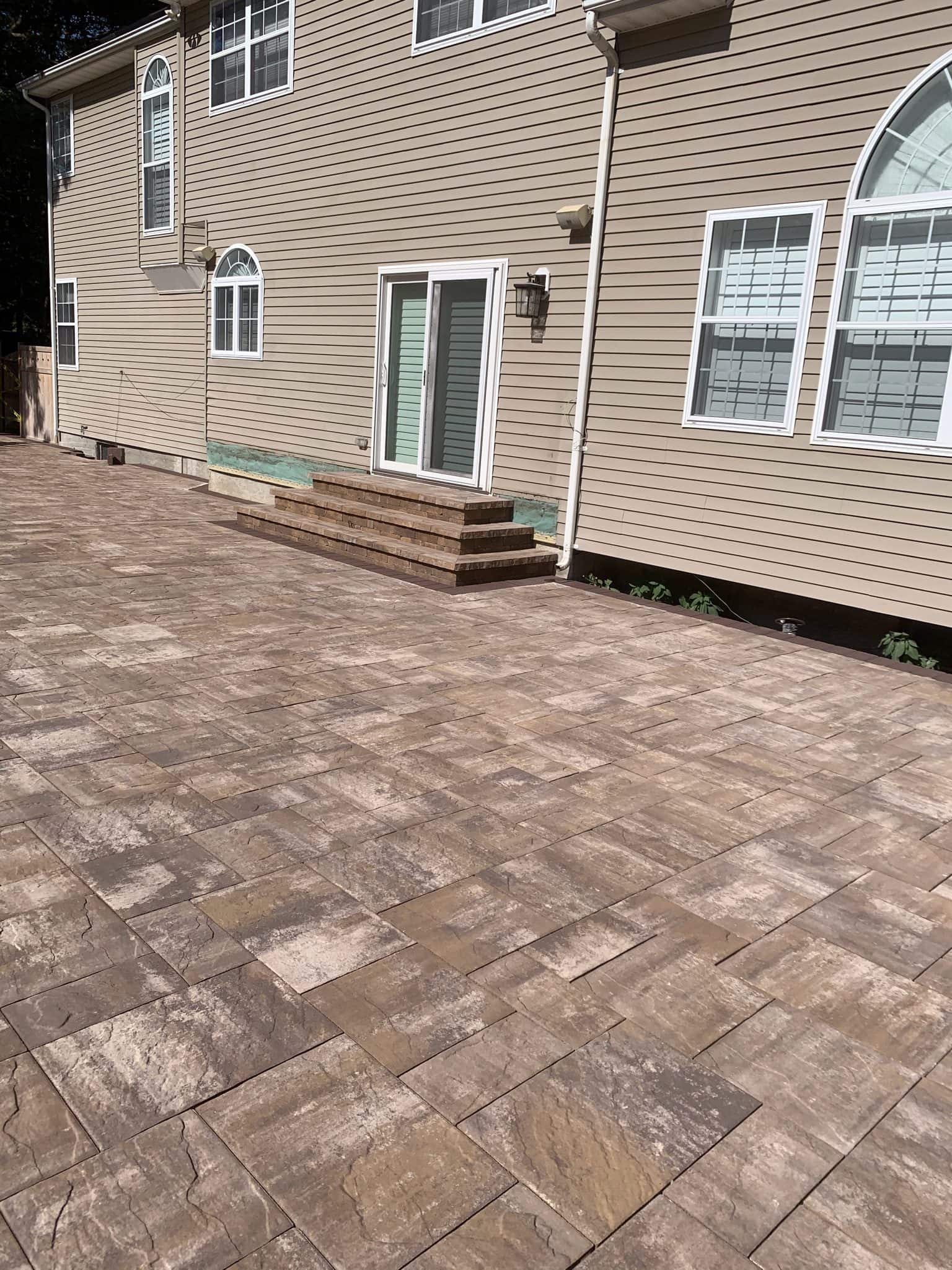
One of the most common complaints Long Island homeowners have about contractors isn’t the price — it’s the experience of meeting a polished salesperson, signing a contract, and then watching an unfamiliar crew show up on installation day. Sometimes a different crew shows up than the one you were told about. Sometimes communication drops off entirely once the deposit clears.
This isn’t a minor inconvenience. It has real consequences for the quality of the finished work. When a crew has installed hundreds of patios together, they’ve developed a rhythm. They know how to read a site, how to handle unexpected drainage issues, and how to execute the details — the corners, the cuts, the edge work — that separate a clean installation from a sloppy one. A rotating team of subcontractors, assembled differently for each job, doesn’t have that.
We handle every estimate and are present on every job site. Communication stays direct — with the owner and the project manager. There are no client portals or automated tracking systems between you and the person responsible for your project. If you have a question on day three of installation, you call the same person you met on estimate day.
For homeowners in communities like West Islip, Ridge, or out toward Calverton, where finding a contractor you can actually reach is half the battle, that kind of direct access matters. It’s also part of why a large portion of our work comes through neighbor referrals — when people see a finished patio and ask who built it, the experience of working with us is as much a part of the recommendation as the quality of the stone.
A few questions come up consistently when homeowners in Suffolk County are choosing a contractor, and they’re worth answering honestly.
Do I need a permit to install a paver patio in Suffolk County? It depends on the scope of the project and the specific municipality. Some towns require permits when the patio is close to a property line or when drainage work is involved. Southampton and East Hampton tend to have stricter requirements than inland towns. A properly licensed contractor should know what’s required in your area and handle the process for you — if a contractor doesn’t bring this up, that’s worth noting.
How long should a professionally installed paver patio last? A patio built on a proper base, with quality materials and correct drainage, should last 25 years or more with basic maintenance — resealing every three to five years and occasional joint sand replenishment. Concrete slabs typically last 10 to 15 years before significant cracking becomes an issue. Individual pavers can be replaced one at a time if they’re ever damaged, which is something you simply can’t do with poured concrete.
What does it actually cost to install a paver patio in Suffolk County? Professional installation in this market typically runs $30 to $45 per square foot, inclusive of excavation, base preparation, materials, and installation. That range shifts based on the complexity of the design, the materials selected, and site conditions. A quote that comes in significantly below that range is worth scrutinizing — something is usually being left out, and it’s almost always in the base.
How do I know if a contractor is actually certified by Cambridge or Techo-Bloc? Ask for documentation and verify directly with the manufacturer if you want to be thorough. Certifications from major manufacturers like Cambridge Pavingstone, Techo-Bloc, Unilock, and Nicolock require contractors to complete technical training and meet installation standards. They’re not handed out freely, and contractors who hold them are generally more serious about the work.
The gap between a paver patio that holds up for decades and one that starts failing after the first hard winter comes down to what happens before the first stone is laid. In Suffolk County — with its sandy soil, coastal moisture, and real winters — that foundation work isn’t optional. It’s the whole job.
If you’re weighing DIY against hiring a professional, the honest answer is that the visible work is learnable. The base preparation, drainage engineering, and site-specific judgment that keeps a patio stable through Long Island’s conditions takes experience that’s hard to replicate from a video.
When you’re ready to talk through your project — whether you’re in Babylon, Smithtown, East Patchogue, or anywhere across Suffolk County — we offer in-person estimates with direct owner involvement, from the first conversation through the final walkthrough.
Article details:
Share:
Continue learning: