Your backyard has potential you haven't tapped yet. Here's what we can actually do for your Suffolk County outdoor space.
Share:

Summary:
We do more than just play “Tetris” with heavy stones in your yard. The work involves engineering outdoor structures that can survive sandy soil, salt air, and freeze-thaw cycles that love to turn “flat” patios into skate parks within a few seasons.
We handle the boring-but-important site evaluation first. We assess where the rain goes (drainage), what we’re digging into (soil), and if the ground is trying to roll away (grade). For Long Island, this means planning for sand that drains fast but shifts whenever it gets a chance, and water tables higher than a kite at Montauk.
The real magic happens where you can’t see it. Proper excavation goes 8 to 10 inches deep—if a contractor shows up with just a hand trowel and a smile, run. Base preparation involves compacted layers of crushed concrete aggregate, not the cheap “mystery dirt” that settles as soon as you put a grill on it.

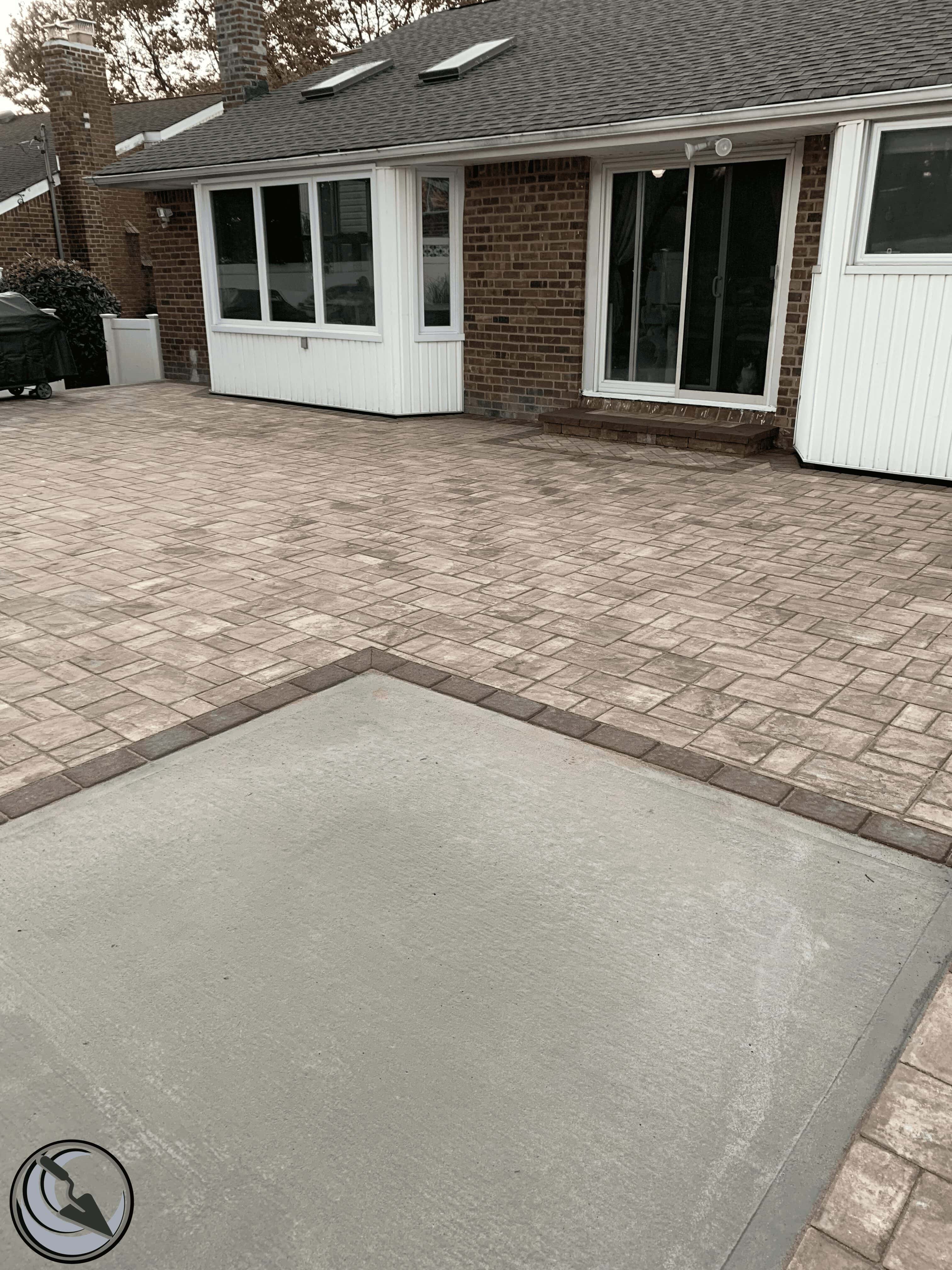
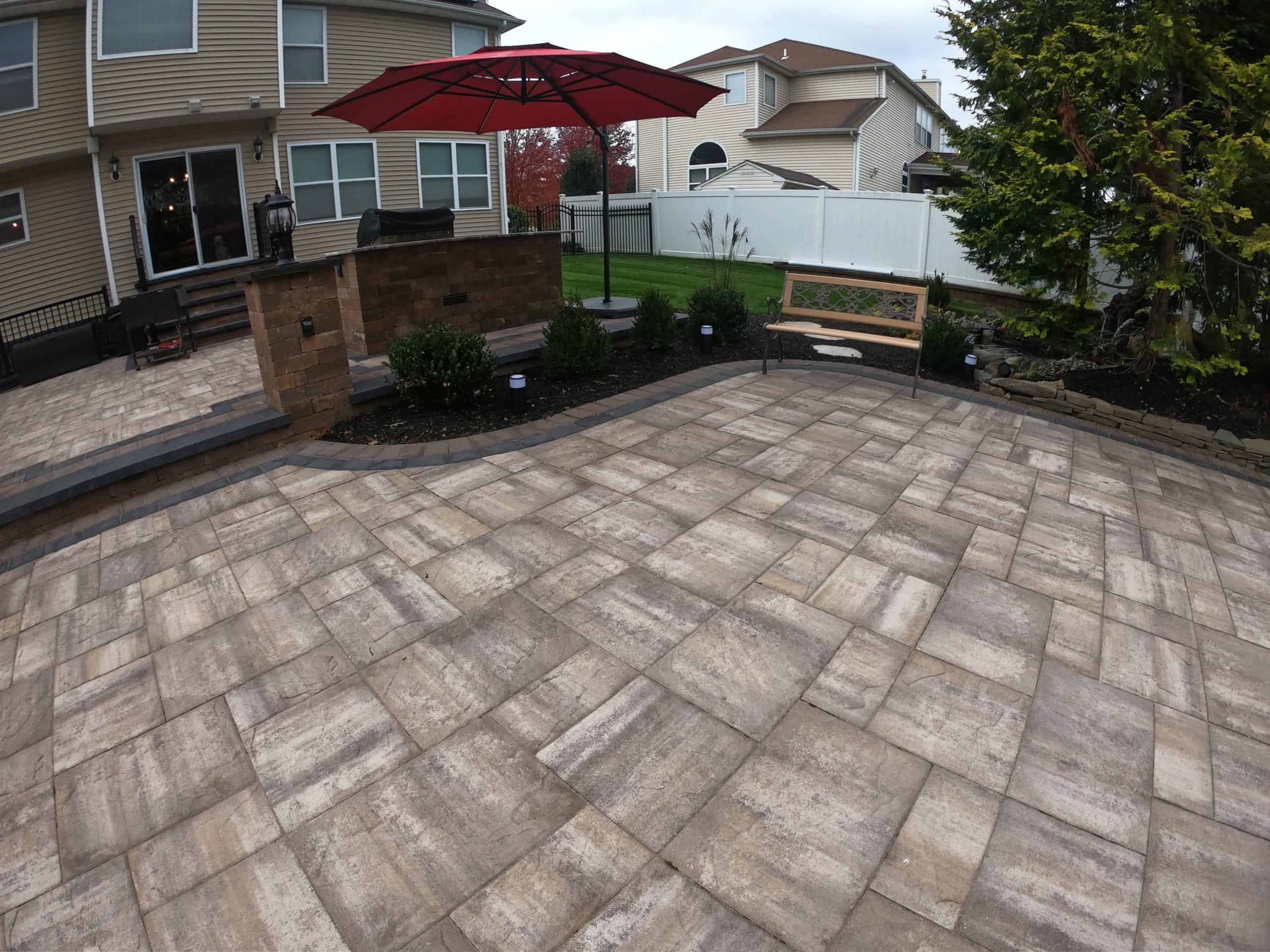
Paver patios are the MVP of Suffolk County backyards. They handle the “freeze, thaw, repeat” cycle of a New York winter without cracking like a sidewalk, and if one stone gets a stain from a dropped burger, you can just replace it without calling in a demolition crew.
But installation determines if your patio lasts 30 years or if it starts “migrating” toward the neighbor’s fence by year three. Water seeps into cracks, freezes, and expands with enough force to lift a car—so imagine what it does to a poorly laid stone. Sandy soil is also a “shifter,” creating low spots where you’ll eventually need a rowboat to reach your lawn chair.
Our process starts deep—8 to 10 inches of excavation is the “gold standard.” We grade the area with a slight “pitch”—about 1.5 inches every 10 feet—to send rain away from your foundation. It’s enough to save your basement, but not so steep that your drink slides off the table.
Next is the “Lasagna of Stability.” We use 4 to 6 inches of crushed concrete, compacted in layers with equipment that sounds like a small earthquake. This creates a foundation that doesn’t care about our shifting sand. A tiny layer of fine sand goes on top for that final “perfectly level” finish before the pavers arrive.
Edge restraints are the unsung heroes. Without them, your patio will literally spread out like it’s on vacation. We finish with polymeric sand—the “magic dust” that locks everything together, stops weeds from moving in, and stays flexible enough to handle the earth’s mood swings.
The difference between a pro and a “guy with a truck” shows up after the first winter. A real Suffolk patio should be a 30-year investment. Cheap work usually starts “sinking” before you’ve even finished paying the bill. It’s the classic case of “pay now or pay much more later to fix it.”
Most Long Islanders spend $30 to $45 per square foot for the real deal. That covers the heavy lifting, the quality stones (think Cambridge or Techo-Bloc), the drainage math, and the cleanup. It’s an investment that pays off in curb appeal and fewer “why is my patio crooked?” problems.
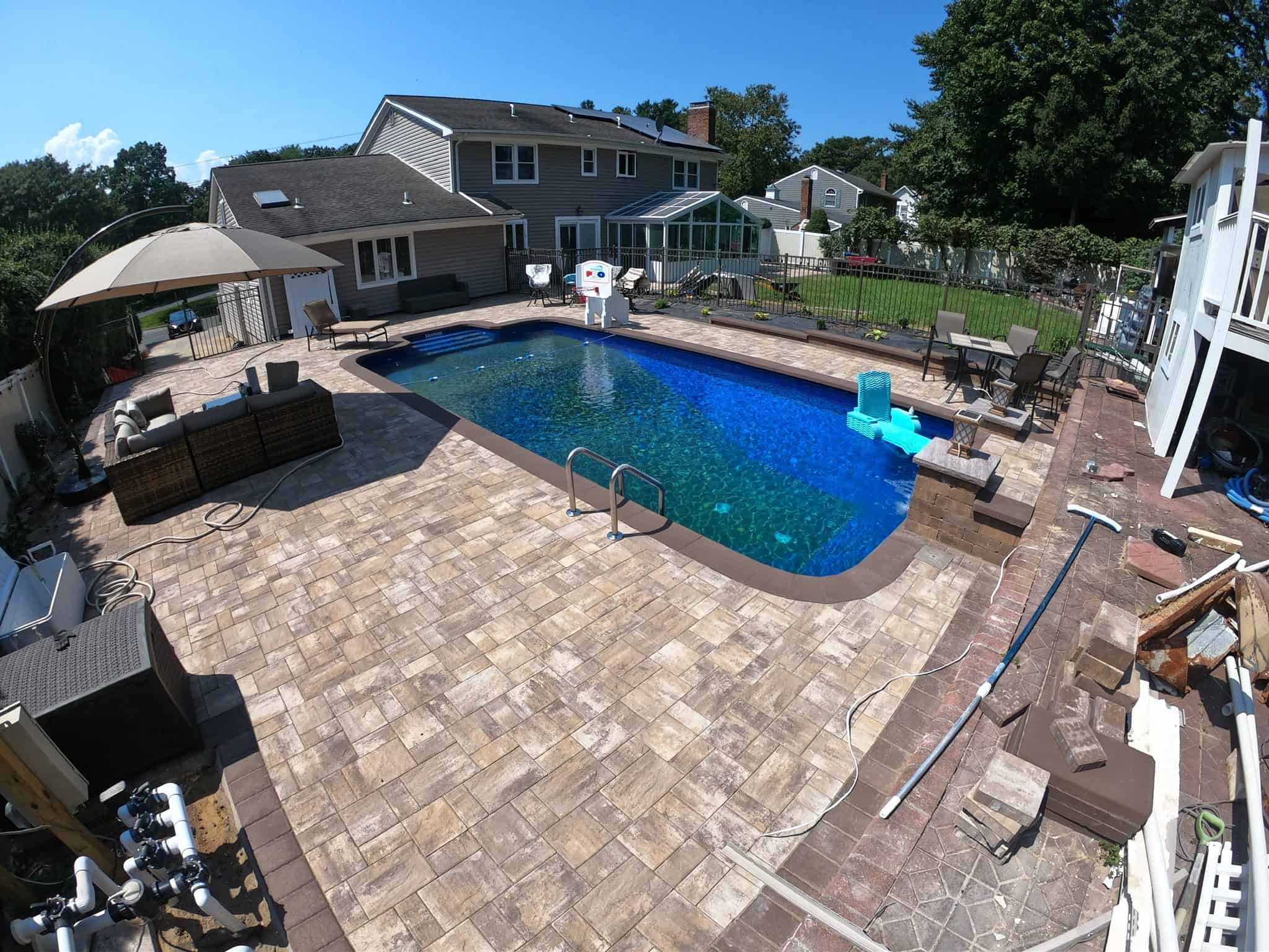
Pool patios are the “Olympics” of masonry. They need to be slip-resistant (because kids never listen when you say “don’t run”), handle constant splashing, and survive the salt or chlorine that would melt a lesser stone. They also need to look good while doing it.
Poolside landscaping isn’t just about planting a few shrubs. It’s about choosing pavers that won’t burn your feet in July and grading the ground so the “pool water” and “rainwater” don’t have a messy divorce on your deck. We use textured surfaces that provide grip even when everyone is cannonballing.
Our poolscapes are built for the Long Island “sink or swim” reality. Sandy soil around a pool is notoriously unstable, requiring deeper excavation that many budget contractors skip to save an hour. We also account for the salt air—a constant factor that eats away at non-marine-rated materials.
Layout is king here. Most people underestimate how much space they need for a lounge chair plus a walkway. A well-designed poolscape has “zones”: the sunbathing zone, the “I’m hiding in the shade” zone, and the “don’t create a bottleneck” pathway. It’s about flow, not just looks.
Drainage is the silent partner. Between splashed water and rain, a pool patio is a wet place. Our installs include perforated pipes and proper grading to ensure that water ends up in the grass, not in the pool or your kitchen. We might even suggest a French drain or a dry well if your yard is a natural bathtub.
Material choice matters. You want pavers rated for freeze-thaw and chemicals. Natural stone like bluestone or travertine looks amazing, but it requires a pro who knows how those materials react to our humidity. It’s about finding the balance between “resort vibes” and “structural integrity.”
Investing in a pro pool deck protects the massive check you just wrote for the pool itself. A bad patio doesn’t just look ugly; it can shift and put pressure on the pool walls, leading to repairs that make the original cost look like pocket change.
Outdoor living is the new “finished basement.” In Suffolk, people are spending up to 25% of their renovation budget on the backyard. Why? Because a custom outdoor kitchen or a fire pit turns your yard into a 5-star destination that doesn’t require a flight from ISP. Plus, the ROI is actually impressive.
An outdoor kitchen is more than just a grill in a stone box. We’re talking gas lines, electricity for that “necessary” wine fridge, and countertops that won’t crack when the temp hits 10°F. The layout needs to follow the “Work Triangle” rule—grill, prep, and fridge—so you aren’t running marathons back into the house for a spatula.
Fire pits are the secret to “Season Extension.” Let’s be real: Long Island gets chilly the moment the sun goes down. A fire pit makes October the best month to be outside. But in our sandy soil, a fire pit without a proper foundation will eventually look like a leaning tower of pizza.

Real estate data says outdoor kitchens have nearly 100% cost recovery. That’s a fancy way of saying they basically pay for themselves. But that only works if the kitchen doesn’t rust into a pile of junk after two years of salt air exposure.
Long Island kitchens face a brutal combo of salt, humidity, and “Polar Vortex” winters. You need marine-grade stainless steel and countertops that don’t throw a tantrum when it freezes. It’s the difference between “cooking outside” and “having a second kitchen that happens to be outdoors.”
The “L-shape” and “U-shape” are the crowd favorites in Suffolk. They create a natural “chef’s zone” while keeping the guests close enough to chat but far enough away from the fire. You want to be close to the house for utilities, but far enough away that your living room doesn’t smell like a rib shack.
Our process involves heavy-duty foundations. These kitchens are essentially stone buildings, and sand loves to let heavy things sink. We handle the gas lines to code (safety first!), the weatherproof electrical outlets, and the drainage so your cooking area doesn’t become a moat after a storm.
Most people spend around $13k on an outdoor kitchen, while the “Pro-Bowl” setups can easily cross $30k. Because it involves gas and electricity, 80% of homeowners hire a pro. It’s one of those projects where “DIY” usually stands for “Don’t Imagine You’ll finish this safely.”
The difference shows up at your first BBQ. In a well-designed kitchen, the prep and hosting happen in one smooth motion. You aren’t fighting smoke, you aren’t hunting for a light switch in the dark, and you’re actually enjoying the party instead of sweating over a tripod grill.
Fire pits have exploded in popularity lately because they turn a boring Tuesday night into a camping trip. But a fire pit is a permanent structure that needs to respect the laws of physics—and your local fire codes.
Installation starts with—you guessed it—the foundation. Our sandy soil is a “shifter,” so we dig deep and compact the gravel base to ensure your fire pit stays level. Without this, the heat and the weight will cause the stones to tilt, which is a great way to have a very stressful s’mores session.
Salt air is the hidden enemy here too. It ruins metal inserts and corrodes cheap materials. We use heat-resistant, coastal-rated stones and plan the drainage so the pit doesn’t turn into a birdbath after a rainstorm. If water pools at the base, the freeze-thaw cycle will crack the masonry from the inside out.
Retaining walls are the “unskilled laborers” of the yard—they do all the hard work. They stop erosion, create flat spaces on “hilly” Long Island lots, and protect your foundation. But they are constantly fighting a war against gravity and water pressure.
Ninety percent of wall failures on the Island are caused by bad drainage. During a Nor’easter, water builds up behind the wall, turning the soil into a heavy sludge that pushes the wall over. Our walls include perforated pipes, gravel backfill (not dirt!), and “weep holes” to let the pressure escape.
We also build for the “Big Freeze.” Water that gets behind a wall and freezes can move thousands of pounds of stone. By sitting our bases below the frost line and using frost-resistant materials, we make sure your wall stays exactly where we put it, regardless of the thermometer. A quality wall should last for decades. It’s all about the “invisible” work—the base, the backfill, and the drainage. It costs more upfront, but it’s a lot cheaper than watching your backyard slide into the neighbor’s pool because someone skipped the gravel.
Your backyard has a lot of potential, but it needs a plan that respects the unique “personality” of Long Island. We transform unused grass into spaces you’ll actually use—from the first warm day of April to the last fire-pit-worthy night of November.
The difference between a 30-year masterpiece and a 3-year mess is all in the engineering. You can’t ignore sandy soil, salt air, or the freeze-thaw cycle. Shortcuts might save a few bucks today, but they’ll cost you a lot of sleep (and money) when the ground starts moving.
When you’re ready to stop “making do” with a boring yard and start living outside, we’re ready to dig. At Stone Escapes Masonry & Outdoor Design Inc, we bring union-trained skill and a “built-to-last” attitude to every project. We handle the estimates, the permits, and the heavy lifting, so you can just focus on where to put the outdoor furniture.
Article details:
Share:
Continue learning: