Suffolk County's sandy soil changes everything about how a concrete driveway should be built. Here's what the process actually looks like when it's done right.
Share:

Summary:
If your driveway is cracking, heaving, or just looking rough after a few winters, you’re not imagining it — Long Island is genuinely hard on concrete. The soil under most of Suffolk County is sandy and loose, a leftover from glacial deposits that drained away thousands of years ago. That soil moves. It shifts under load, erodes when water runs through it, and doesn’t hold a foundation the way denser soils do in other parts of the country. So when a contractor installs a driveway here the same way they would in, say, central New Jersey, it tends to show within a few years. This page explains what proper concrete driveway installation actually looks like in Suffolk County — and what questions to ask before you hire anyone.
Concrete driveway installation is mostly a below-the-surface job. What you see when it’s done — the finished slab — is maybe 20% of the actual work. The other 80% is what happens before the concrete truck shows up, and that’s where projects in Suffolk County diverge from the national standard.
Most installation guides recommend excavating to 4–6 inches. On sandy glacial soil, that’s not enough. We excavate to 8–10 inches on every project, because that’s what it takes to get below the unstable surface layer and reach something that will actually hold. From there, a compacted gravel sub-base is built up in layers, drainage is engineered into the slope, edge restraints are set, and then — and only then — does the concrete go in.
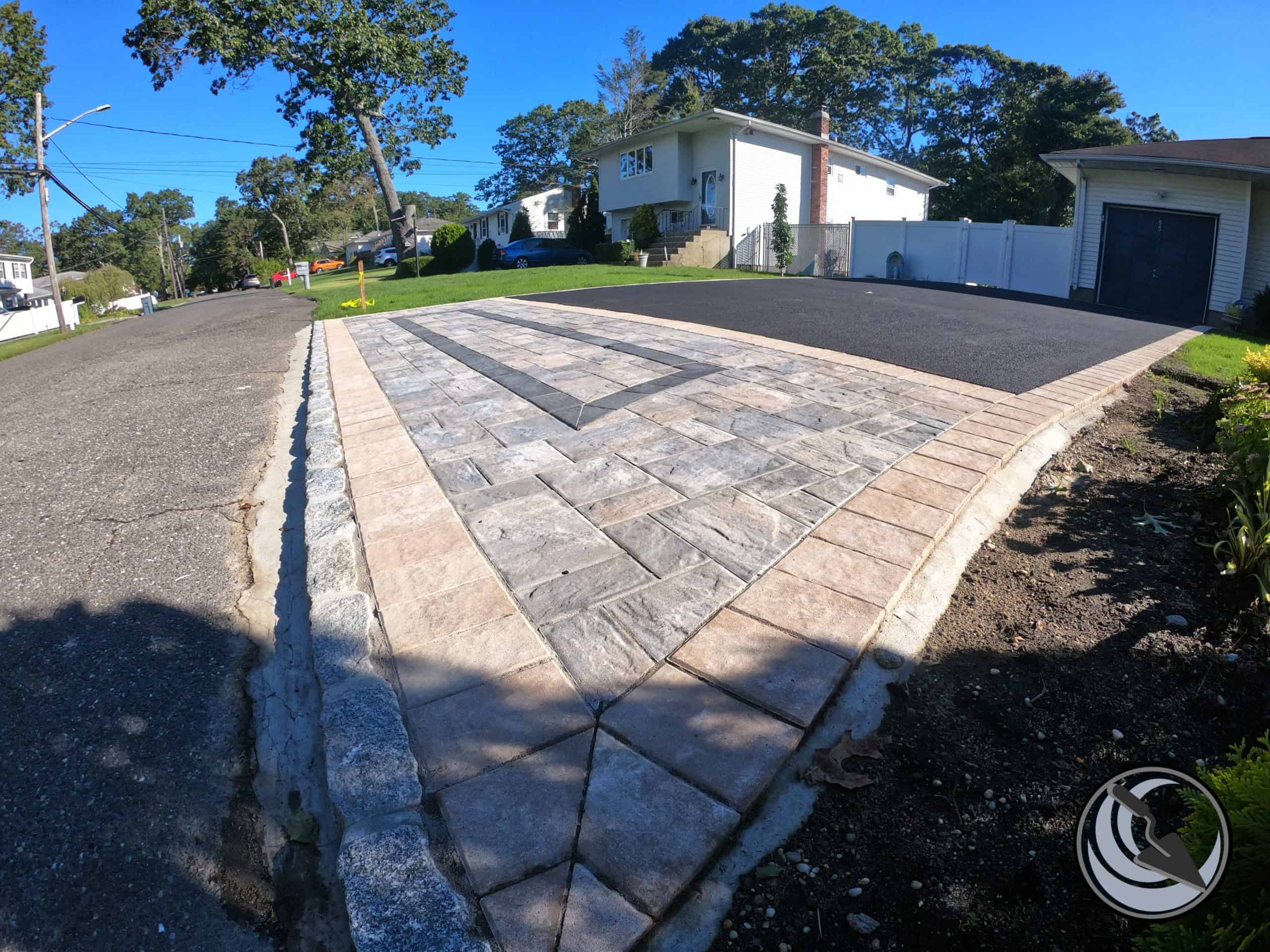
The excavation depth conversation matters more than most homeowners realize, and it’s one of the easiest things for a contractor to cut corners on without you ever knowing. When a crew digs to 4 inches instead of 8, it saves them time and labor. Your driveway looks identical on day one. The difference shows up in year two or three, when the slab starts to settle unevenly or cracks begin forming across the surface — not because of the concrete, but because of what’s underneath it.
Once the excavation is done correctly, the sub-base work begins. This means laying and compacting gravel in stages, not just dumping a layer and calling it done. Each pass of the compactor is building the stable platform the slab will live on for the next few decades. On sandy soil throughout Suffolk County, this step is even more critical because the native ground won’t do any of that work for you.
Drainage planning comes next, and it’s something a lot of driveway companies skip entirely or treat as an afterthought. On Long Island, where the water table is high in many areas and storm events can be intense, water that has nowhere to go will find its way under your slab. Over time, that movement erodes the sub-base and causes the concrete above it to crack or sink. A properly sloped driveway with intentional drainage routing isn’t a luxury — it’s what separates a 5-year driveway from a 30-year one.
Reinforcement is the last major pre-pour decision. For standard passenger vehicles, a 4-inch slab with wire mesh or rebar is typically sufficient. If you’re parking heavier vehicles — a truck, an RV, a boat trailer — or if your soil conditions are particularly unstable, stepping up to a 5–6 inch slab with rebar makes a meaningful difference in long-term performance. This is worth discussing during your estimate, not deciding after the fact.
Long Island sits in a climate zone where winter temperatures cycle above and below freezing multiple times throughout the season. That pattern — freeze, thaw, freeze again — is one of the most destructive forces a concrete driveway faces. Here’s the mechanics of it: water finds its way into small surface cracks or pores in the concrete, freezes, and expands by roughly 9%. That expansion widens the crack. The next thaw lets more water in. The next freeze widens it further. Repeat that process over a few winters and what started as a hairline crack becomes a structural problem.
The fix isn’t complicated, but it has to happen at installation. Concrete that’s properly thick, properly sealed, and poured over an adequate base is far more resistant to this cycle than a thin slab sitting on a shallow, poorly compacted foundation. Control joints — the lines cut into the surface of a new driveway — are also part of this. They give the concrete a designated place to flex and crack if it needs to, rather than cracking randomly across the surface.
One thing worth knowing: concrete needs at least seven days to cure before you drive on it. That timeline isn’t arbitrary. Rushing it — especially in cooler temperatures — weakens the surface and makes the slab more vulnerable to the freeze-thaw damage described above. A contractor who tells you the driveway will be ready in two or three days is either cutting the timeline or pouring in conditions that require special precautions they may not be taking.
Sealing is the last line of defense. A properly sealed driveway resists moisture penetration, which slows the freeze-thaw cycle’s ability to do damage. It also helps with the salt air exposure that comes with living near the Atlantic or Long Island Sound — a factor that accelerates surface degradation on unsealed concrete and something that affects a significant portion of Suffolk County properties.
The contractor you hire matters more than the material you choose. A well-installed asphalt driveway will outlast a poorly installed concrete one every time. So before you compare quotes by price, it’s worth understanding what you’re actually comparing.
In Suffolk County, licensing is a real differentiator — not just a checkbox. The county is divided into ten separate towns, each with its own building department and permit requirements. A contractor licensed at the county level isn’t automatically licensed to work in Southampton or East Hampton. If you’re in one of those townships, that distinction matters both legally and practically. We’re licensed and permitted to work across all of Suffolk County, which means we handle the local requirements for your specific town without you having to navigate them.

The estimate conversation is your best window into how a contractor actually works. Most homeowners focus on the final number, but the questions you ask before that number lands will tell you a lot more about what you’re buying.
Start with excavation depth. Ask specifically: how deep are you digging, and why? A contractor who knows Long Island’s soil conditions should be able to explain why 8–10 inches is the standard here without you prompting them. If they give you a vague answer or quote the national 4–6 inch guideline without acknowledging the local soil context, that’s a signal worth noting.
Ask about drainage. How is water being directed away from the slab? What happens during a heavy rain event or a Nor’easter? If they haven’t thought about it, your driveway eventually will.
Ask who’s actually doing the work. Some larger operations bid jobs and then hand them off to rotating subcontractors. That’s not inherently a problem, but it does mean the person who assessed your property and made promises during the estimate may never set foot on your job site again. Knowing whether you’ll have consistent crew throughout the project — and whether the owner is involved — gives you a clearer picture of accountability.
Ask about permits. In most Suffolk County towns, a driveway installation requires a permit. A contractor who skips this step is saving themselves paperwork and putting the liability on you. If something goes wrong — or if you sell the house and a buyer’s inspector finds an unpermitted driveway — that becomes your problem, not theirs.
Finally, ask for local references. Not just Google reviews, but actual projects in your area. A contractor who’s done work in Huntington, Islip, Smithtown, or wherever you are should be able to point to it. Suffolk County’s conditions are specific enough that experience elsewhere doesn’t fully transfer.
**How long does a concrete driveway last in Suffolk County?** A properly installed concrete driveway should last 30 years or more. The caveat is “properly installed” — which, on Long Island, means deeper excavation, a well-compacted sub-base, adequate drainage, and regular sealing to handle the freeze-thaw cycle and coastal moisture. Driveways that fail in 5–10 years here almost always have a preparation problem, not a concrete problem. We’ve seen this pattern repeatedly across Suffolk County communities, which is why we prioritize the foundation work that most contractors rush.
**Does a concrete driveway need a permit in Suffolk County?** In most cases, yes. Suffolk County’s ten towns each have their own building departments, and most require a permit before driveway work begins. The permit process typically includes an inspection to verify that the installation meets local code. Costs are generally modest — usually somewhere between $50 and $200 — but skipping the permit creates real liability for the homeowner. We handle the permitting process as part of the project, so you’re not navigating the specific requirements for your town on your own.
**Is concrete or asphalt better for a Long Island driveway?** Both can work well when installed correctly. Concrete tends to last longer — typically 30-plus years versus 15–20 for asphalt — and handles freeze-thaw cycles better when properly sealed. Asphalt is generally less expensive upfront and easier to repair. The right answer depends on your budget, your timeline, and what you’re looking for aesthetically. If longevity and low maintenance are the priority, concrete usually wins.
**Can I pour new concrete over my existing driveway?** Generally, no — and it’s worth understanding why. Pouring over an existing slab skips the sub-base preparation that makes a driveway last. Whatever caused the original driveway to fail is still there underneath. You’d essentially be adding a new surface on top of an old problem. The right approach is to remove the existing material, address the sub-base, and start fresh.
**Why is my concrete driveway cracking if it was just installed a few years ago?** Almost always, the answer is in the preparation. Either the excavation wasn’t deep enough, the sub-base wasn’t properly compacted, drainage wasn’t accounted for, or the concrete was too thin for the load it’s carrying. Sandy soil in Suffolk County is particularly unforgiving of these shortcuts — it shifts more than denser soils, and it erodes faster when water moves through it. If your driveway is cracking early, a thorough assessment of what’s underneath it will usually tell you why.
The honest takeaway is this: concrete driveway installation on Long Island isn’t harder than anywhere else — it just requires more attention to what’s happening below the surface. The sandy soil, the freeze-thaw cycles, the coastal moisture, the drainage demands — none of these are insurmountable. They just need to be accounted for from the first shovel in the ground, not patched over after the fact.
If you’re replacing a driveway that’s failed early, the cause is almost always in the preparation work that didn’t happen. If you’re installing a new one, the preparation work is exactly where the money is well spent.
When you’re ready to talk through your project, we work directly with homeowners across Suffolk County — from Huntington and Smithtown to Southampton and East Hampton — with in-person estimates, consistent crews, and an owner who’s present from the first conversation to the last day on site.
Article details:
Share:
Continue learning: