Not all masonry contractors understand Long Island's sandy soil and freeze-thaw cycles. Ask these 5 questions before signing to avoid costly mistakes.
Share:

Summary:
This question isn’t about being a “Karen.” It’s about protecting yourself from a world of financial hurt. Think of it as the “pre-nup” of backyard renovations.
Suffolk County has very specific rules for masonry, and they change depending on where you park the truck. A contractor working in Southampton needs different paperwork than one in Holbrook. If your “mason near me” is flying under the radar without a license, you’re the one who gets stuck with the fines, the failed inspections, and a massive problem when you eventually try to sell your house.
Insurance is the other half of the “don’t sue me” sandwich. You need to see proof of general liability and workers’ comp. Why? Because if a worker trips over a rogue garden gnome and breaks an ankle on your property, you don’t want your homeowner’s insurance to be the one picking up the tab.

When you grill masonry contractors about their credentials, they should cough up a Suffolk County Home Improvement Contractor license number faster than a Long Islander orders a bacon-egg-and-cheese. If you’re in Nassau or the East End, they need those specific badges of honor, too.
Don’t just nod and smile. Ask for the actual paper and verify the number. Real pros are proud of their licenses—they worked hard (and paid a lot) for them. The guys who get defensive or say, “My cousin handles that,” are waving a giant red flag in your face.
The same goes for insurance. Don’t settle for a photocopy that looks like it was made in 1994. Request a fresh certificate directly from their agent. It should list you as “additionally insured.” Your general liability should be at least $1 million per occurrence—because masonry involves heavy things that like to fall on other things.
Call the number on the certificate. It takes five minutes and ensures the policy hasn’t expired. “Bargain” contractors are often cheap because they aren’t paying for these protections. If they drop a boulder through your sunroom, that “savings” will vanish faster than a parking spot at Smith Point Beach in July.
Since we live on a giant sandbar, your contractor also needs to be a “Permit Whisperer.” Retaining walls over four feet or gas-powered outdoor kitchens aren’t just “plug and play.” They require permits and inspections. A licensed pro knows exactly what the Suffolk County inspectors are looking for, while an amateur will leave you with a “Notice of Violation” taped to your front door.
The right answer sounds like: “Here is my Suffolk license, my $2M aggregate insurance policy, and I’ve already checked the setbacks for your township.” Anything less? Keep walking.
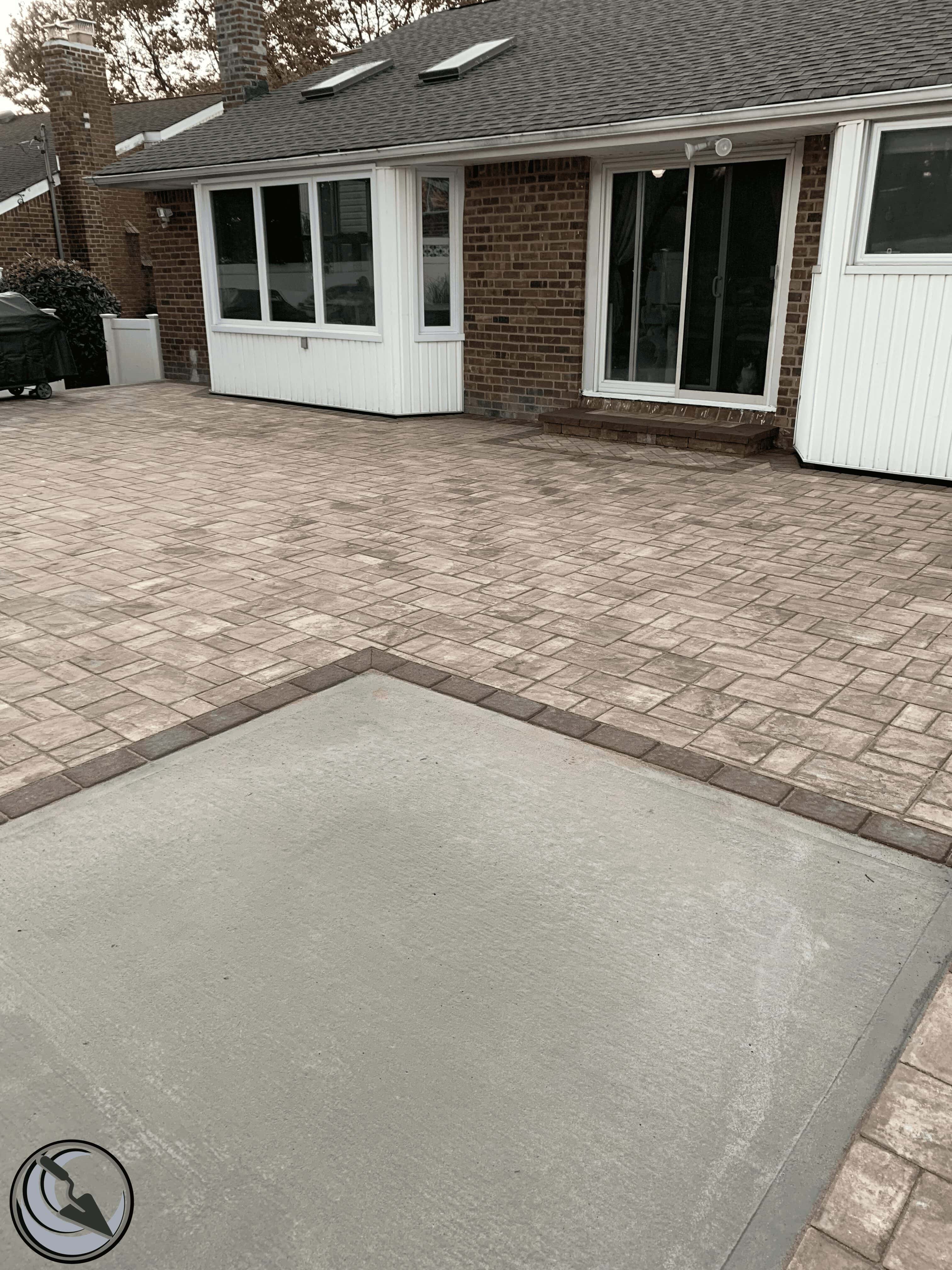
This is the “technical” round that separates the masters from the pretenders. Our soil is mostly sand, which is great for drainage but terrible for staying put. If a contractor uses the same “standard” technique they learned in the Midwest, your patio will be uneven before the first snow flies.
The right answer involves actual numbers. Your patio builder should talk about excavating 8 to 10 inches deep. If they say “six inches is plenty,” they’re basically building you a temporary floor. They should mention stone base layers, a 1-2% drainage slope, and edge restraints that act like a “corset” to keep your pavers from spreading out.
You need to hear about crushed stone (not just “dirt”), commercial-grade compaction equipment, and polymeric sand that locks the joints. This isn’t just “masonry nerd” talk; it’s the reason your patio will last 30 years instead of looking like a topographical map of the Moon by year three.
Because our water table is higher than a kite on a windy day at Montauk, water is always lurking underground. A proper base allows that water to flow through rather than pooling. If the water pools, the ground “heaves” when it freezes, and suddenly your flat driveway has a new mountain range in the middle of it.
Ask them to walk you through the “Lasagna” of the base. It should go: excavated soil, compacted stone layers (plural!), a thin sand leveling layer, and then the pavers. If they skip the compaction or the proper depth, they are basically hoping for the best—and “hope” is not a structural strategy.
Sandy soil also makes lateral movement a huge pain. Without proper edge restraints—usually heavy-duty plastic or concrete—your pavers will slowly “drift” apart. You’ll see gaps appearing between stones, which is the perfect place for weeds to throw a house party.
Then there’s the “Salt Factor.” Coastal air is corrosive—it loves to eat through cheap materials. A Long Island pro will recommend pavers rated for “freeze-thaw” and salt exposure. They know which sealers work in our 90% humidity and which ones will just turn into a sticky, cloudy mess.
Watch their faces when you ask about drainage. If they look confused or say “the water just goes away,” you’re talking to the wrong person. A real pro will have a plan for every drop of rain before they even unload the truck.
The guy who sells you the dream isn’t always the guy who digs the hole. Sometimes, the person you liked during the estimate vanishes the moment the check clears, leaving you to deal with a crew that has no idea what you actually discussed.
This is where the “Telephone Game” becomes dangerous. Communication breakdowns are the #1 cause of backyard disasters. You need to know who is the “One Throat to Choke” (professionally speaking, of course) when you have a question about where the fire pit is going.
Some big companies use “Closer” salespeople who have never actually laid a brick in their lives. They’re great at nodding and smiling, but when the crew hits a buried pipe, they’re nowhere to be found. You want a manager who knows the difference between a “bullnose” and a “beveled edge.”
Ask masonry contractors for a play-by-play on communication. Do I text you? Do I call an office in another state? Is there an app? (Actually, let’s hope there isn’t an app—just a human who picks up the phone).
The gold standard is direct owner involvement or a dedicated project manager who actually stays on-site. You want someone who can make a call on the fly if the drainage needs an adjustment, rather than someone who has to “check with the home office” for three days while your yard is a mud pit.
Red flags include: “Oh, the guys will handle it,” or “Just leave a message with my sister.” If they can’t tell you who is in charge of the daily operations, then nobody is in charge. That’s how you end up with a driveway that’s three feet too short.
Ask about their “Response Window.” If they say “whenever I get a chance,” keep your deposit in your pocket. A pro will commit to a same-day or 24-hour response time. If they can’t manage a text message during the honeymoon phase of the estimate, they definitely won’t answer when the excavator is stuck in your lawn.
Don’t be afraid to ask about subcontractors. Some companies sub out the whole job, which means you’re basically hiring a middleman with a markup. Others use their own crews for the stones but bring in a licensed sparky for the outdoor lighting. Both are fine, but you need to know who is covered by whose insurance if things get messy.
Subcontractors aren’t a deal-breaker, but they add layers of “Who’s Fault Is It?” if a stone cracks. Make sure the lead contractor takes 100% responsibility for everyone on the property. If the sub breaks a sprinkler head, you want to know exactly who is fixing it (and paying for it). A professional company has a rhythm. They have a schedule, a manager, and a way to handle “Plan B” when it rains. The ones who “wing it” are the ones who leave your project half-finished for three weeks because they “found a better job” across town.
Ask for a sample timeline. “Day 1: We dig. Day 2: We compact. Day 3: We lay stone.” If they give you a vague “it’ll take about a week,” they haven’t planned the logistics. Real pros can tell you how long the “ugly phase” lasts and when you can finally fire up the grill.
References are the “Yelp” of the real world, but better. Anyone can talk a big game, but references tell you what actually happens when the “New Patio Smell” wears off and the bill is paid.
Ask for three names from the last year—specifically in Suffolk. You don’t want to hear about a project from 1998; you want to know how their current crew is doing. If their best reference is their mom, you might want to reconsider.
Match the project type. If you’re doing a massive poolside deck, don’t talk to someone who just had a single step repaired. You want “apples to apples” comparisons. Ask the reference: “Did they show up on time? Did they leave cigarette butts in the mulch? Did the price magically jump by 20%?”
When you call these people, ask about the “Boring Stuff”: cleanup and follow-through. Did the contractor leave a pile of dirt in the driveway for a month? Did they come back to fix that one loose stone? These little things are what separate a “Mason” from a “Hero.”
Don’t skip this because you’re “too busy.” A five-minute call can save you $15,000 and six months of regret. Contractors who do “A+” work are usually chomping at the bit to give you references. They want you to hear how great they are. The ones who stall? Well, they’re probably hiding a trail of angry homeowners.
Online reviews are a start, but they can be gamed. A direct conversation allows you to ask the “uncomfortable” questions—like how they handled it when things went wrong. Because things always go wrong (rain, broken parts, etc.); it’s how the contractor handles the “wrong” that makes them a pro.
Ask about the final bill. Did it match the estimate? Some guys lowball the quote just to get their foot in the door, then “discover” five new problems that cost an extra $500 each. Transparency is the hallmark of a quality mason; hidden fees are the sign of a hustler.
Finally, ask about the “Post-Game.” If a stone settled an inch after a hurricane, did the contractor pick up the phone? Reputable firms stand behind their work with a real warranty. If the reference says, “I haven’t heard from him since I signed the check,” consider yourself warned.
If a contractor can’t find three people in all of Suffolk County to say something nice about them, you shouldn’t be the fourth person on their list.
These five questions are your “BS Detector” for hiring masonry contractors in Suffolk County. Licensing protects your wallet, installation techniques protect your patio, and communication protects your sanity. By the time you get to the references, you’ll know exactly who you’re dealing with.
Most people pick a contractor because they had a “good feeling” or because they were $500 cheaper. Don’t be “most people.” Be the person whose patio is still perfectly level ten years from now. You need an expert who respects Long Island’s sand, salt, and seasons as much as you respect your bank account.
The right pro won’t be scared of these questions—they’ll be impressed you asked. They’ll show you the licenses, explain the drainage science, and introduce you to their happy clients. When you’re ready to build something that actually lasts, Stone Escapes Masonry & Outdoor Design Inc is here to provide the answers, the expertise, and the “built-for-Suffolk” quality your home deserves.
Article details:
Share:
Continue learning: